
Alibaba has officially launched Qwen4 Max, its latest flagship AI model featuring 2.4 trillion backbone parameters, native vision capabilities, and a redesigned Mixture of Experts architecture. Released on November 16, 2026, the model delivers substantial efficiency improvements and lower API pricing, although independent testing shows it still trails Moonshot AI's Kimi K3.1 Pro in overall intelligence and terminal coding performance.
According to Alibaba's official announcement, Qwen4 Max retains the 2.4 trillion parameter backbone of Qwen3.8 Max while introducing an optimized architecture that activates approximately 71 billion parameters per token. The design combines Gated DeltaNet (GDN), Qwen Sparse Attention (QSA), and Gated Residual connections to improve long context processing, training stability, and computational efficiency. An additional 328 billion parameter N gram embedding system helps accelerate language processing without requiring every parameter to participate in conventional computation.
The model also introduces native image and video understanding alongside text processing, supporting a context window of 1 million tokens. Alibaba claims its redesigned attention mechanism can process long sequences more than 7 times faster under certain conditions, while improving autonomous coding, research, and professional workflows.
Qwen4 Max vs Kimi K3.1 Pro
| Specification | Qwen4 Max | Kimi K3.1 Pro |
|---|---|---|
| Developer | Alibaba | Moonshot AI |
| Total Parameters | 2.4T backbone + 328B embeddings | 2.8T |
| Active Parameters | 71B | 104B |
| Context Window | 1M tokens | 1M tokens |
| Input Support | Text, image, video | Text, image |
| Architecture | Native vision MoE | MoE |
| API Input Price per 1M Tokens | 1.50$ | 2.00$ |
| API Output Price per 1M Tokens | 4.50$ | 10.00$ |
| Cached Input per 1M Tokens | 0.075$ | 0.20$ |
| Artificial Analysis Index | 43 | 46 |
| Vals Index | 63.20% | 62.52% |
| Model Weights | Proprietary | Open weight |
The comparison highlights Alibaba's competitive pricing strategy. Qwen4 Max costs 25% less for input and 55% less for output tokens compared with Kimi K3.1 Pro, while also reducing input and output prices by 25% compared with Qwen3.8 Max.
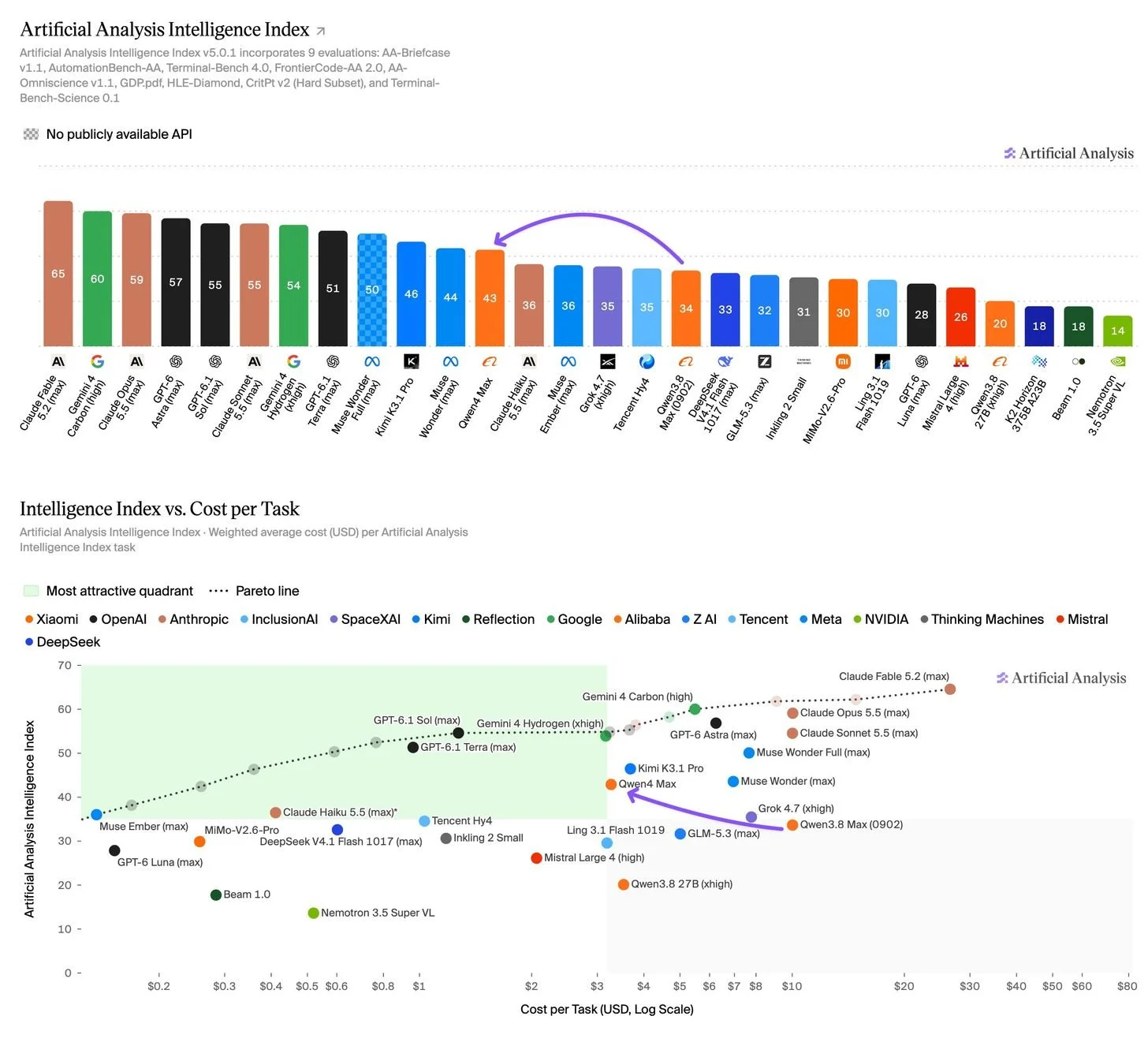
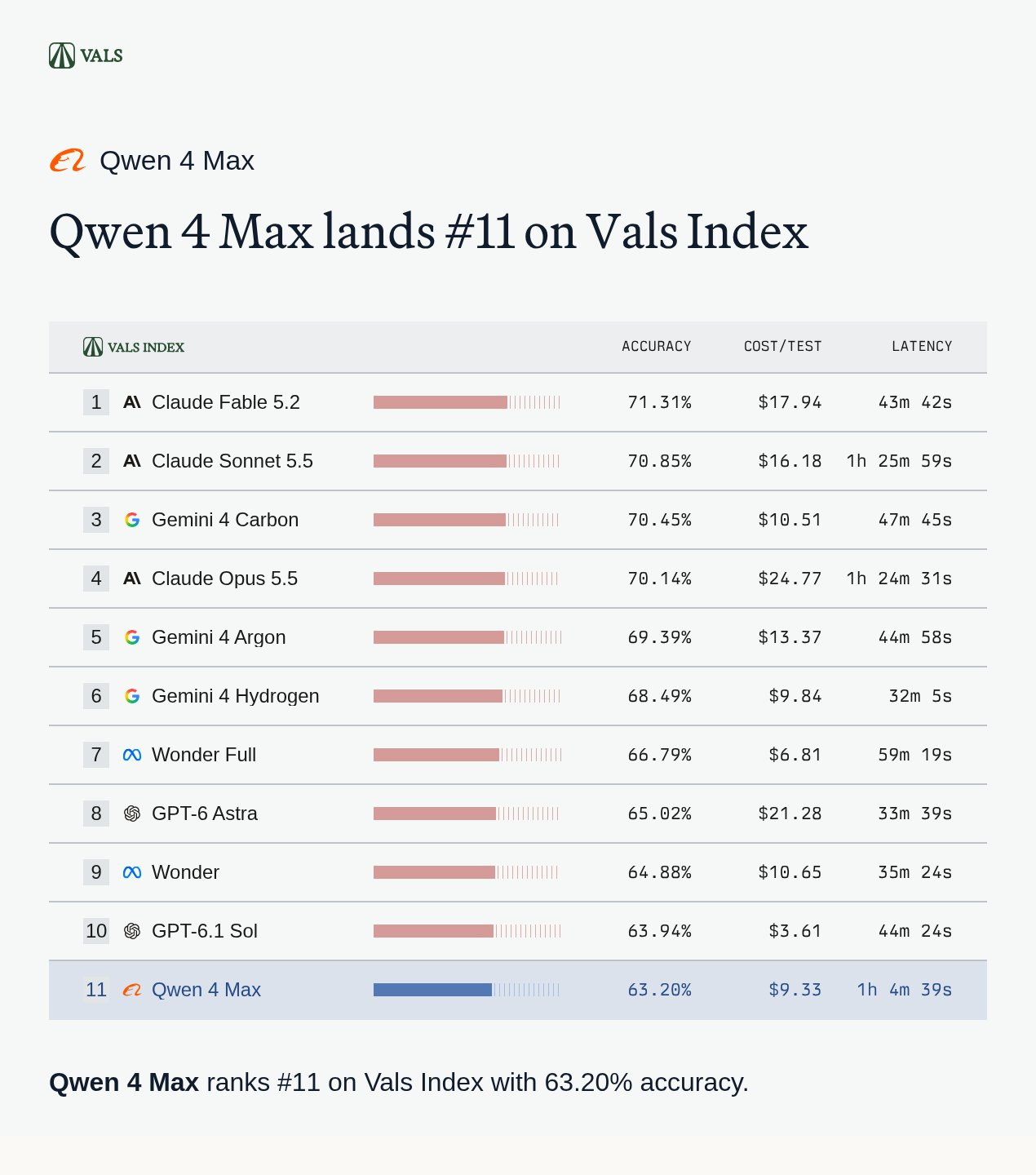
According to Artificial Analysis, Qwen4 Max scores 43 on its Intelligence Index, improving by 9 points over Qwen3.8 Max but remaining behind Kimi K3.1 Pro at 46. Alibaba's model averages approximately 3.27$ per benchmark task compared with 3.68$ for Kimi, representing an 11% cost advantage. However, results vary between evaluations. Vals AI places Qwen4 Max slightly ahead with 63.20% against Kimi's 62.52%, although Kimi maintains a substantial advantage in Terminal Bench 4.0, scoring approximately 63.6% against Qwen's 48.5%.
Qwen4 Max is available through Alibaba Cloud Model Studio, supporting OpenAI and Anthropic compatible APIs for developers integrating AI into existing applications. However, unlike Kimi K3.1 Pro, Qwen4 Max is currently proprietary and cannot be downloaded for local deployment. Alibaba plans to release smaller open weight models based on the Qwen4 architecture, although no specific release dates have been announced.
Qwen4 Max demonstrates that architectural efficiency and competitive pricing can be just as important as increasing parameter counts. Alibaba has improved performance while reducing API costs, creating stronger competition in a market increasingly dominated by expensive proprietary AI services.
However, Kimi K3.1 Pro maintains an important advantage through its publicly available model weights, allowing developers to deploy AI on infrastructure they control. Although both models require substantial computing resources, open weight availability remains essential for local AI development, privacy, and hardware independence.
For PC enthusiasts and independent developers, the real opportunity lies in bringing these architectural improvements to smaller models capable of running on consumer GPUs. Alibaba's upcoming Qwen4 releases could become particularly interesting if they deliver similar efficiency improvements without requiring expensive enterprise hardware or recurring cloud subscriptions.
Would you choose Qwen4 Max for its lower API pricing, or do you prefer Kimi K3.1 Pro because its open weights provide greater control over local AI deployment?
