
007 First Light Adds Path Tracing With RTX 5090 Targeting 4K at Over 200 FPS
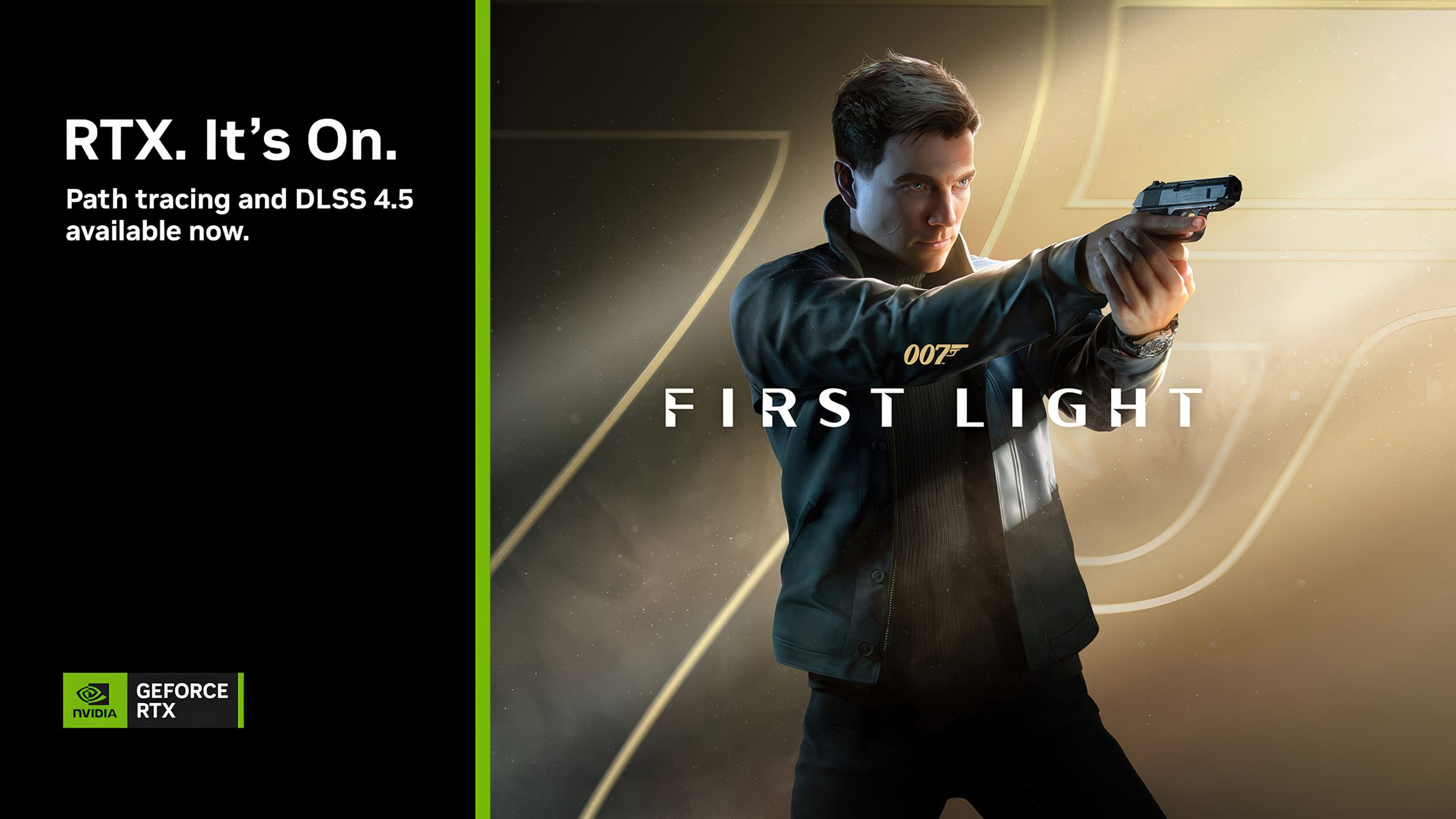
007 First Light has received its long awaited PC path tracing update, bringing fully path traced lighting, shadows, reflections, and global illumination to IO Interactive's Glacier engine alongside NVIDIA DLSS 4.5 Ray Reconstruction.
The free update launched September 15 and expands the technology already available since release, including DLSS 4.5 Super Resolution and Dynamic Multi Frame Generation. IO Interactive says path tracing is available on GeForce RTX GPUs, while NVIDIA's recommended configurations currently focus on RTX 50 Series desktop cards. DLSS 4.5 Ray Reconstruction is automatically enabled when the path tracing renderer is selected.
IO Interactive rebuilt major parts of Glacier's lighting pipeline around NVIDIA RTX Global Illumination, RTX Path Tracing, Opacity Micro Maps, and Ray Reconstruction. Instead of combining separate techniques for direct lighting, reflections, shadows, and indirect illumination, the path traced renderer handles these effects through a more unified light simulation.
| Path Tracing | Minimum | Recommended | Ultra |
|---|---|---|---|
| Target | 1080p 60 FPS | 1440p 60 FPS | 4K 200+ FPS |
| Preset | Medium | Medium | High |
| GPU | RTX 5070 12 GB | RTX 5080 16 GB | RTX 5090 32 GB |
| CPU | Core i5 13500 / Ryzen 5 7600 | Core i5 13500 / Ryzen 5 7600 | Core i5 13600K / Ryzen 7 7700X |
| RAM | 16 GB | 16 GB | 32 GB |
The 4K 200+ FPS figure should be read carefully. NVIDIA lists it as a DLSS 4.5 configuration, meaning it relies on reconstruction and frame generation rather than representing native 4K path traced rendering at more than 200 FPS. Path tracing remains extremely demanding even on Blackwell hardware.
Visually, the biggest improvements come from more accurate indirect lighting and reflections. NVIDIA's comparisons show illuminated objects affecting surrounding surfaces more naturally, stronger ambient occlusion, improved reflected light, and more accurate shadows. Highly reflective interiors and scenes with complex artificial lighting benefit particularly strongly.
The implementation also became a development challenge for both IO Interactive and NVIDIA. IO Interactive says nightclub scenes with rapidly flashing lights stressed the temporally accumulated lighting system, while office environments filled with reflective glass required additional work on denoising. Some improvements developed during the collaboration are now being incorporated into NVIDIA's public SDKs for other studios to use.
The update completes a feature originally planned closer to launch. 007 First Light arrived in May with DLSS 4.5 Super Resolution and Dynamic Multi Frame Generation, while path tracing was delayed for additional development. We previously covered NVIDIA's wider DLSS 4.5 rollout, which positioned the Bond adventure as one of the major showcases for Ray Reconstruction.
007 First Light is now one of the clearest demonstrations of why NVIDIA keeps pairing path tracing with increasingly aggressive AI reconstruction and frame generation.
The lighting upgrade can be substantial, but the RTX 5070 being positioned as the starting point for 1080p 60 FPS shows just how expensive full path tracing remains. The RTX 5090 reaching the advertised 4K 200+ FPS target only through the complete DLSS 4.5 stack makes that even clearer.
For players who already own RTX 50 Series hardware, however, the update turns 007 First Light into a much stronger technical showcase than it was at launch.
Would you enable path tracing for the improved lighting, or keep the rasterized renderer for higher native performance?
