
An open source development project has demonstrated that Windows 11 can render its desktop interface using a Neural Processing Unit (NPU) instead of relying on conventional GPU acceleration. Developed by the labscommunity team, the experimental software successfully transfers desktop composition tasks to Intel's dedicated AI hardware, demonstrating an unconventional application for processors normally designed to accelerate neural networks. However, performance currently reaches just 2 to 3 frames per second, making the technology impractical for everyday use.
The project, officially named npu-render and available on GitHub, uses a custom Windows 11 display driver to redirect graphics operations from the Desktop Window Manager toward Intel's NPU. Instead of processing desktop elements through the normal Direct3D graphics pipeline, the driver captures rendering commands and executes them through specialized SHAVE processing kernels using Intel's OpenVINO framework. This allows the NPU to handle desktop composition, including windows, interface elements, and visual effects, despite not being designed as a traditional graphics processor.
Testing was conducted on a laptop powered by Intel's Panther Lake architecture, featuring the company's NPU 5 technology. According to the developers, the prototype successfully rendered Windows Explorer, the Start menu, Notepad, Microsoft Edge, and other desktop applications for extended periods without crashing. The system also includes a recovery mechanism that restores conventional GPU rendering when the experimental driver is disabled or encounters a fault.
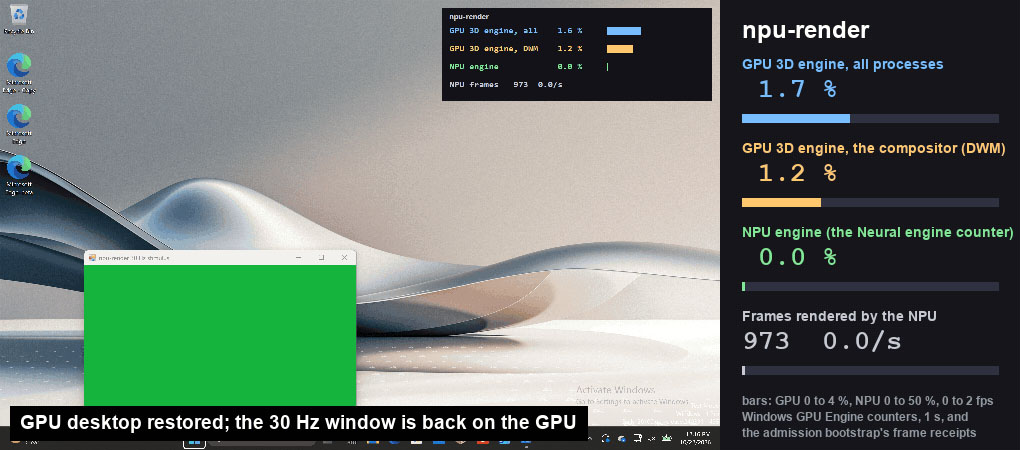
The major limitation is performance. The project currently manages approximately 2 to 3 desktop updates per second, substantially below the team's target of 30 Hz. In one documented test, the system delivered 1.6 frames per second while rendering at 1024 × 768 resolution, with NPU utilization reaching approximately 58%. More complex effects, including background blur, can require several seconds to process.
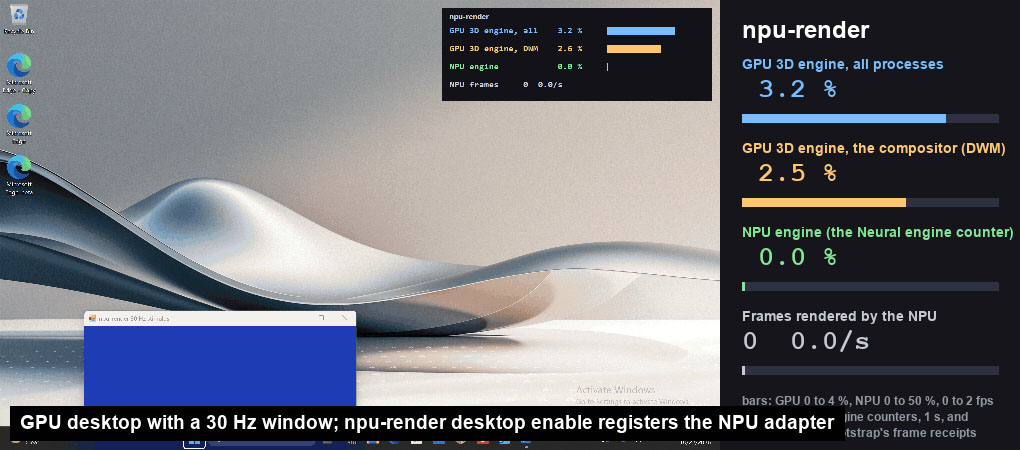
The experiment also produced an interesting change in GPU utilization. During one demonstration, reported GPU 3D activity decreased from 3.4% to 0.6% after switching desktop composition to the NPU. However, the developers explicitly caution that this does not establish a measurable improvement in available GPU performance. Their controlled tests found that desktop composition already consumed very little GPU processing capacity, meaning the experiment has not demonstrated a meaningful performance benefit for other workloads.
Importantly, the NPU does not completely eliminate GPU involvement. The experimental system still uses conventional graphics hardware to present the completed image to the physical display. The achievement is therefore the successful migration of desktop composition calculations rather than a complete replacement of the graphics subsystem.
Intel NPU Desktop Rendering Results
| Measurement | Experimental Result |
|---|---|
| Tested Hardware | Intel Panther Lake laptop |
| Operating System | Windows 11 |
| Rendering Processor | Intel NPU 5 |
| Verified Desktop Refresh Rate | Approximately 2 to 3 Hz |
| Measured Demonstration | 1.6 FPS |
| Target Performance | 30 Hz |
| Rendered Resolution | 1024 × 768 |
| NPU Utilization | Approximately 58% |
| GPU 3D Activity in Demonstration | 3.4% reduced to 0.6% |
| Development Status | Open source research prototype |
Results come from the developers' tests on 1 laptop. The GPU utilization reduction does not establish an overall performance improvement.
Although the current implementation is extremely slow, it raises questions about how dedicated AI accelerators could be used beyond their intended workloads. Modern processors increasingly include separate CPU, GPU, and NPU resources, allowing different tasks to execute on specialized hardware. Developers are investigating whether some operations traditionally assigned to graphics processors could eventually be handled elsewhere, potentially improving resource allocation or energy efficiency.
However, GPUs remain substantially better suited to conventional desktop rendering. Their architectures are specifically optimized for graphics operations, texture processing, and high throughput pixel calculations, while NPUs primarily accelerate mathematical operations associated with machine learning. The developers acknowledge that achieving functional desktop rendering is only the first step, with significant optimization required before the project could become useful.
The demonstration arrives as Microsoft continues expanding the role of NPUs in Windows 11. While Microsoft's Copilot+ PC requirements focus on processors capable of accelerating local AI features, this experiment explores whether the same hardware could support entirely different computing tasks.
For now, npu-render remains a research project distributed under the Apache 2.0 license. It requires compatible Intel hardware, specialized development tools, and modifications to the Windows driver environment. It is not intended for ordinary users or production systems.
This experiment demonstrates why open source development remains valuable to the PC ecosystem. Running Windows 11 desktop rendering on an NPU at 2 FPS may sound impractical, but the technical achievement lies in successfully executing graphics workloads on hardware designed for a completely different purpose.
Modern processors increasingly dedicate valuable silicon area to AI acceleration, yet many everyday users rarely utilize their NPUs beyond video conferencing effects, background processing, or occasional AI applications. Exploring alternative workloads could eventually create new opportunities for developers to make better use of existing computing resources.
However, shifting desktop rendering away from the GPU does not automatically improve performance or efficiency. The developers' own measurements show that conventional desktop composition already requires relatively little GPU processing power. Any future advantage must therefore be demonstrated through measurable improvements in energy consumption, responsiveness, or the performance of other applications.
For gamers and local AI enthusiasts, the concept is particularly interesting. If specialized processing units eventually become more flexible, operating systems could distribute workloads more intelligently between available hardware. Nevertheless, NPUs are not replacements for graphics cards, and this experiment does not suggest that GPU rendering is becoming obsolete.
The real breakthrough is not Windows running at 2 FPS. It is demonstrating that dedicated AI hardware can perform tasks outside its original design.
Would you like to see Windows use NPUs for more everyday computing tasks, or should developers focus on improving local AI performance while leaving graphics rendering to the GPU?
