
PSSR 2.0 Games List on PS5 Pro: Native Support, Upgradeable Titles, and What the New Sony Upscaler Actually Changes
PlayStation 5 Pro owners now have a clearer picture of how Sony’s upgraded image reconstruction pipeline is being deployed across the platform, as PSSR 2.0 continues rolling out to supported titles and to older PSSR enabled releases through a new system level enhancement toggle. Sony officially announced that an upgraded version of PlayStation Spectral Super Resolution, or PSSR, would begin rolling out globally to PS5 Pro players in the following weeks, with the feature designed to improve image quality across a growing number of PS5 Pro Enhanced games.
For players trying to understand where this matters, the short answer is that PSSR remains one of the most important graphics features exclusive to the PS5 Pro. It is Sony’s machine learning based upscaling solution, built to reconstruct a higher resolution image from a lower internal render target so that developers can redirect performance headroom toward smoother frame rates, better ray tracing, or improved visual settings. Sony describes PSSR as an AI library that analyzes game images pixel by pixel as it upscales them, and that core approach is what places it closer in concept to technologies such as NVIDIA DLSS and newer AMD FSR implementations than to older basic spatial upscalers.
The latest version, commonly referred to as PSSR 2.0, represents a meaningful quality update over the original release that shipped with the PS5 Pro in November 2024, according to current reporting. Wccftech reports that the upgraded version launched on March 16, 2026, and states that it is based on a fork of AMD FSR 4 optimized for PS5 Pro hardware as part of the broader Project Amethyst collaboration between Sony and AMD. While Sony’s own PlayStation Blog announcement does not use the term “PSSR 2.0,” it does confirm that an upgraded PSSR version is rolling out, and game specific PlayStation Blog posts such as the one covering Assassin’s Creed Shadows say the new implementation improves pixel sharpness, image stability, and motion clarity.
That quality uplift matters because the original PSSR implementation was often praised for its ambition, but it also drew criticism for issues such as shimmering, noise, and temporal instability in difficult scenes with foliage, hair, fences, and fine detail. Reporting around the upgraded version consistently points to improved reconstruction and motion handling, with Digital Foundry and other coverage noting that the newer model offers a substantial step forward in clarity and stability. The broader takeaway for gamers is practical: this is not just a minor revision number. It is an image quality upgrade that can make performance modes and reconstructed 4K output look noticeably cleaner on supported titles.
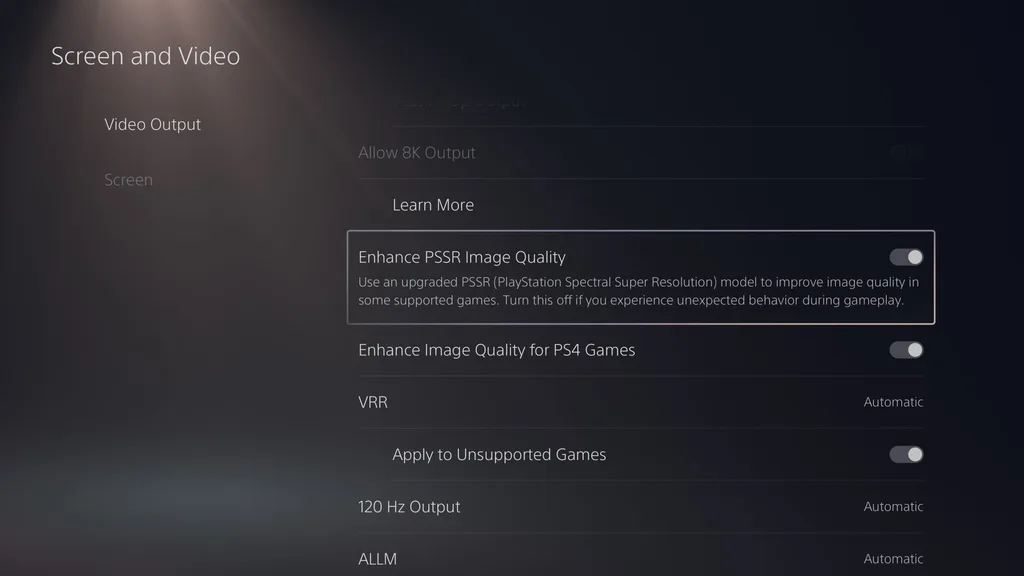
Even more important for existing PS5 Pro owners, Sony has introduced a console level option called Enhance PSSR Image Quality, which can apply the upgraded upscaling path to earlier PSSR enabled games that were originally built around the first generation model. According to reporting citing Mark Cerny, Sony’s current strategy is for that toggle to remain fixed to the upgraded version for now, which gives players a simple way to bring older PSSR titles closer to the latest image quality standard. At the same time, Sony has also warned that not every game will behave perfectly with the enhanced mode enabled, so users may occasionally need to switch back if visual issues appear.
Below is the current split between games reported as using the new version natively and titles confirmed as PSSR 1.0 releases that can be upgraded through the system toggle.
Native PSSR 2.0 Games
The following games have been reported as using the upgraded PSSR implementation natively through developer support or updated PS5 Pro enhancement work:
Alan Wake 2
Assassin’s Creed: Shadows
Control: Ultimate Edition
Crimson Desert
Cyberpunk 2077
Dragon Age: The Veilguard
Dragon’s Dogma 2
Final Fantasy VII Rebirth
Monster Hunter Wilds
Nioh 3
Resident Evil: Requiem
Rise of the Ronin
Senua’s Saga: Hellblade II
Silent Hill 2
Silent Hill f
Starfield
A notable point is that Assassin’s Creed: Shadows is one of the clearest public examples of Sony and Ubisoft discussing the upgraded PSSR directly, with Sony confirming the new upscaler’s arrival for the game and highlighting stronger image stability and cleaner motion.
PSSR 1.0 Games That Can Be Upgraded Via the PS5 Pro System Toggle
Sony’s system level enhancement option allows a larger group of PS5 Pro titles that originally shipped with PSSR support to benefit from the newer image quality model. Reported titles include:
007: First Light
Albatroz
Alien: Rogue Incursion
Apex Legends
Ark: Survival Ascended
Arma Reforger
Assassin’s Creed: Mirage
Astro Bot
Avatar: Frontiers of Pandora
Baldur’s Gate 3
Battlefield VI
Black Myth: Wukong
Blades of Fire
Call of Duty: Black Ops VI
Call of Duty: Black Ops VII
Days Gone Remastered
Demon’s Souls
Enlisted
F1 24
F1 25
FBC: Firebreak
Ghost of Yotei
God of War Ragnarök
Gran Turismo 7
Hogwarts Legacy
Horizon Forbidden West
Indiana Jones and the Great Circle
Kingdom Come: Deliverance 2
Lies of P
Lords of the Fallen
Marvel’s Spider Man Remastered
Marvel’s Spider Man: Miles Morales
Marvel’s Spider Man 2
Metal Gear Solid Delta: Snake Eater
Naraka: Bladepoint
NBA 2K25
Ninja Gaiden 4
No Man’s Sky
Off the Grid
Outbreak: Shades of Horror – Chromatic Split
Paladin’s Passage
Path of Exile 2
Ratchet & Clank: Rift Apart
Resident Evil 4 Remake
Resident Evil Village
Retrieval
Returnal
Slitterhead
STALKER 2: Heart of Chernobyl
Star Wars Jedi: Survivor
Star Wars: Outlaws
Stellar Blade
The Crew Motorfest
The First Descendant
The Last of Us Part I
The Last of Us Part II Remastered
The Seven Deadly Sins: Origin
Tides of Annihilation
War Thunder
Warframe
Warhammer 40,000: Darktide
Warhammer 40,000: Space Marine 2
Where Winds Meet
Ys X: Proud Nordics
As always with live support lists, it is worth remembering that some entries are based on current reporting and platform level tracking rather than a single official master database from Sony. In other words, this is the most up to date published view available right now, but it can still evolve as more games are patched and as Sony updates PS5 Pro Enhanced support over time.
There is also another longer term feature on the horizon. Mark Cerny has already confirmed that a version of AMD FSR Frame Generation is planned for future PlayStation consoles. Sony has not yet detailed how that will be branded at the consumer level, but there is a reasonable expectation that any eventual implementation would be customized for PlayStation hardware and may end up associated closely with the broader PSSR ecosystem. That part remains forward looking, but it is one of the clearest signs that Sony sees AI assisted image reconstruction and frame generation as a major part of the PS5 Pro and future PlayStation visual roadmap.
For PS5 Pro users, the strategic value of PSSR 2.0 is straightforward. Native 4K rendering remains expensive even on upgraded console hardware, especially once ray tracing and high image quality settings enter the equation. A stronger upscaler gives developers more room to target better visual fidelity without sacrificing performance as heavily. For players, that means the best PS5 Pro versions of current and upcoming games will increasingly depend not just on raw GPU horsepower, but on how effectively Sony’s machine learning reconstruction stack continues to improve.
What do you think has the bigger impact on the PS5 Pro experience right now: native PSSR 2.0 support in new games, or the ability to upgrade older PSSR titles through Sony’s system toggle?
