
Intel Arc Pro B70 Gaming Benchmarks Show What a Big Battlemage Arc B770 Could Have Delivered
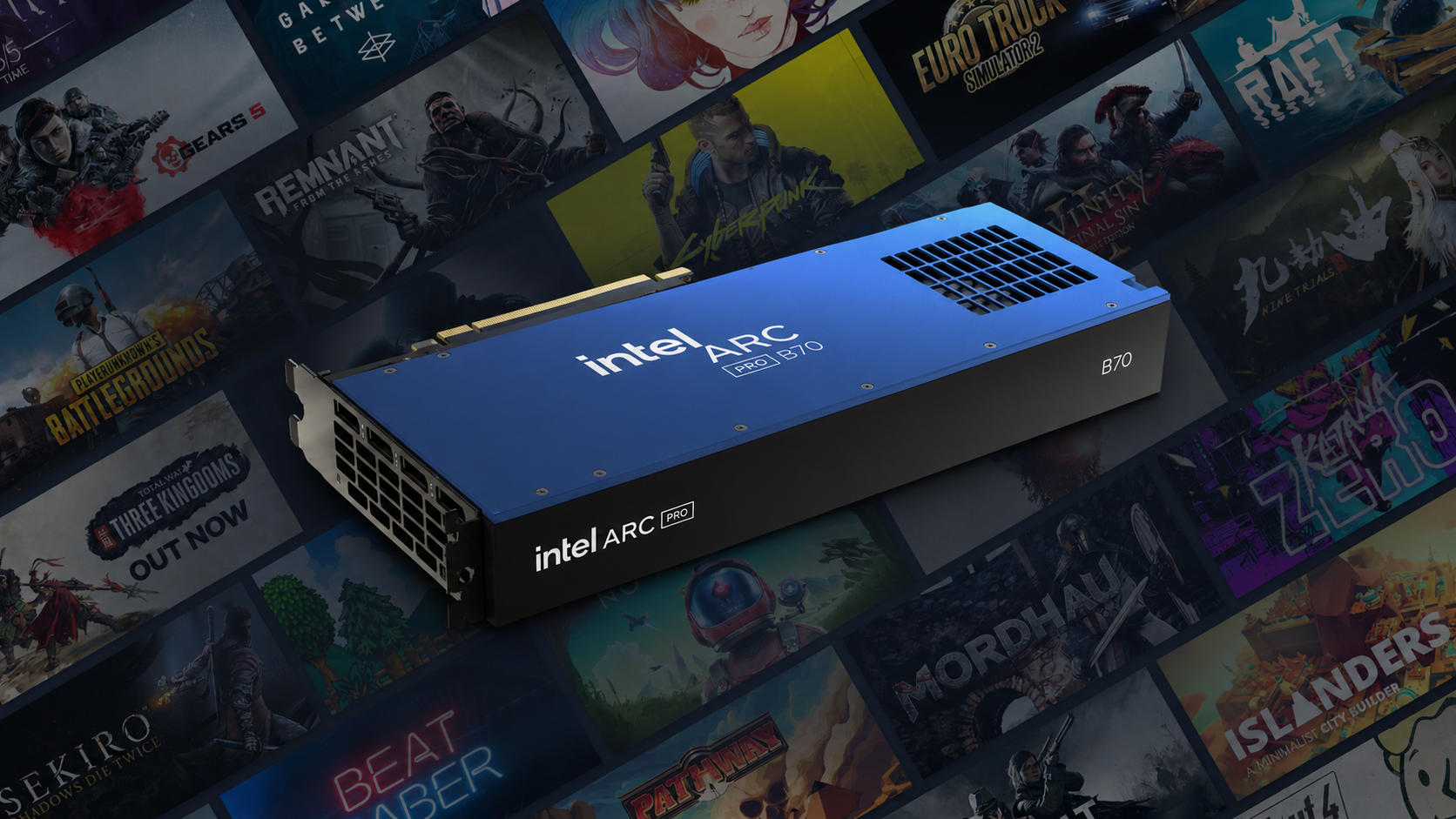
Intel’s Arc Pro B70 was never designed as a mainstream gaming card, but fresh benchmark coverage is giving PC gamers a clearer look at what a full Big Battlemage gaming GPU might have looked like. After Intel introduced gaming support for its Arc Pro B70 and B65 through its latest Arc graphics driver, reviewers were finally able to put the workstation focused card through a broader set of modern games. The resulting tests from Expreview now offer one of the closest real world previews yet of the Arc B770 class product that never officially arrived.
The Arc Pro B70 itself sits at the top of Intel’s Arc Pro B series stack and is based on the full BMG G31 silicon. Intel says the card is built on Xe2 architecture, offers up to 32 Xe cores and 32GB of VRAM, and launched with a suggested starting price of 949 dollars for Intel branded models when availability began on March 25, 2026. Intel positioned the product around creators, engineering workloads, and AI inference, not gaming, which is why these new game results are especially interesting for enthusiasts who were waiting for a larger Battlemage gaming card.
What makes this test run more relevant is the software side. Intel’s current Arc graphics driver package explicitly lists support for Intel Arc Pro B70 and Arc Pro B65 graphics, which opened the door for broader gaming evaluation on hardware that was originally marketed more around professional and AI use cases. In other words, the Arc Pro B70 is still not a purpose built gaming SKU, but it now has enough driver level support to give us a credible performance signal for what a gaming tuned Big Battlemage product could have offered.
On paper, the Arc Pro B70 is an impressive piece of silicon. Based on the specifications shared in the benchmark report, it carries 32 Xe2 HPG cores, 256 XMX engines, 32 RT units, 32GB of GDDR6 memory on a 256 bit bus, 19 Gbps memory speed for 608GB per second of bandwidth, and a 2800 MHz GPU clock. That is a far larger memory configuration than what most upper midrange gaming cards currently offer, even if much of the product’s pricing premium comes from its Pro positioning rather than pure gaming intent.
In 2K raster tests, the Arc Pro B70 posted a particularly strong result in Cyberpunk 2077, reaching 90.27 FPS compared to 79.06 FPS for the GeForce RTX 5060 Ti 16GB and 66.02 FPS for the Arc B580 12GB. That puts the Pro B70 ahead of the RTX 5060 Ti in this title and roughly 36.7% ahead of the Arc B580. Across the rest of the tested raster lineup, which includes Monster Hunter Wilds, Marvel Rivals, Assassin’s Creed Shadows, and Black Myth Wukong, the Arc Pro B70 continues to show a clear step up over the Arc B580, while the RTX 5060 Ti holds the broader overall lead.
| 2K Raster Gaming Tests via Expreview | Arc Pro B70 32GB | RTX 5060 Ti 16GB | Arc B580 12GB |
|---|---|---|---|
| Cyberpunk 2077 | 90.27 | 79.06 | 66.02 |
| Monster Hunter Wilds | 51.33 | 56.53 | 39.23 |
| Marvel Rivals | 69 | 74 | 49 |
| Assassin’s Creed Shadows | 49 | 58 | 42 |
| Black Myth Wukong | 44 | 53 | 32 |
Ray tracing results are even more revealing. In F1 25, Doom The Dark Ages, and Cyberpunk 2077, the Arc Pro B70 reportedly beats the RTX 5060 Ti 16GB by an average of around 9%, with the largest advantage appearing in F1 25 at about 14%. In Assassin’s Creed Shadows and Monster Hunter Wilds, NVIDIA pulls back ahead, but Intel still shows a major uplift over the Arc B580. Versus the smaller Battlemage card, the Arc Pro B70 is up to 65.7% faster in some ray tracing scenarios and roughly 40% faster on average based on the figures shared.
| 2K Ray Tracing Gaming Tests via Expreview | Arc Pro B70 32GB | RTX 5060 Ti 16GB | Arc B580 12GB |
|---|---|---|---|
| F1 25 | 58 | 51 | 35 |
| Doom The Dark Ages | 62.29 | 56.19 | 42.92 |
| Cyberpunk 2077 | 35.05 | 33.9 | 25.12 |
| Assassin’s Creed Shadows | 37 | 40 | 30 |
| Monster Hunter Wilds | 43.1 | 51.14 | 33.87 |
The AI side also remains one of the Arc Pro B70’s strongest talking points, which is not surprising given Intel’s official messaging around the card. Intel has been marketing the B70 heavily around AI developers and multi user inference workloads, and Expreview’s MLPerf Client data lines up with that direction. In the reported results, the Arc Pro B70 leads both the RTX 5060 Ti 16GB and Arc B580 in token throughput for Llama 3.1 8B and Phi 4 Reasoning 14B, showing that the card’s larger memory pool and workstation orientation can provide tangible acceleration in local AI tasks. Intel itself has also highlighted strong AI response and price to performance positioning for the B70 in its launch material.
| MLPerf Client Tokens Per Second via Expreview | Arc Pro B70 32GB | RTX 5060 Ti 16GB | Arc B580 12GB |
|---|---|---|---|
| Llama 3.1 8B | 95.5 | 73.7 | 76.6 |
| Phi 4 Reasoning 14B | 55.3 | 39.7 | 43.7 |
Taken together, these numbers paint a very clear picture. If Intel had launched a gaming optimized Arc B770 based on Big Battlemage, it likely would have landed well above the Arc B580 and very close to, or directly against, the RTX 5060 Ti 16GB in many games. In some raster and ray tracing workloads, it could have even edged ahead. That is what makes the Arc Pro B70 so frustratingly interesting for gamers. It is not the gaming card many were waiting for, yet it strongly suggests Intel had the hardware foundation for a far more competitive upper midrange Battlemage product than what ultimately reached the consumer market.
Of course, there is an important caveat here. The Arc Pro B70 carries a 949 dollar starting price because it is a professional card with 32GB of memory and a workstation focused market position, not because it was intended to fight directly in the 500 dollar gaming tier. Intel’s own launch messaging makes that clear. But strip away the Pro branding, reduce the memory pool, optimize clocks and power around gaming, and the benchmark data suggests there may have been room for a compelling Arc B770 product that could have brought serious pressure to NVIDIA in this segment.
For PC gamers and hardware watchers, this is one of those rare cases where a workstation card tells the story of a product category that never fully materialized. The Arc Pro B70 may be aimed at creators and AI developers, but its gaming numbers now stand as the closest glimpse yet at what Big Battlemage could have meant for Intel’s gaming GPU roadmap.
Would you have bought an Arc B770 if Intel had launched it with 16GB or 24GB VRAM at around the RTX 5060 Ti price range?
