
Up To 7200 MT/s Native DDR5 Support Confirmed for Intel Arrow Lake Core Ultra 200S Refresh CPUs
Intel’s upcoming Arrow Lake Core Ultra 200S Refresh desktop processors are set to debut at CES 2026, and one of the most meaningful improvements has now been confirmed through Intel’s official datasheet. The refresh lineup will introduce native 7200 MT/s DDR5 memory support, marking a notable uplift over the current generation.
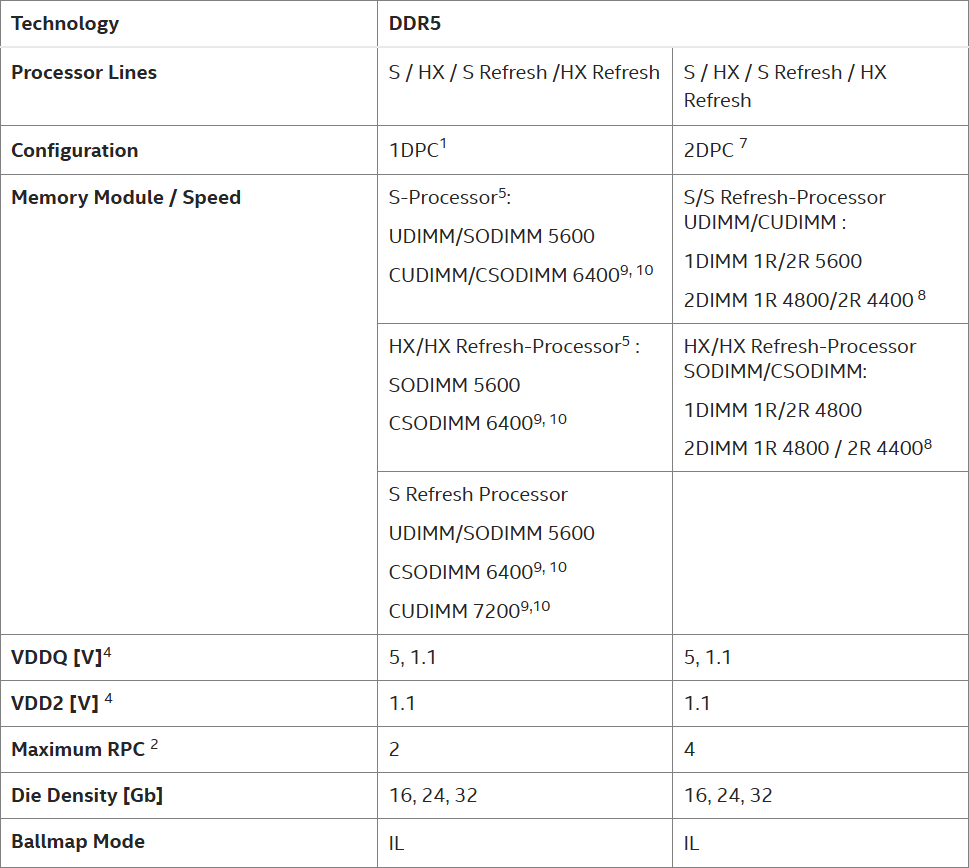
According to Intel’s newly published SKU matrix for the Core Ultra Series 2 CPUs, the upgraded memory speed applies to CUDIMM modules equipped with CKD (Clock Driver) ICs. Native support for standard UDIMM modules remains unchanged at 5600 MT/s, while CSODIMM support also continues at 6400 MT/s.
This means the refresh delivers a 12.5 percent uplift in CUDIMM speeds, from 6400 MT/s to 7200 MT/s, powered by two key improvements
An optimized IMC (Integrated Memory Controller)
Additional platform level refinements on the LGA 1851 socket
Intel is not expected to introduce a new chipset beyond Z890, but motherboard vendors may deliver updated designs to better utilize the higher memory ceiling.
2DPC memory speeds remain consistent across both Arrow Lake and Arrow Lake Refresh CPUs. On mobile platforms, Arrow Lake HX Core Ultra 200HX processors retain identical memory specifications with 5600 MT/s SODIMM and 6400 MT/s CSODIMM support.
Beyond memory improvements, the Core Ultra 200S Plus lineup includes two refreshed SKUs featuring four additional E cores and 100 MHz higher boost clocks in select models. The refresh is expected to offer modest performance gains, but overall consumer reception may remain conservative following Arrow Lake’s earlier underwhelming launch against AMD Ryzen.
Adoption may be further limited by the platform’s short lifespan. Intel is already preparing to replace LGA 1851 with the new LGA 1954 socket in the second half of 2026, built for next generation Nova Lake S processors. These will compete directly with AMD Zen 6 Ryzen CPUs.
With Arrow Lake Core Ultra 200S Refresh, Intel is delivering a measurable memory speed upgrade and incremental performance improvements, but many PC builders may choose to wait for the next platform cycle.
Do you think the jump to native 7200 MT/s is enough to make the Arrow Lake refresh appealing, or will most users wait for Nova Lake? Share your thoughts below.
