

Taiwan Semiconductor Manufacturing Company (TSMC) is evaluating a major expansion of its United States manufacturing operations with a proposed $22.6 billion semiconductor fabrication facility in Brazos County, Texas. The project would manufacture advanced logic chips using 2nm and more advanced process technologies, with construction scheduled to begin in 2027 and commercial operations targeted for 2031.
According to the official application submitted to the Texas Comptroller, TSMC Arizona Corporation is seeking property tax incentives through the state's Jobs, Energy, Technology and Innovation (JETI) program. The proposed manufacturing campus would occupy approximately 3,232 acres near College Station, providing substantial space for potential future expansion beyond the initial fabrication facility.
The project's economic assessment outlines approximately $8.6 billion in real property investment and $14.02 billion in manufacturing machinery and equipment. The facility is expected to create 2,099 permanent positions, while supporting an estimated 5,336 additional indirect and induced jobs across Texas.
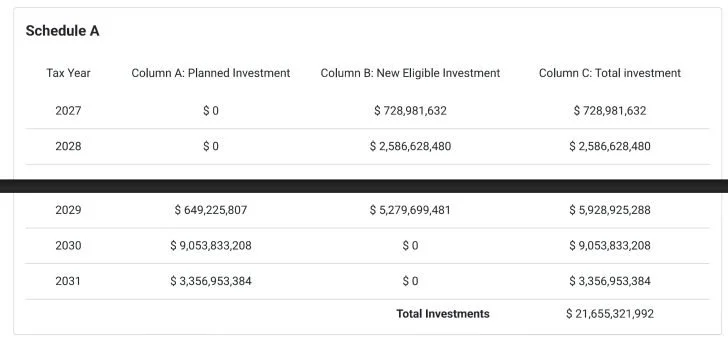
The proposed Texas facility would represent TSMC's second major advanced semiconductor manufacturing campus in the United States, complementing its ongoing Arizona expansion targeting 2nm and A16 process technologies. Its manufacturing capabilities would primarily address demand for advanced logic processors across artificial intelligence, high performance computing, and other advanced computing applications.
The Texas Comptroller has recommended the tax incentive application for approval, with Brazos County officials confirming a public hearing scheduled for December 10, 2026. The proposed agreement would limit eligible property valuations for certain school district taxes over a 10 year period, although approval from both the Texas governor and the school district remains necessary.
Despite the scale of the proposed investment, TSMC has not yet finalized its decision to establish the Texas facility. Production capacity, customer allocations, and the specific process nodes that will enter commercial manufacturing in 2031 have also not been disclosed.
TSMC's potential expansion into Texas represents another significant step toward geographical diversification of advanced semiconductor manufacturing. However, with commercial operations targeted for 2031, the facility will do little to address current semiconductor supply constraints or rising consumer hardware prices in the immediate future.
While expanding manufacturing capacity to accommodate AI and enterprise computing demand remains commercially attractive, semiconductor investments of this magnitude should also contribute to greater availability of consumer processors, gaming graphics cards, and hardware for local AI applications.
Public tax incentives should deliver measurable benefits beyond corporate profitability, including sustainable employment, infrastructure development, responsible resource consumption, and improved semiconductor accessibility. Increasing global production capacity should ultimately benefit personal computing users rather than exclusively serving hyperscale AI infrastructure.
Do you believe TSMC's expansion into Texas will eventually improve consumer hardware availability and affordability, or will most of the additional manufacturing capacity be reserved for enterprise AI?
