
TRUSTA AI Scaler Extended Memory Solution Targets GPU Bottlenecks With DRAM and SSD Expansion
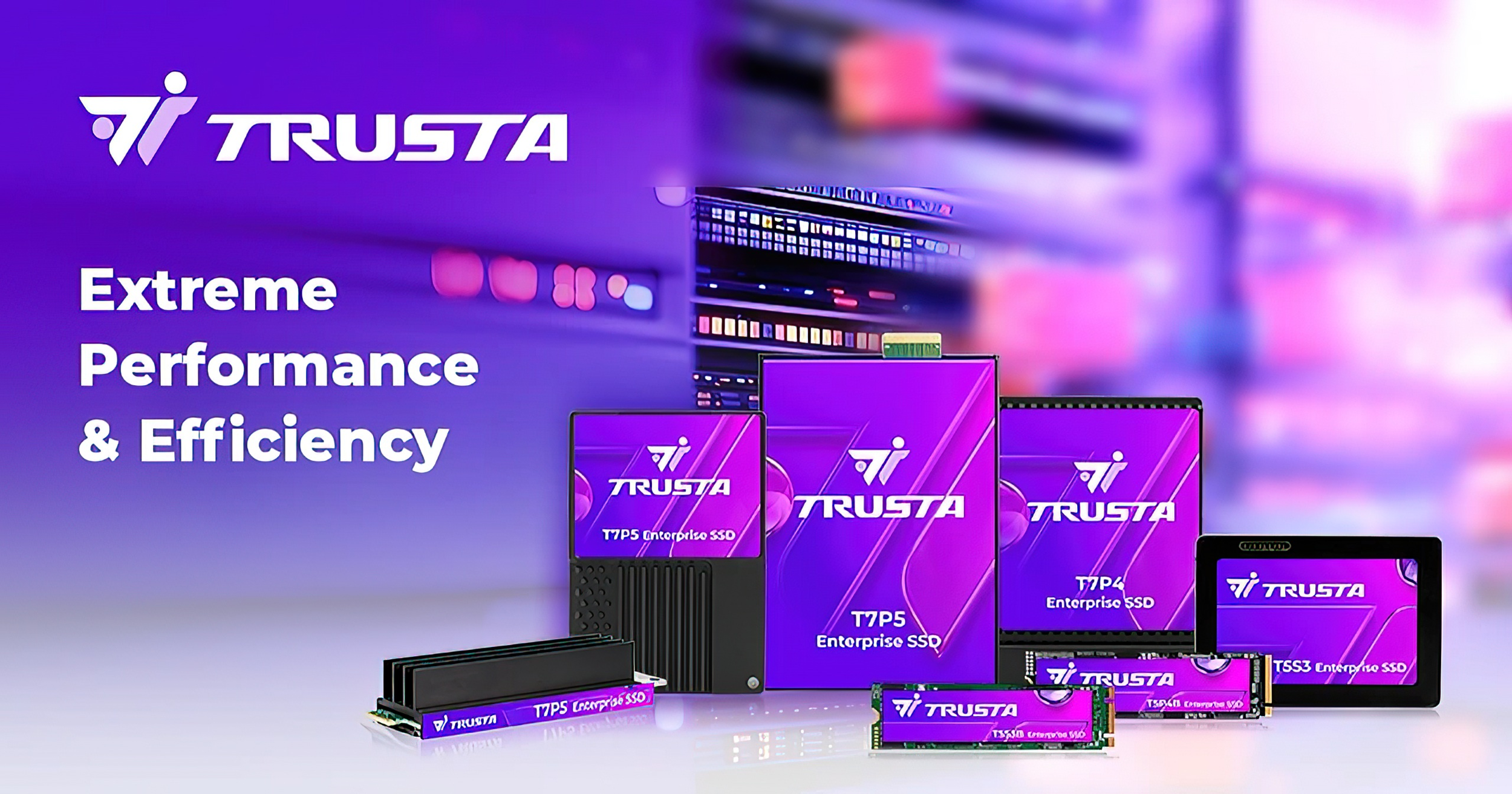
ADATA’s enterprise storage brand TRUSTA has introduced the AI Scaler Extended Memory Solution, a new software and hardware integrated platform designed to help enterprises overcome GPU memory limitations during AI inference and fine tuning. The solution aims to reduce deployment costs by more than 50% by extending AI model deployment beyond GPU memory and into system DRAM and high speed SSD storage.
As AI inference and agentic AI workflows continue to grow, memory capacity has become one of the biggest pressure points in modern AI infrastructure. Large language models often require expensive high end GPUs with large VRAM capacities, creating high deployment barriers for enterprises that want to run AI workloads on premises. TRUSTA’s answer is to rethink how memory resources are used across the system, allowing AI models to operate across GPU memory, DRAM, and SSDs instead of relying only on accelerator VRAM.
According to TRUSTA, the AI Scaler Toolkit is the core of this new solution. It enables enterprises, research institutions, and developers to deploy AI models across a broader memory hierarchy, helping them use existing system resources more efficiently. By combining GPU memory with system memory and SSD storage, TRUSTA says the solution can reduce infrastructure costs in model inference and fine tuning scenarios while improving flexibility for enterprise AI adoption.
"TRUSTA, the enterprise storage brand of memory leader ADATA Technology Co., today will officially launch the TRUSTA AI Scaler Extended Memory Solution. As an industry pioneer, TRUSTA introduces the AI Scaler Toolkit as the core of the solution, extending AI model deployment beyond GPU only architectures to system memory and high speed SSDs. This software hardware integrated solution helps enterprises overcome GPU memory limitations and reduce AI deployment costs by more than 50% in model inference and fine tuning scenarios."
— TRUSTA
The launch also represents a broader strategic shift for ADATA. The company is positioning itself not only as a memory and storage manufacturer, but also as a provider of integrated AI infrastructure solutions. This is important as more enterprise AI deployments move beyond cloud based services and into on premises and edge environments, where cost control, data privacy, regulatory compliance, and data location become major concerns.
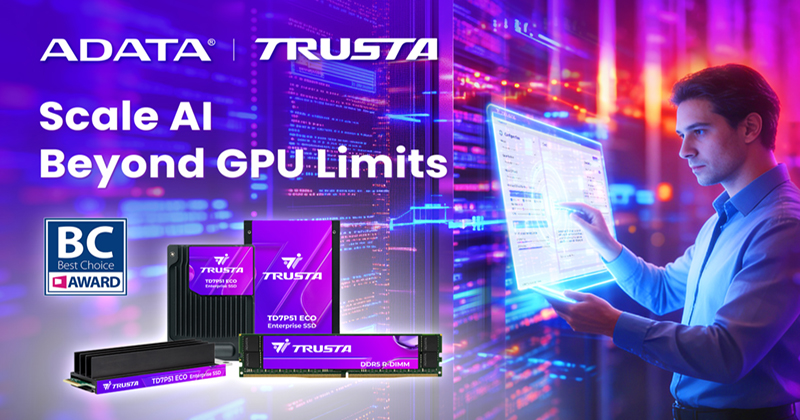
TRUSTA says AI infrastructure is expected to grow at a compound annual growth rate of approximately 26% through 2034, and the company is targeting enterprises that need a more scalable and economical way to deploy AI models. Instead of forcing every workload into expensive GPU memory configurations, AI Scaler Extended Memory is designed to distribute resources across GPU VRAM, DRAM, and SSD storage.
In tested scenarios, TRUSTA says model inference workloads that typically require multiple GPUs can be optimized to run on a single GPU paired with expanded system memory. For fine tuning, the platform can dynamically allocate computing resources across GPU memory, DRAM, and SSDs, giving organizations more flexibility when building AI infrastructure under limited budgets.
This approach could be especially relevant for companies experimenting with AI agents, internal large language model deployment, retrieval augmented generation, private AI assistants, and specialized inference workloads. In these environments, the ability to reduce dependence on high VRAM GPUs could significantly lower the barrier to entry.
The AI Scaler Toolkit is designed as a free and open source platform, and TRUSTA says it is not tied to specific hardware configurations. This gives users more freedom to configure their own systems based on available resources, workload needs, and budget. The toolkit supports mainstream model families including Llama, Qwen, Mistral, Mixtral, GPT OSS, DeepSeek, Phi, and Gemma, with additional model compatibility continuing to expand.
The platform also supports agentic AI applications such as OpenClaw, NemoClaw, and Hermes Agentic, allowing users to integrate AI Scaler into more complete agentic AI workflows. This is an important direction as enterprises increasingly look beyond basic chatbot use cases and toward AI systems that can reason, interact with tools, automate tasks, and operate across internal business environments.
The AI Scaler Toolkit is now available for download and use, giving developers and enterprise teams a direct way to test the platform. Alongside the AI Scaler announcement, TRUSTA will also showcase its TD7P51 ECO PCIe Gen5 enterprise SSD at COMPUTEX. The drive offers capacities of up to 15.36TB and supports multiple enterprise form factors, including U.2, E1.S, and E3.S. It also includes FDP, known as Flexible Data Placement, which helps improve reliability and stability through intelligent data placement.
For AI infrastructure, storage is becoming more than a secondary component. As models grow larger and workloads demand faster access to data, SSD performance, capacity, endurance, and placement intelligence become increasingly important. TRUSTA’s focus on combining enterprise SSDs with expanded AI memory deployment reflects a larger industry shift where storage and memory are becoming central to AI system design.
TRUSTA also says its products have been validated on multiple leading global server platforms, strengthening its enterprise storage portfolio for AI, cloud, and data center applications. That validation will be important for enterprise customers that need stable, tested, and scalable infrastructure before deploying AI workloads in production environments.
The AI Scaler Extended Memory Solution arrives at a time when GPU availability, VRAM capacity, and deployment cost remain major challenges across the AI market. While high end accelerators will continue to dominate the most demanding workloads, TRUSTA’s approach offers a practical alternative for organizations that need to scale AI inference and fine tuning without building every system around multiple expensive GPUs.
If the platform can deliver consistent performance across real enterprise workloads, AI Scaler could become an important tool for companies looking to make AI deployment more cost effective, flexible, and accessible. For ADATA and TRUSTA, it also signals a clear move into the next phase of AI infrastructure, where memory, storage, and software optimization are no longer separate pieces, but part of the same deployment strategy.
Do you think solutions like TRUSTA AI Scaler can make enterprise AI deployment more accessible, or will high VRAM GPUs remain the main requirement for serious AI workloads?
