
The Witcher 4 Adopts NVIDIA RTX Mega Geometry to Improve Performance and Cut VRAM Use
NVIDIA has announced that CD Projekt Red’s upcoming The Witcher 4 will use an updated version of RTX Mega Geometry, with the company positioning the technology as a major step toward making dense, fully path traced environments more practical in real time. According to NVIDIA, the new implementation is specifically focused on foliage heavy scenes, where forests and other natural environments place a major burden on both rendering performance and memory usage.
RTX Mega Geometry was first introduced by NVIDIA as a way to compress massive amounts of scene geometry into reusable clusters that can be cached and updated more efficiently across frames. The company says this approach helps accelerate the building of ray tracing structures and makes it possible to handle much more detailed scenes with lower overhead. In its latest GDC 2026 update, NVIDIA said the technology can update geometry structures up to 100 times faster than earlier methods, which is a key part of why it is now being extended into more advanced path traced environments.
NVIDIA also pointed to Alan Wake 2 as an early proof point for the technology. Remedy’s implementation of RTX Mega Geometry in that title reportedly delivered a 5% to 20% frame rate uplift while also cutting VRAM use by around 300 MB in foliage rich scenes. The company has already confirmed that Control Resonant will also adopt RTX Mega Geometry later this year, but the more significant announcement now is that CD Projekt Red is taking the concept further with a new foliage focused evolution of the system for The Witcher 4.

The key challenge here is the type of world The Witcher 4 is expected to deliver. Large open world forests are among the hardest environments to render with full path tracing because they combine huge object counts, fine geometric detail, and continuous animation. Trees, leaves, and layered vegetation all create a massive amount of complexity for ray tracing systems. Traditionally, one way to manage that load has been to reduce geometric detail, but that comes at the expense of image quality and scene density. NVIDIA’s new approach is designed to avoid that compromise.
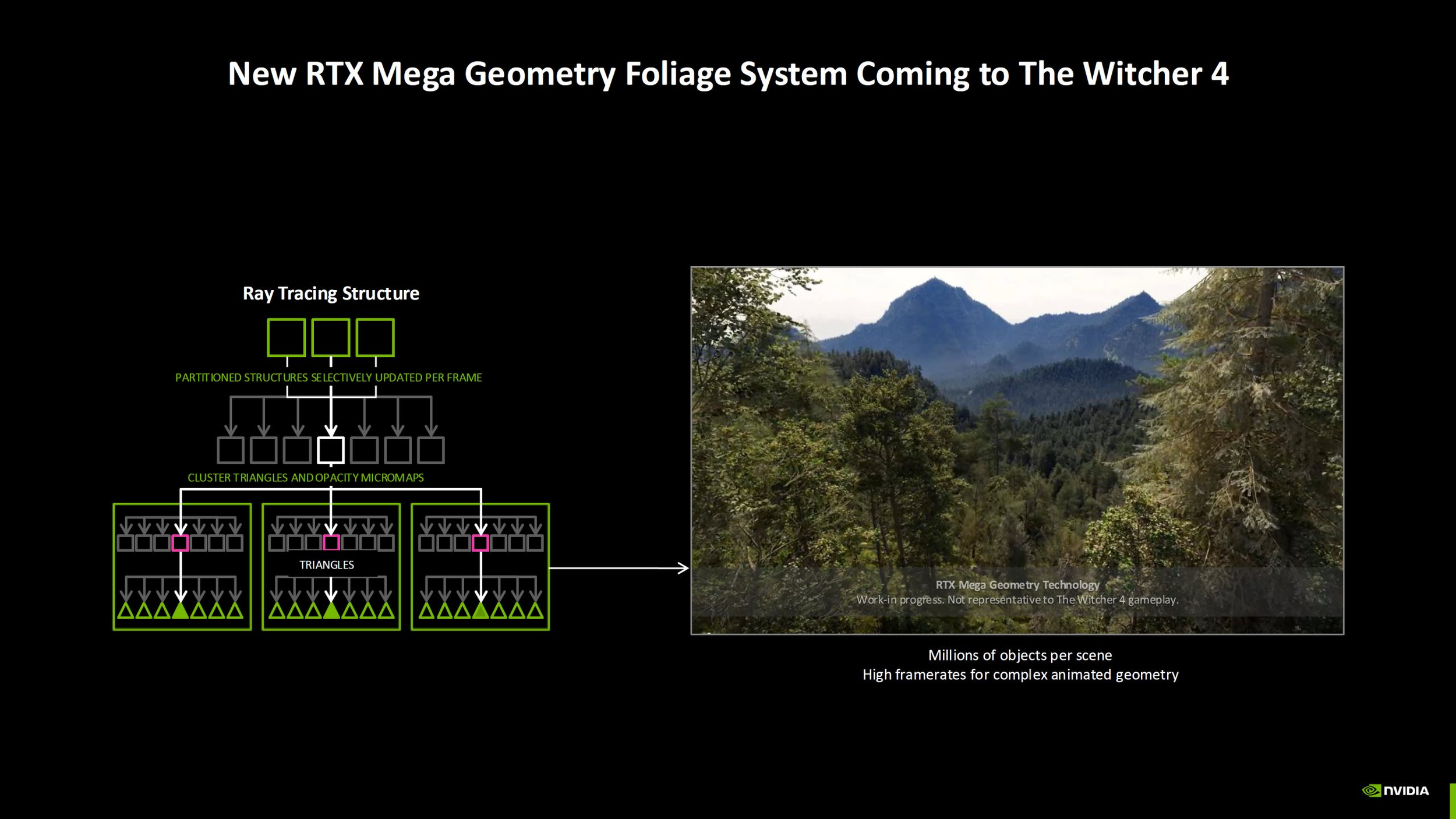
For The Witcher 4, NVIDIA says it is introducing a new RTX Mega Geometry foliage system that includes a fresh level of detail approach for vegetation. The system selectively updates the parts of a scene that matter most frame by frame, which reduces memory usage and improves performance while keeping transitions visually seamless. NVIDIA says this allows, for the first time, dense environments with millions of detailed plants and trees, unique animation, and accurate real time lighting and shadows to be path traced at game ready performance.
CD Projekt Red also publicly commented on the collaboration. Cezary Bella, Rendering Engineer at CD Projekt Red, said the in development Mega Geometry foliage technology will allow the studio to bring fully path traced forests into the world of The Witcher 4. That statement matters because it confirms this is not simply a marketing label being attached after the fact, but an active technical collaboration between NVIDIA and one of the industry’s most visible AAA developers.
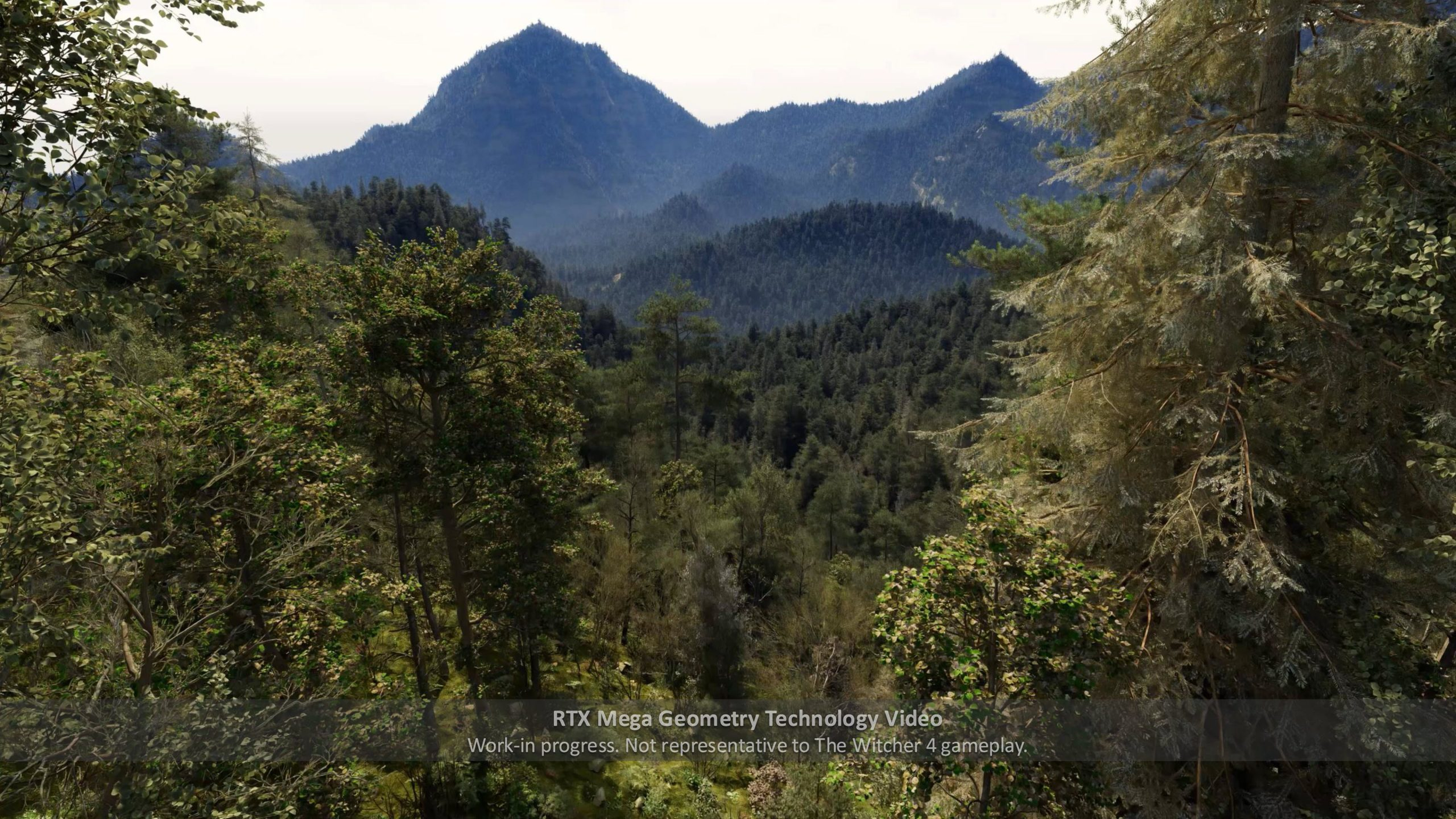
From a broader technical perspective, this is one of the more important NVIDIA rendering announcements from GDC 2026. Path tracing has become a major visual showcase for high end PC gaming, but its biggest weakness remains the cost of rendering extremely detailed and highly dynamic worlds. A forest is one of the clearest stress tests for that problem. If The Witcher 4 can deliver large scale path traced woodlands with strong image quality, stable performance, and lower VRAM demand, it would represent a meaningful milestone not only for NVIDIA’s RTX stack but also for how future open world RPGs approach lighting and environmental detail. This is an inference based on NVIDIA’s stated goals and the known rendering challenges of dense foliage scenes.
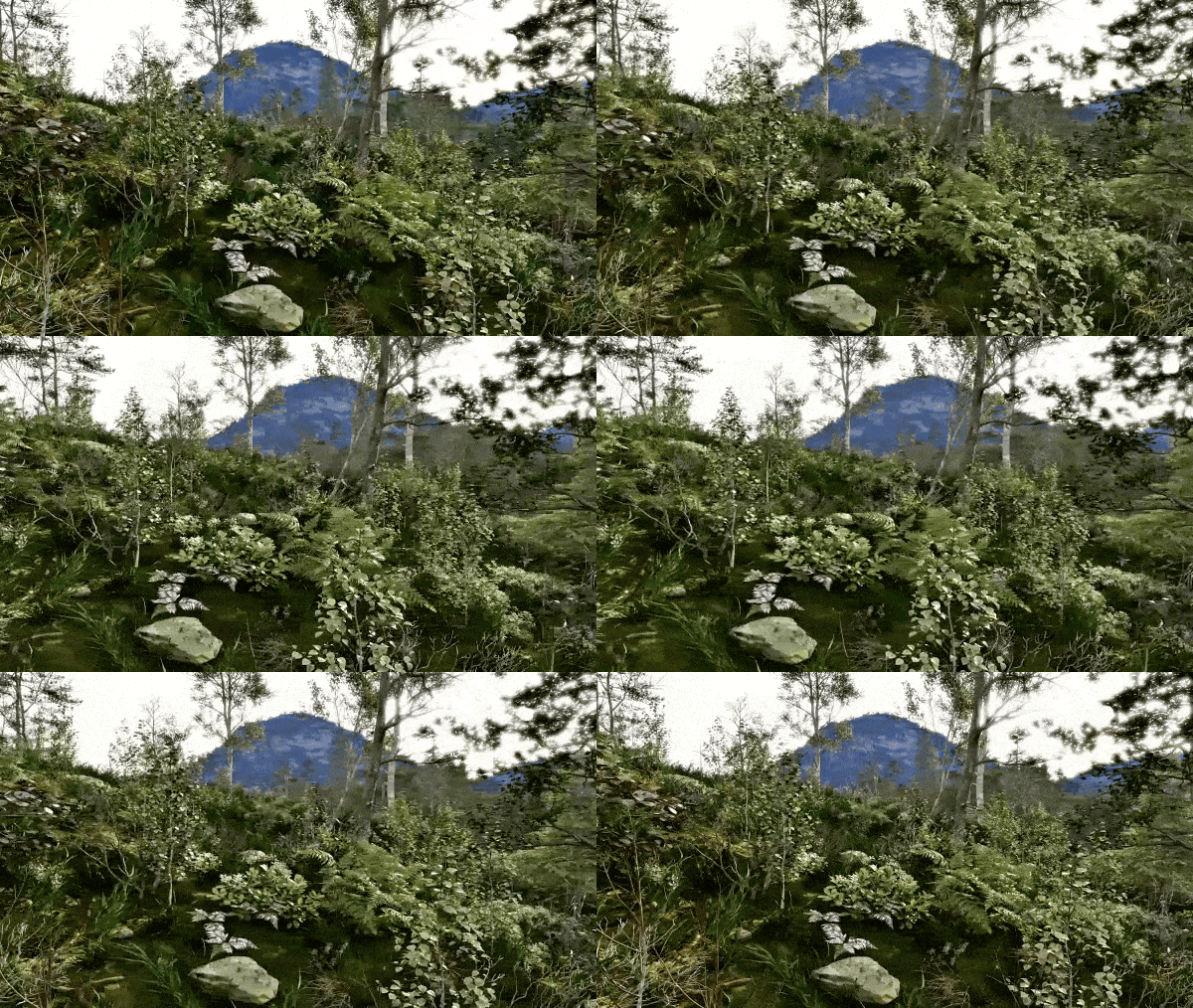
NVIDIA also said that it plans to open source its latest RTX Mega Geometry innovations later this year, which could eventually allow more developers to adopt the same advancements in their own projects. That gives this announcement relevance beyond The Witcher 4 itself. While CD Projekt Red may be the headline partner today, the underlying technology could end up influencing a much wider set of next generation PC titles built around ray tracing and path tracing.
What do you think about NVIDIA’s new foliage focused RTX Mega Geometry system for The Witcher 4? Could this be one of the technologies that finally makes full path traced open world forests practical in modern AAA games?
