
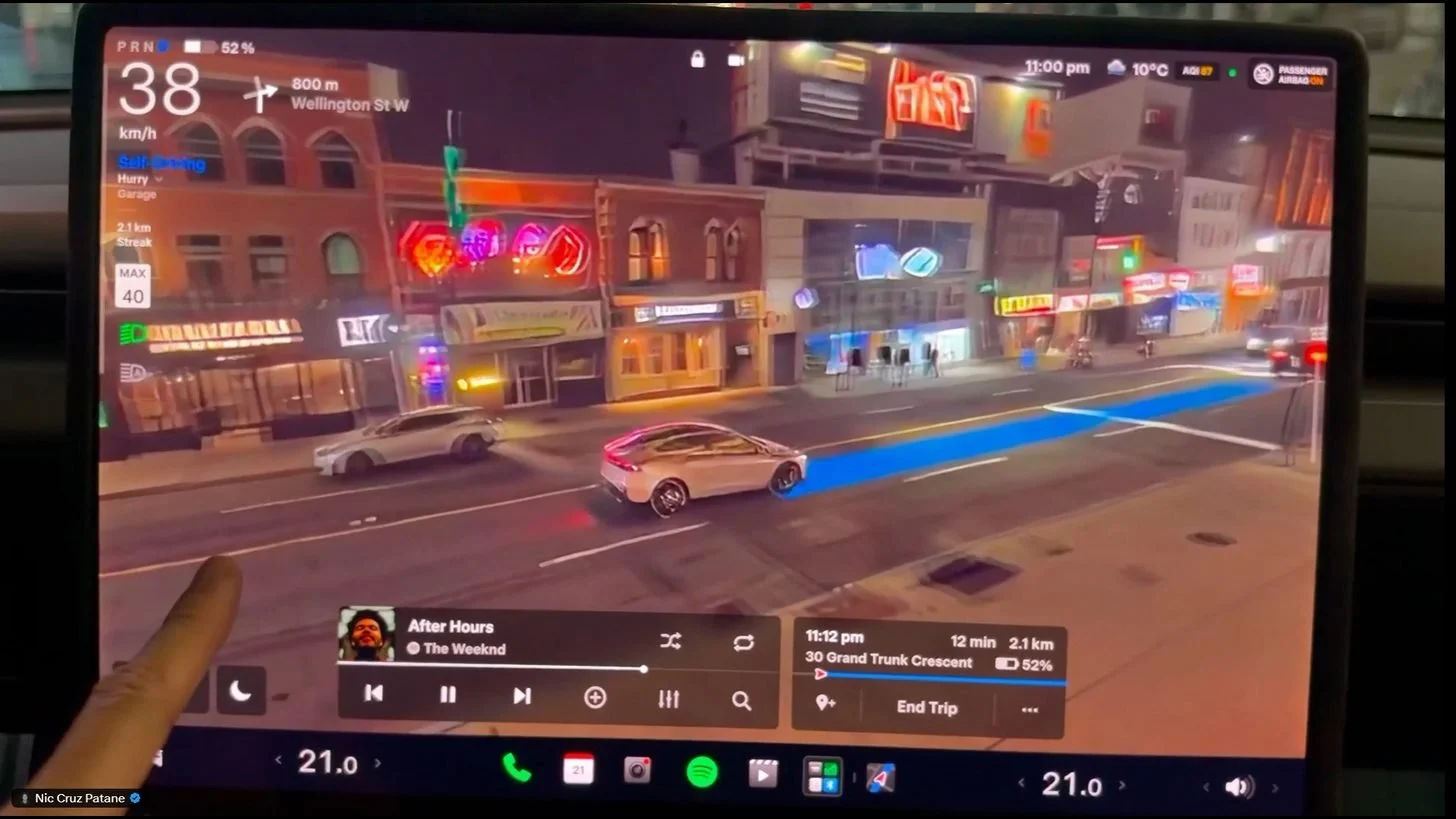
Tesla has demonstrated a major advancement in local artificial intelligence, running a 1 billion parameter generative AI model directly inside its vehicles to produce realistic visual representations of their surroundings at 36 FPS. Introduced alongside Full Self Driving (Supervised) v15 on November 21, 2026, the technology powers a new feature called Tesla Reality View, replacing conventional vehicle visualizations with AI generated imagery. The achievement demonstrates how optimized neural networks can perform demanding real time inference on specialized hardware without relying on external cloud computing.
In the official Tesla Self Driving V15 demonstration, the company showcased Reality View, which generates a continuously updated visualization of the surrounding environment from a virtual camera positioned above the vehicle. Unlike traditional graphics systems that render simplified roads, cars, and buildings through conventional 3D assets, Tesla uses a generative model to reconstruct the environment based on information gathered from its cameras. The resulting visualization presents a more realistic representation of traffic, road markings, buildings, and other environmental details while allowing drivers to observe the actions planned by the assisted driving system.
Elon Musk subsequently explained the technical implementation on X, revealing that Tesla has possessed a nearly pixel accurate world model since 2025, primarily used to generate synthetic training data. The version deployed inside production vehicles is considerably smaller and uses a conditional mean flow architecture combined with a diffusion model containing approximately 1 billion parameters.
The system operates alongside Tesla's 3 billion parameter driving action network, with both models receiving information from the company's Universal Vision Encoder. Rather than generating each frame independently, Reality View takes the previously generated image, introduces controlled noise, and uses the diffusion network to reconstruct an updated representation of the environment. This approach helps maintain visual consistency while reducing the computational requirements of continuously generating new images.
According to Musk, the model generates sequences containing 8 images at 36 FPS, matching the vehicle's interface resolution. The Universal Vision Encoder operates at 18 Hz, with the visualization workload distributed across 4 processing cycles. However, the system still experiences noticeable latency due to hardware constraints, with Tesla investigating optimizations that could reduce the delay by approximately 35%.
Tesla Reality View Technical Specifications
| Specification | Details |
|---|---|
| Technology | Tesla Reality View |
| AI Architecture | Conditional mean flow and diffusion |
| Generative Model | Approximately 1 billion parameters |
| Driving Network | Approximately 3 billion parameters |
| Visual Output | 36 FPS |
| Generated Sequence | 8 frames |
| Vision Encoder Frequency | 18 Hz |
| Processing Hardware | Tesla AI4 |
| Accelerator Allocation | Half of 1 TRIP engine |
| Available TRIP Engines | 3 on the referenced SoC |
| Numerical Acceleration | Primarily INT8 |
| Proposed Latency Improvement | Approximately 35% |
| Software | FSD (Supervised) v15 |
Perhaps the most impressive detail is the limited computing hardware required. Musk confirmed that Tesla managed to operate the model using only half of 1 TRIP accelerator on its AI4 hardware, leaving the remaining processing resources available for other vehicle functions. Engineers achieved this by moving a small decoder into on chip SRAM, reducing memory access overhead and freeing additional computational capacity.
The implementation is particularly challenging because the accelerator primarily supports 8 bit integer operations, while certain transformer calculations, including softmax, require emulation across 28 processing steps. Despite these limitations, Tesla successfully deployed a generative visualization model within the power and processing constraints of an automotive computer.
Musk also claimed that Tesla's upcoming AI5 architecture could deliver approximately 12 times greater computing capability, although this remains a manufacturer estimate rather than an independently verified performance measurement. The company's broader AI5 and AI6 hardware development plans demonstrate its continued investment in specialized processors for robotics and local inference.
Beyond Reality View, Tesla claims its FSD v15 update delivers a 25 times improvement in handling certain safety critical situations through upgrades to its vision encoder and driving network. However, the company has not published sufficient independent evidence to validate that specific improvement. Reality View is also a visualization system rather than the neural network responsible for controlling the vehicle, and its AI generated images should not be considered an exact representation of surrounding hazards.
Tesla's Full Self Driving remains a supervised driver assistance system, requiring drivers to remain attentive and prepared to intervene. The initial release is being distributed to selected compatible vehicles, with broader availability dependent on hardware, software, and regional support.
Tesla's achievement demonstrates how far specialized AI hardware and efficient model architectures have progressed. Running a 1 billion parameter generative model at 36 FPS on existing automotive hardware is an interesting example of local inference optimization, particularly when the system must share limited computational resources with other applications.
The most important accomplishment is not simply generating realistic visuals, but performing continuous AI inference within a restricted hardware and power budget. This approach has implications beyond automotive technology, including robotics, embedded computing, gaming handhelds, and locally operated AI systems.
For PC enthusiasts, it also reinforces an important principle: increasing model efficiency can be just as valuable as purchasing more powerful hardware. Optimized numerical precision, efficient memory allocation, and specialized processing architectures could allow increasingly capable AI applications to operate on existing consumer devices.
However, AI generated visualizations should never be confused with verified environmental awareness or autonomous driving safety. A visually convincing representation does not guarantee that a system correctly identifies every object or predicts every dangerous situation.
The broader opportunity lies in developing efficient AI technologies that operate locally, preserve user control, and reduce dependence on expensive cloud infrastructure. The future of AI should not be measured exclusively by larger models and greater power consumption, but by how effectively existing hardware can perform useful computations.
Do you believe Tesla running a 1 billion parameter AI model at 36 FPS on existing hardware represents a major breakthrough for local AI, or should manufacturers prioritize practical improvements in efficiency and reliability over visually impressive demonstrations?
