
SEGA Cancels Super Game After a Loss Hit FY2026, but Crazy Taxi, Golden Axe, Jet Set Radio, and More Revivals Remain in Play
SEGA Sammy’s latest full year results show a company that is still profitable at the operating level, but under clear pressure in key entertainment segments, and that pressure is now reshaping strategy in a very visible way. For the fiscal year ended March 31, 2026, SEGA Sammy reported sales of 487.5 billion yen and operating income of 47.1 billion yen, but it also recorded a loss attributable to owners of parent for the year after impairment losses tied to Rovio and Stakelogic. In the same presentation, the company made one of its biggest strategic calls in years by confirming that it has decided to cancel its long discussed Super Game initiative.
The cancellation was not buried in vague language either. In its official FY2026 presentation, SEGA Sammy said it reviewed the strategic positioning of Game as a Service and noted that new free to play titles struggled during the year. The company specifically cited the weak performance of Sonic Rumble Party, the failure to generate the expected economic value from collaboration with Rovio, and delays to some launches. It then stated directly that it had decided to cancel Super Game, while adding that there are no additional costs associated with that cancellation.
That makes the broader pivot easy to understand. SEGA is clearly pulling back from a more aggressive free to play expansion strategy and redirecting resources toward what it sees as more dependable franchise driven development. The same investor material says the company has lowered the priority of free to play and already moved over 100 development staff from that side of the business into full game development teams focused on mainstay IPs. That is not a minor internal adjustment. It is a very direct reallocation of talent toward a more traditional premium software roadmap.
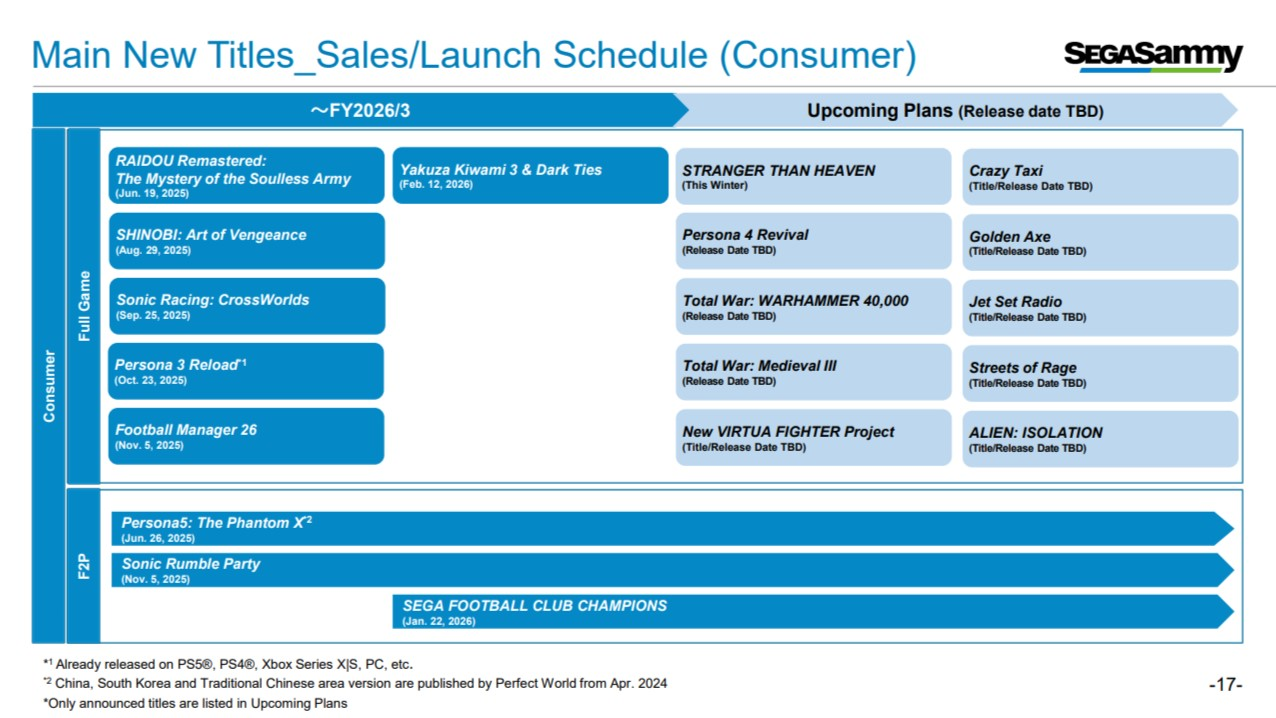
Importantly for players, Super Game being cut does not mean SEGA has wiped out its broader revival plans. Quite the opposite. The company’s current upcoming plans still list new projects for Crazy Taxi, Golden Axe, Jet Set Radio, Streets of Rage, a new Virtua Fighter project, Stranger Than Heaven, Persona 4 Revival, Total War: Medieval III, Total War: WARHAMMER 40,000, and an Alien: Isolation sequel. Those titles remain in SEGA Sammy’s official pipeline even after the Super Game cancellation, which strongly suggests the company is trimming strategy around monetization and portfolio structure rather than abandoning its major legacy revival push.
There is also a financial logic behind this shift. In the Entertainment Contents business, full game sales fell from 76.4 billion yen to 67.2 billion yen year on year, while full game unit sales dropped from 31.45 million to 22.95 million. At the same time, the company says consumer sales still rose slightly overall within the segment, supported by existing free to play titles, subscription services, DLC, and steadier animation contributions. In other words, SEGA is not collapsing, but it is not getting the kind of return it wanted from newer free to play bets, and that has forced a reset in how it wants to grow from here.
Super Game itself had always been framed as something bigger than a single title. In earlier official strategy materials, SEGA described it as an initiative meant to create AAA titles that could go beyond the traditional framework of games and use the company’s broader technical capabilities in new ways. Now that idea is effectively off the table, at least in its original form. What survives is the more grounded part of SEGA’s future plan: established franchises, recognizable IP, and premium projects with clearer commercial identities.
That may ultimately be better news for long time SEGA fans than for anyone still hoping the company would become a major live service hit machine. The numbers show why management is making this call, but the pipeline also shows that the retreat from Super Game is not a retreat from ambition. It is a reorganization of where that ambition gets deployed. If SEGA executes well, the next few years could be defined less by experimental platform scale bets and more by the return of some of the publisher’s strongest names in a more focused lineup.
What do you think is the smarter move for SEGA right now: cutting back on free to play ambitions, or pushing even harder on classic franchise revivals?
