
RTX 5090 Purchase at Micro Center Reportedly Now Requires Buyer Paperwork
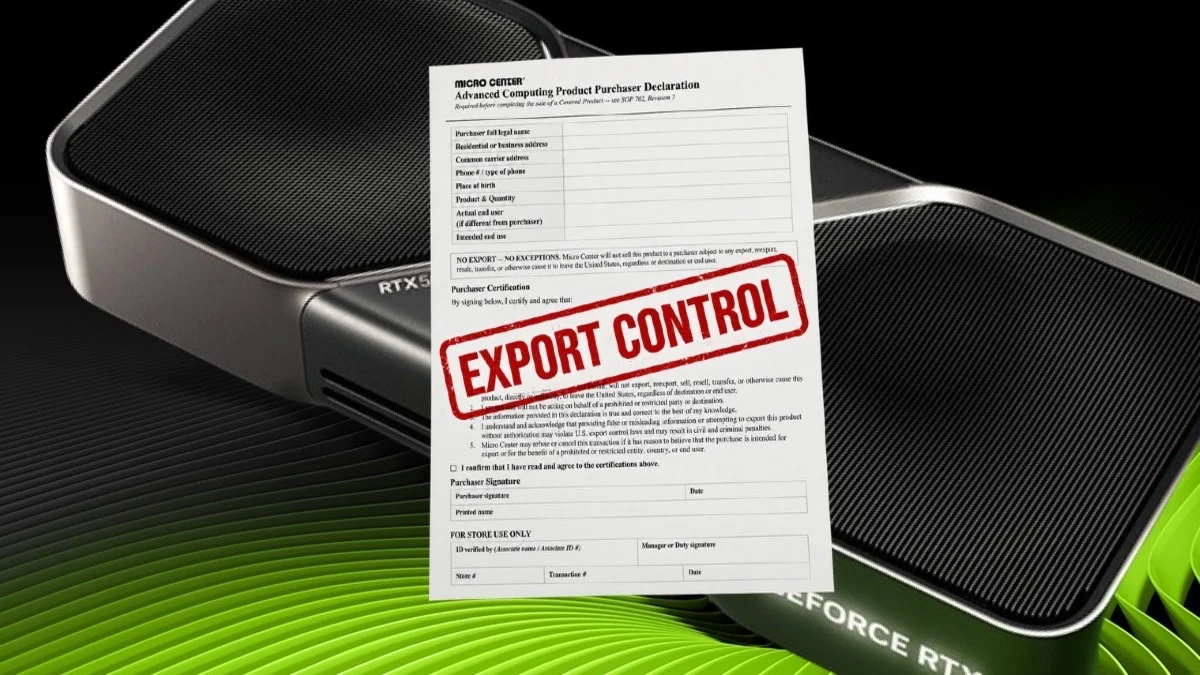
Buying an RTX 5090 at Micro Center may now involve more than just finding one in stock and paying the bill. A customer on the Micro Center subreddit says they were required to fill out an Advanced Computing Product Purchaser Declaration and have their driver license scanned before purchasing a PowerSpec AI90 prebuilt PC equipped with NVIDIA’s flagship GeForce RTX 5090.
According to the customer, the requirement was presented by a manager at Micro Center’s Tustin, California location and was described as a new process that had started only a few days earlier. The posted form reportedly asks for the buyer’s legal name, residential or business address, government issued photo ID, phone number, email address, actual end user, installation location and intended end use. It also states that Micro Center will not sell the product to a purchaser who intends to export, reexport, resell, transfer or otherwise cause it to leave the United States, regardless of destination.
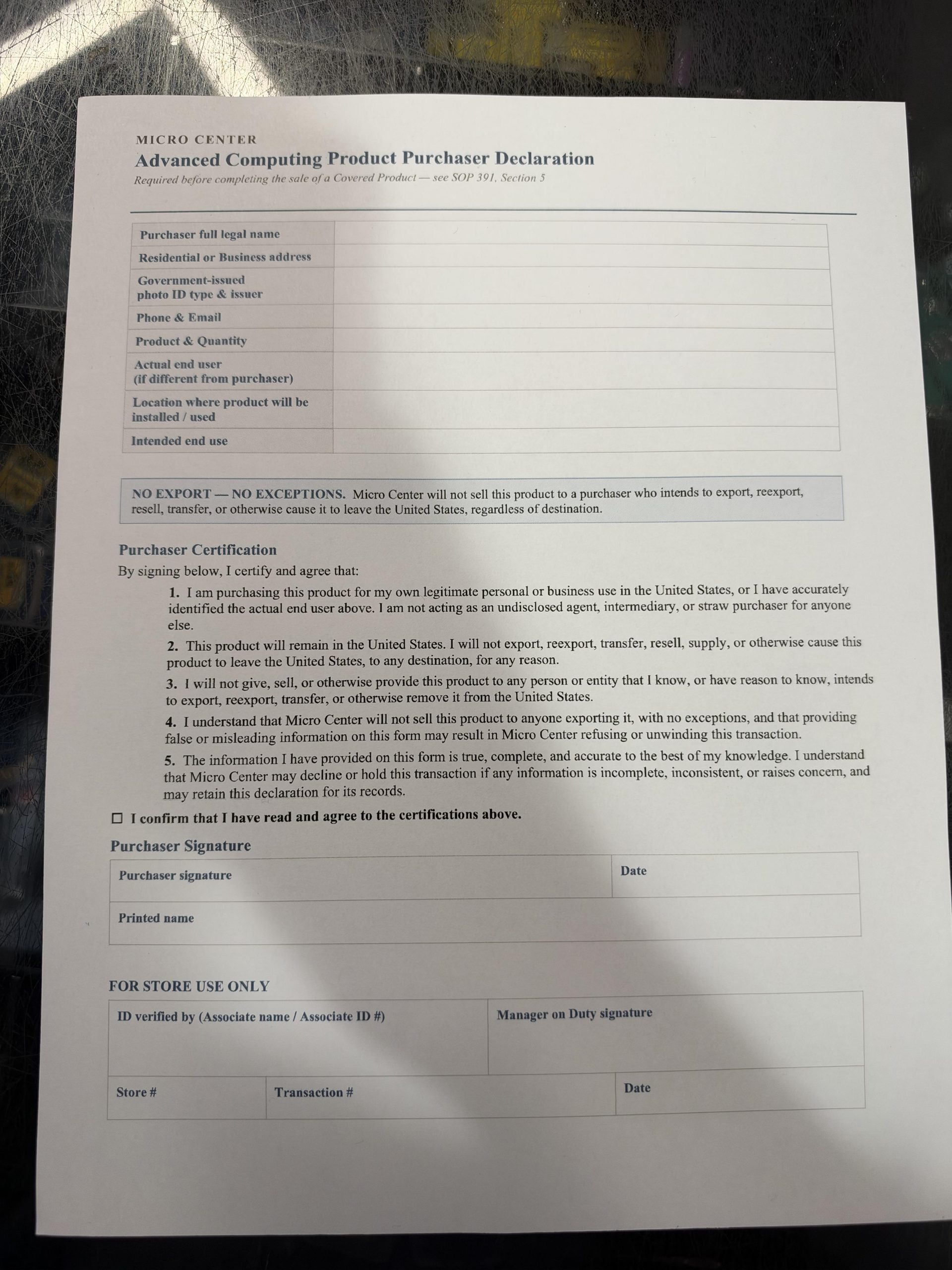
The situation has not yet been officially confirmed as a nationwide Micro Center policy. That distinction matters. At the moment, the clearest public evidence comes from 1 customer account, discussion inside the retailer’s subreddit and follow up reporting from outlets that reviewed the posted form. Micro Center has not publicly explained whether the declaration applies only to RTX 5090 equipped prebuilts, standalone RTX 5090 graphics cards, specific locations, repeat buyers or all future sales involving NVIDIA’s highest end consumer GPU.
Even with those open questions, the report reflects how unusual the RTX 5090 market has become. A graphics card originally positioned as a flagship consumer product is now being treated more like advanced computing hardware with end use documentation. That shift is not happening in isolation. The RTX 5090 carries 32 GB of GDDR7 memory and has become valuable not only to gamers, but also to local AI users, workstation builders and buyers looking for powerful compute hardware below professional accelerator pricing.
This also follows the extreme pricing pressure when RTX 5090 listings approached $10,000 as United States online stock disappeared. Micro Center has remained one of the more visible retail sources for RTX 5090 hardware, but even its in store listings have already shown prices far above NVIDIA’s original $1,999 Founders Edition launch price. In that environment, any retailer selling scarce high end GPUs faces a difficult balance between serving real customers, limiting scalpers and avoiding export compliance risk.
The paperwork also arrives as United States export controls continue to focus on advanced computing hardware. The RTX 5090 is not a data center accelerator, but its compute performance and 32 GB memory configuration make it attractive in markets where access to higher tier NVIDIA AI hardware is restricted or difficult. Retail level forms may not stop organized smuggling, but they create a paper trail and make casual resale or bulk flipping more difficult.
For normal PC gamers, the immediate impact is more practical than political. If the policy expands, buying an RTX 5090 could require identity verification, a signed declaration and additional checkout time. For buyers who simply want a gaming PC, that feels unusual. For the broader hardware market, however, it shows how the line between gaming GPU, workstation product and AI compute asset keeps getting thinner.
The RTX 5090 has crossed into strange territory. It is still a gaming GPU, but the market no longer treats it like a normal gaming product. Scarcity, AI demand, resale incentives, export controls and extreme pricing have turned a consumer graphics card into a compliance sensitive asset at retail level.
Micro Center’s reported form may be limited, temporary or location specific, but the message is still clear. The RTX 5090 is valuable enough that retailers are now thinking beyond inventory limits and customer queues. They are thinking about where the product goes after checkout. That is a major shift for PC hardware and a sign of how AI demand is reshaping even the enthusiast gaming market.
Would you still buy an RTX 5090 if the checkout process required ID verification and a signed declaration, or would that make you walk away?
