
Palit Revives the RTX 3060 12 GB as the Budget GPU Market Struggles
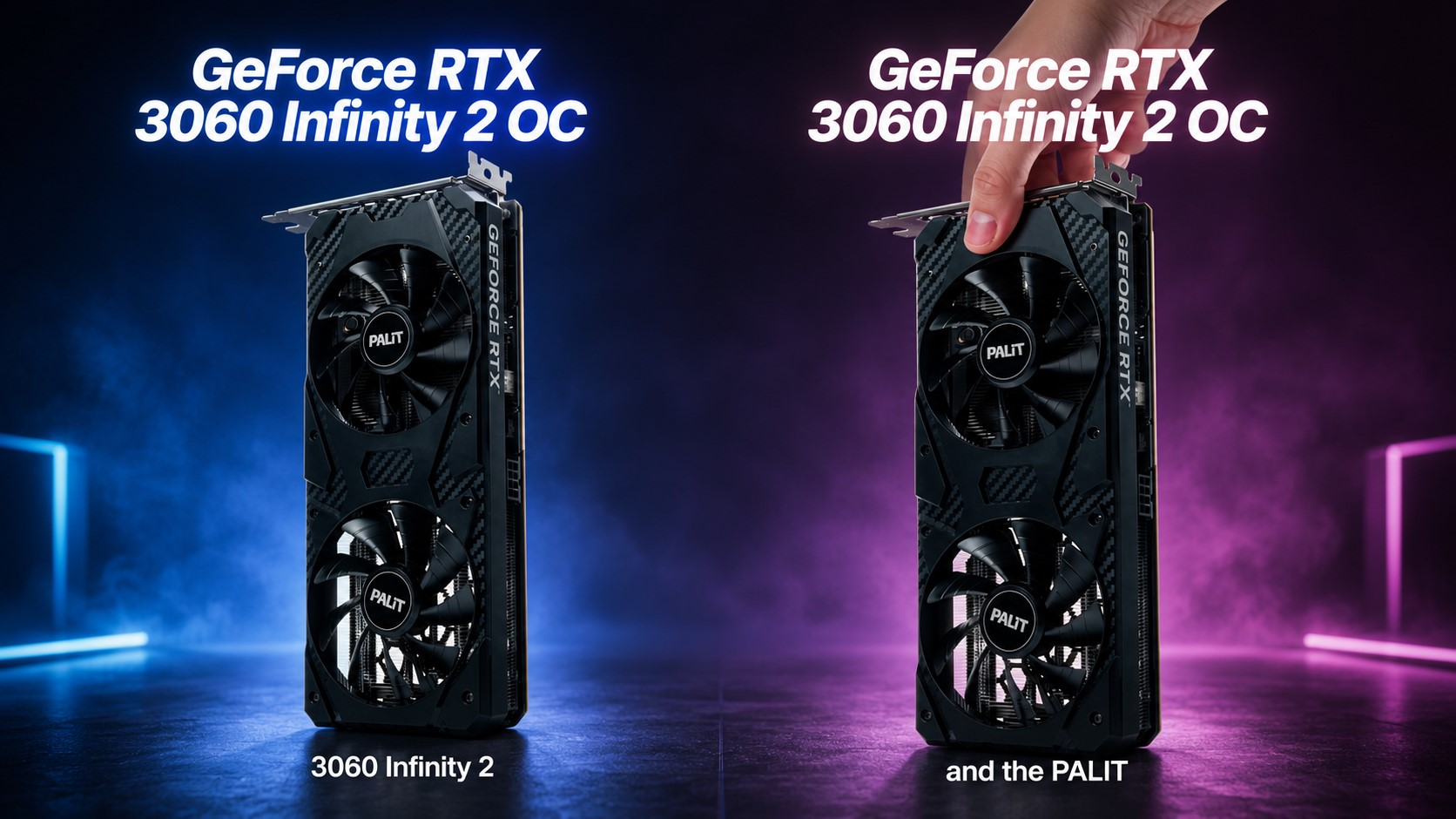
Palit has officially returned the GeForce RTX 3060 12 GB to its graphics card portfolio with the new Infinity 2 OC, reviving NVIDIA’s Ampere architecture as rising component costs and constrained consumer GPU availability continue to place pressure on budget PC gaming.
The Palit GeForce RTX 3060 Infinity 2 OC is positioned as a mainstream graphics card for smooth 1080p gaming and creative applications. It combines 12 GB of GDDR6 memory with a factory overclock, a compact dual fan cooling system, zero decibel fan technology, a ventilated protective backplate, and a design intended to fit a wide range of gaming systems.
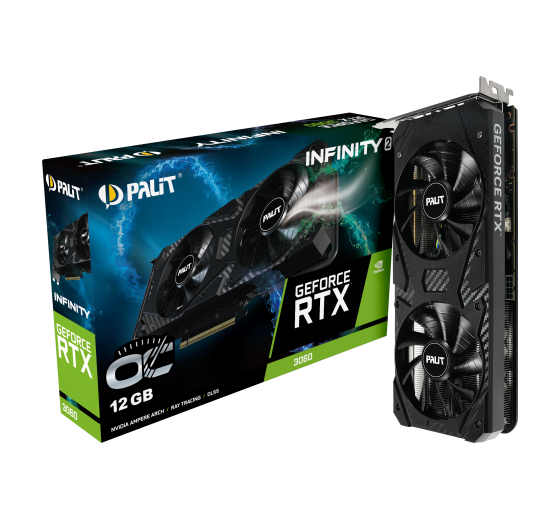
The card retains the familiar RTX 3060 configuration with 3,584 CUDA cores, a 192 bit memory interface, and 12 GB of GDDR6 memory. Palit raises the boost clock to 1,792 MHz, representing a minor increase over NVIDIA’s reference specification rather than a substantial performance upgrade.
"The GeForce RTX 3060 GPU continues to stand as a reigning champion on the Steam Hardware Survey."
Palit
Palit’s description requires some clarification. According to the June 2026 Steam Hardware Survey, the RTX 3060 remains the most widely used desktop graphics card with a 4.06% share. However, it is no longer the most popular GPU overall, as the RTX 4060 Laptop GPU has moved ahead with 4.16%. The desktop RTX 5060 currently holds approximately 2.90%, showing that the older Ampere model still maintains a significantly larger installed base than NVIDIA’s newer budget option.
The RTX 3060’s primary advantage remains its 12 GB memory capacity. NVIDIA replaced that configuration with 8 GB on the RTX 4060 and RTX 5060, creating concerns about long term memory limitations as modern games adopt higher resolution textures, ray tracing, and increasingly demanding asset streaming systems.
However, more memory does not automatically make the RTX 3060 the stronger gaming product. The RTX 5060 uses NVIDIA’s newer Blackwell architecture, 8 GB of GDDR7 memory, fourth generation ray tracing cores, fifth generation Tensor cores, and support for DLSS Multi Frame Generation. The RTX 3060 can still use DLSS Super Resolution, ray tracing, and NVIDIA Reflex, but it cannot access the frame generation technologies reserved for newer architectures.
Pricing will therefore determine whether Palit’s revived card has a meaningful place in the market. NVIDIA launched the RTX 5060 with an official starting price of $299, while Palit has not announced the price or regional availability of the Infinity 2 OC. The RTX 3060 could remain attractive for affordable 1080p systems, local artificial intelligence experiments, content creation, and games that benefit from more than 8 GB of memory, but only if it is sold considerably below newer alternatives.
The return of a graphics card originally introduced in 2021 also reflects the unusual condition of the consumer hardware market. Artificial intelligence infrastructure is absorbing growing amounts of semiconductor manufacturing, memory, and packaging capacity, while mainstream gamers continue facing limited options at genuinely affordable prices. Reintroducing Ampere allows board partners to serve this segment with an established design, but it also highlights how slowly performance and memory capacity are progressing at the lower end of the market.
The RTX 3060 earned its popularity because it offered a practical combination of performance, 12 GB of memory, and accessible pricing. Those qualities remain relevant, particularly when many newer budget cards still provide only 8 GB.
However, popularity on the Steam Hardware Survey describes what gamers already own, not necessarily what they should purchase in 2026. The RTX 3060 lacks the efficiency, architectural improvements, encoding capabilities, and frame generation support available from newer GPUs.
Palit’s Infinity 2 OC could become a reasonable budget option if it arrives below $250. At a price close to the RTX 5060, buyers would be exchanging modern performance and features for an additional 4 GB of memory. That trade could make sense for selected workloads, but it would be increasingly difficult to justify for mainstream gaming.
Would you choose the RTX 3060 with 12 GB of memory over a faster RTX 5060 with 8 GB if both graphics cards were similarly priced?
