
Original DOOM Gets DLSS 5 Neural Rendering Through a Custom DirectX 12 Port
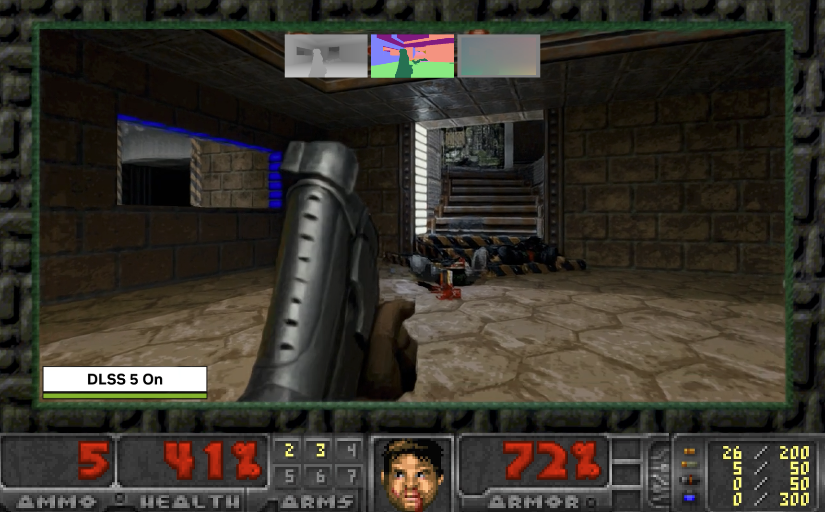
More than 30 years after its original release, DOOM is once again being used to demonstrate graphics technology that would have been unimaginable when id Software launched the game in 1993. Developer Nikolai Zhivotenko has created an experimental Windows version of the original DOOM that combines a custom DirectX 12 presentation path with NVIDIA DLSS and a community implementation of DLSS 5 Neural Rendering.
The open source DOOM + DLSS 5 project is based on Linux DOOM 1.10 and converted into a Windows x64 application. The game still renders internally at its original 320 x 200 resolution, while the DirectX 12 output runs at 1280 x 800. The modified engine also generates depth, surface normals, and motion data, providing modern reconstruction systems with information the original renderer never produced.
A G Buffer, short for Geometry Buffer, typically stores scene information such as depth, surface normals, and material attributes for later rendering stages. In this project, similar auxiliary data helps connect DOOM's 1993 software renderer with current graphics technologies.
The project supports several presentation modes, allowing users to compare different approaches to processing the same 320 x 200 source image.
| Rendering Mode | Implementation |
|---|---|
| Original | Nearest neighbor 4X scaling |
| DLSS Ray Reconstruction | NVIDIA DLSS Ray Reconstruction |
| DLSS 4 | Super Resolution using Preset K |
| DLSS 4.5 | Super Resolution using Preset L |
| DLSS 5 | DLSS 4.5 followed by Neural Rendering |
| Anime4K | Anime4K Fast Mode C |
| AMD FSR | AMD FSR 2.2 |
The DLSS 5 mode is not a native implementation built directly into DOOM. The port first uses NVIDIA NGX and DLSS 4.5 Super Resolution to reconstruct the original image to 1280 x 800, after which an external RenoDX component installed through DLSS 5 Swapper applies the Neural Rendering stage. Without that component, the dedicated build effectively behaves like the DLSS 4.5 configuration.
Another notable detail is that DLSS receives DOOM's actual 320 x 200 render rather than a pre enlarged nearest neighbor image. The status bar is added after reconstruction so interface elements remain sharp.
NVIDIA describes DLSS 5 as 3D Guided Neural Rendering, where image data and engine information are used to influence the appearance of lighting, materials, shadows, and other scene details. DOOM is an unusually extreme test case because its graphics were built decades before physically based rendering, temporal reconstruction, or neural graphics pipelines existed.
A video demonstration shows how the system interprets DOOM's sprites, walls, weapons, enemies, and environments. The resulting image can look dramatically different from the original pixel presentation, but the engineering required to adapt such an old renderer for modern reconstruction technology is arguably the more interesting part of the project.
Zhivotenko has effectively built a modern graphics layer around the original software renderer rather than replacing it. DOOM continues producing its familiar low resolution frame while the new DirectX 12 code supplies the additional data required by contemporary rendering systems.
Users interested in experimenting with the project need to compile the Windows port and provide their own compatible DOOM IWAD. Commercial game data is not distributed with the source code, although Freedoom can also be used as an open alternative.
The GitHub project can additionally expose its color, depth, normal, and velocity buffers individually, giving users a closer look at the scene information generated by the modified renderer.
The most interesting part of this project is not simply seeing DOOM with Neural Rendering. It is seeing how a software renderer from 1993 can be extended to communicate with graphics technology designed more than 3 decades later.
DOOM has already been adapted for hardware acceleration, ray tracing, path tracing, virtual reality, and countless source ports. Neural Rendering now joins that list, reinforcing why the game continues to serve as one of PC gaming's most enduring technical playgrounds.
Would you experiment with Neural Rendering in the original DOOM, or do you think its classic 320 x 200 pixel presentation should remain untouched?
