
OpenAI Cuts GPT 6 Sol and Luna Pricing as AI Cost War Intensifies
OpenAI has sharply lowered the cost of frontier AI access with GPT 6 Sol and GPT 6 Luna, cutting API pricing by roughly 50% compared with their GPT 5.6 predecessors. The new rates place GPT 6 Sol at half the raw token price of Anthropic's newly released Claude Opus 5.5, while GPT 6 Luna now costs less for uncached input and output than even DeepSeek V4.1 Flash during its discounted off peak hours. The result is another escalation in the AI industry's price competition, although benchmark results show that lower pricing does not automatically mean OpenAI now leads every performance category.
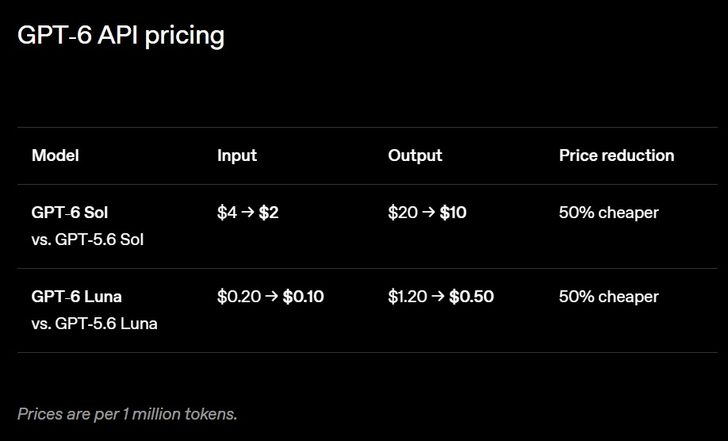
According to OpenAI's GPT 6 announcement, GPT 6 Sol costs $2 per 1 million input tokens and $10 per 1 million output tokens, down from $4 and $20 under the promotional GPT 5.6 Sol pricing. GPT 6 Luna drops to just $0.10 for input and $0.50 for output, compared with $0.20 and $1.20 previously. OpenAI says improvements to inference efficiency and prompt caching helped make the reductions possible, with cached input reads also receiving a 90% discount.
| Model | Input per 1M Tokens | Output per 1M Tokens | Cached Input |
|---|---|---|---|
| GPT 6 Sol | $2.00 | $10.00 | $0.20 |
| Claude Opus 5.5 | $4.00 | $20.00 | $0.20 |
| GPT 6 Luna | $0.10 | $0.50 | $0.01 |
| DeepSeek V4.1 Flash Off Peak | $0.15 | $0.60 | $0.003 |
| DeepSeek V4.1 Flash Peak | $0.30 | $1.20 | $0.006 |
Anthropic launched Claude Opus 5.5 at the same time with its own substantial price reduction. The model costs $4 per 1 million input tokens and $20 per 1 million output tokens, making GPT 6 Sol exactly 50% cheaper at the standard token level. Anthropic says Opus 5.5 costs around 40% less to run than Opus 5 during typical workloads because cache reads have also dropped to $0.20 per million tokens. This means the actual difference between the models can vary substantially depending on how much context an application repeatedly reuses rather than simply how many new tokens it processes.
GPT 6 Luna creates an even more unusual comparison with DeepSeek. DeepSeek's current API pricing places V4.1 Flash at $0.15 per 1 million uncached input tokens and $0.60 per 1 million output tokens during off peak periods, doubling to $0.30 and $1.20 during peak hours. Luna therefore undercuts DeepSeek for fresh input and generated output even during its cheapest pricing window. DeepSeek retains a major advantage for cached input, however, charging only $0.003 off peak compared with Luna at approximately $0.01, meaning highly repetitive long context applications can still produce a very different cost profile.
Independent testing also adds important context to the pricing battle. Artificial Analysis testing gives GPT 6 Sol a cost of approximately $1.06 per task on its Intelligence Index, roughly half the $1.99 measured for GPT 5.6 Sol. GPT 6 Luna falls to around $0.07 per task from $0.18 previously. However, the same testing currently gives Claude Opus 5.5 an Intelligence Index score of 58 compared with 48 for GPT 6 Sol at maximum effort, while DeepSeek V4.1 Flash scores 39 against Luna's 37. OpenAI therefore leads strongly on cost in these comparisons without necessarily taking the highest raw benchmark score.
GPT-6 Sol and Luna push the cost efficiency frontier by halving cost relative to GPT-5.6 Sol and Luna. Intelligence Index and Coding Agent Index scores remain level with GPT-5.6, with progress in some evaluations and regressions in others
— Artificial Analysis (@ArtificialAnlys) September 22, 2026
Pricing is approximately half that of… pic.twitter.com/eubnxPVsyN
That distinction becomes particularly important when discussing open weight models. Lower hosted API prices make the economics of paying for proprietary inference much more competitive, especially for developers who previously considered operating their own infrastructure primarily to reduce per token costs. But open weight systems such as DeepSeek still provide capabilities a closed API cannot replace, including local deployment, model modification, private infrastructure, offline operation, provider independence, and control over inference hardware. OpenAI itself returned to open weight models with GPT OSS, highlighting why openness remains relevant even when hosted inference becomes inexpensive.
The new pricing also changes the competitive position DeepSeek built around unusually cheap inference, DeepSeek preparing significant API price changes as V4 Flash demand increased, and V4.1 Flash has since moved to a peak and off peak structure while retaining open weights. OpenAI is now challenging that cost advantage from the opposite direction, using massive centralized infrastructure and improved inference efficiency to push proprietary models into pricing territory previously associated with much smaller or open systems.
The most important development here is not that OpenAI has suddenly made open weight AI irrelevant. It has made cheap hosted inference much harder to use as the only argument for running an open model yourself.
At $0.10 input and $0.50 output per 1 million tokens, GPT 6 Luna changes the calculation for developers who simply want inexpensive access to a capable model without buying GPUs, managing inference servers, or maintaining deployment infrastructure. GPT 6 Sol does something similar higher up the stack, costing half as much per token as Claude Opus 5.5 even though Anthropic currently holds a significant advantage on several independent intelligence benchmarks.
Open weights still solve a different problem. Companies that require local control, customization, predictable infrastructure, privacy, or freedom from an API provider can still have strong reasons to deploy them. What OpenAI is attacking is the economic middle ground where developers previously chose open models primarily because proprietary APIs were too expensive. That part of the market just became considerably more competitive.
At these prices, would you still deploy an open weight model locally, or is hosted inference becoming cheap enough that managing your own AI infrastructure no longer makes sense?
