
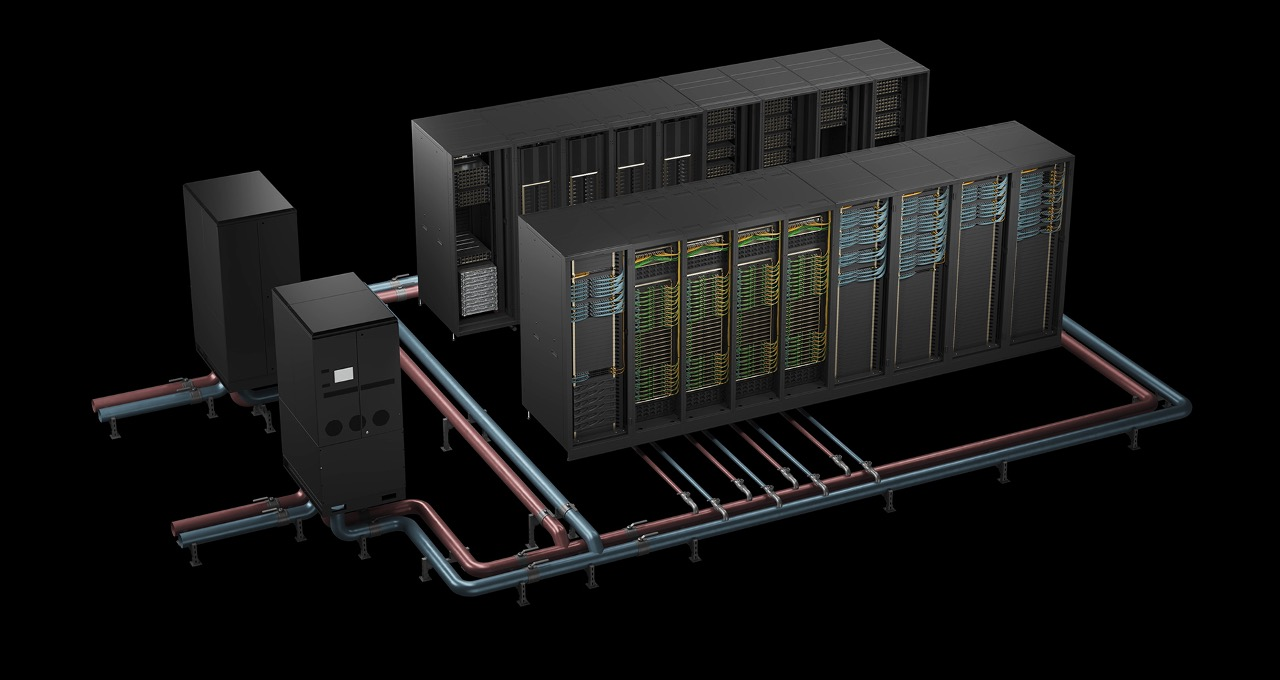
NVIDIA's next generation Rubin Ultra AI infrastructure is highlighting one of the industry's biggest challenges: delivering enough electricity to power increasingly dense computing systems. The company's original Kyber rack concept, showcased at GTC 2025, targeted approximately 600 kW of power consumption per cabinet, nearly 5 times the requirements of a Blackwell NVL72 system. While the design promised substantial AI computing performance, it also exposed limitations in existing data center electrical and cooling infrastructure.
The original Kyber concept was designed to accommodate 576 Rubin Ultra GPUs within a single liquid cooled cabinet. However, NVIDIA has since revised its architecture. According to the company's updated Vera Rubin documentation, the NVL576 configuration now distributes 576 GPUs across 8 racks, while Kyber NVL144 supports 144 GPUs per cabinet. Consequently, the original 600 kW figure represents an earlier design target rather than a confirmed power specification for the revised systems.
| NVIDIA Platform | GPU Configuration | Power Requirement |
|---|---|---|
| Blackwell GB200 NVL72 | 72 GPUs per rack | Approximately 120 to 130 kW |
| Blackwell GB300 NVL72 | 72 GPUs per rack | Approximately 132 to 142 kW |
| Original Rubin Ultra Kyber | 576 GPUs per rack | Approximately 600 kW |
| Updated Rubin Ultra NVL576 | 576 GPUs across 8 racks | Not confirmed |
| Updated Kyber NVL144 | 144 GPUs per rack | Not confirmed |
Power distribution is becoming as important as GPU performance. Traditional data centers were not designed to supply hundreds of kilowatts to individual cabinets, particularly when existing 54V electrical systems require substantial copper wiring and complex power conversion equipment. NVIDIA is addressing these limitations through its 800V DC architecture, designed to improve electrical efficiency, reduce current requirements, and support higher computing densities.
Manufacturing also presents challenges. In July 2026, industry reports suggested that NVIDIA's Kyber NVL144 could slip to 2028 because of difficulties producing its advanced PCB midplane. NVIDIA maintained that its broader roadmap remained intact, although final production schedules and updated power requirements have not been confirmed.
As AI infrastructure continues expanding, electricity availability, cooling capacity, and semiconductor manufacturing resources could become significant limitations. These investments also create additional competition for components, particularly memory, potentially affecting the broader PC hardware market.NVIDIA's Rubin Ultra ambitions demonstrate that increasing GPU performance is no longer enough. Data centers must also provide the electricity, cooling, and infrastructure necessary to operate increasingly powerful AI accelerators.
While 800V DC power distribution represents an important technological advancement, the growing resource requirements of AI infrastructure raise concerns about sustainability and consumer hardware availability. With AI demand already placing pressure on memory production and component prices, the industry should prioritize efficiency rather than pursuing higher computing performance at any cost.
Future innovation should improve performance without making essential computing hardware increasingly inaccessible to consumers and PC gamers.
Will electricity and cooling become bigger limitations for AI development than GPU manufacturing, and should NVIDIA prioritize efficiency over increasingly powerful hardware?
