
NVIDIA RTX PRO 4500 Blackwell Server Edition Debuts With 10,496 Cores, 32 GB GDDR7 and a Single Slot Design
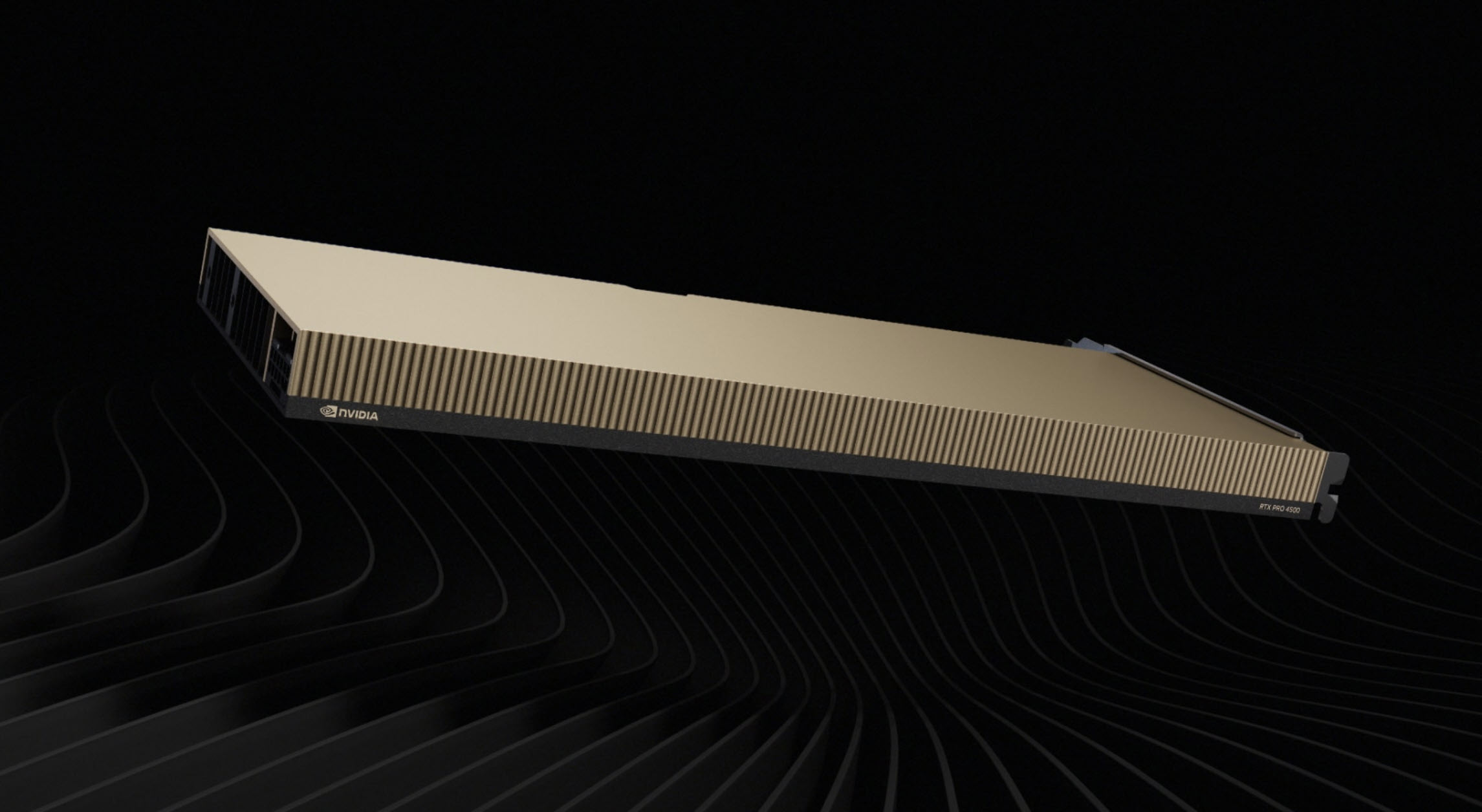
NVIDIA has officially expanded its enterprise GPU portfolio with the RTX PRO 4500 Blackwell Server Edition, a new data center and edge focused accelerator that brings Blackwell architecture into a compact single slot form factor. According to NVIDIA’s official product page, the card is available now and is positioned as a power efficient multi workload accelerator for enterprise AI inference, data science, video, and visual computing deployments across the data center, edge, and cloud.
The headline specifications are strong for the size class. NVIDIA lists the RTX PRO 4500 Blackwell Server Edition with 10,496 CUDA cores, 82 RT cores, 1.6 PFLOPS of FP4 Tensor performance, 811 TFLOPS of FP8, 406 TFLOPS of FP16 and BF16, 203 TFLOPS of TF32, 51 TFLOPS of FP32, and 154 TFLOPS of peak ray tracing performance. That makes this a notable step up for companies that need serious accelerated compute in denser server environments where power and slot efficiency matter just as much as raw performance.
Memory is another major part of the pitch. NVIDIA equips the card with 32 GB of GDDR7 on a 256 bit interface, delivering 800 GB/s of memory bandwidth. For enterprise workloads, that amount of memory inside a compact server GPU can be especially useful for smaller language model inference, vision AI, vector databases, analytics, and mixed AI plus graphics deployments, all without stepping into much larger and more power hungry accelerator categories.
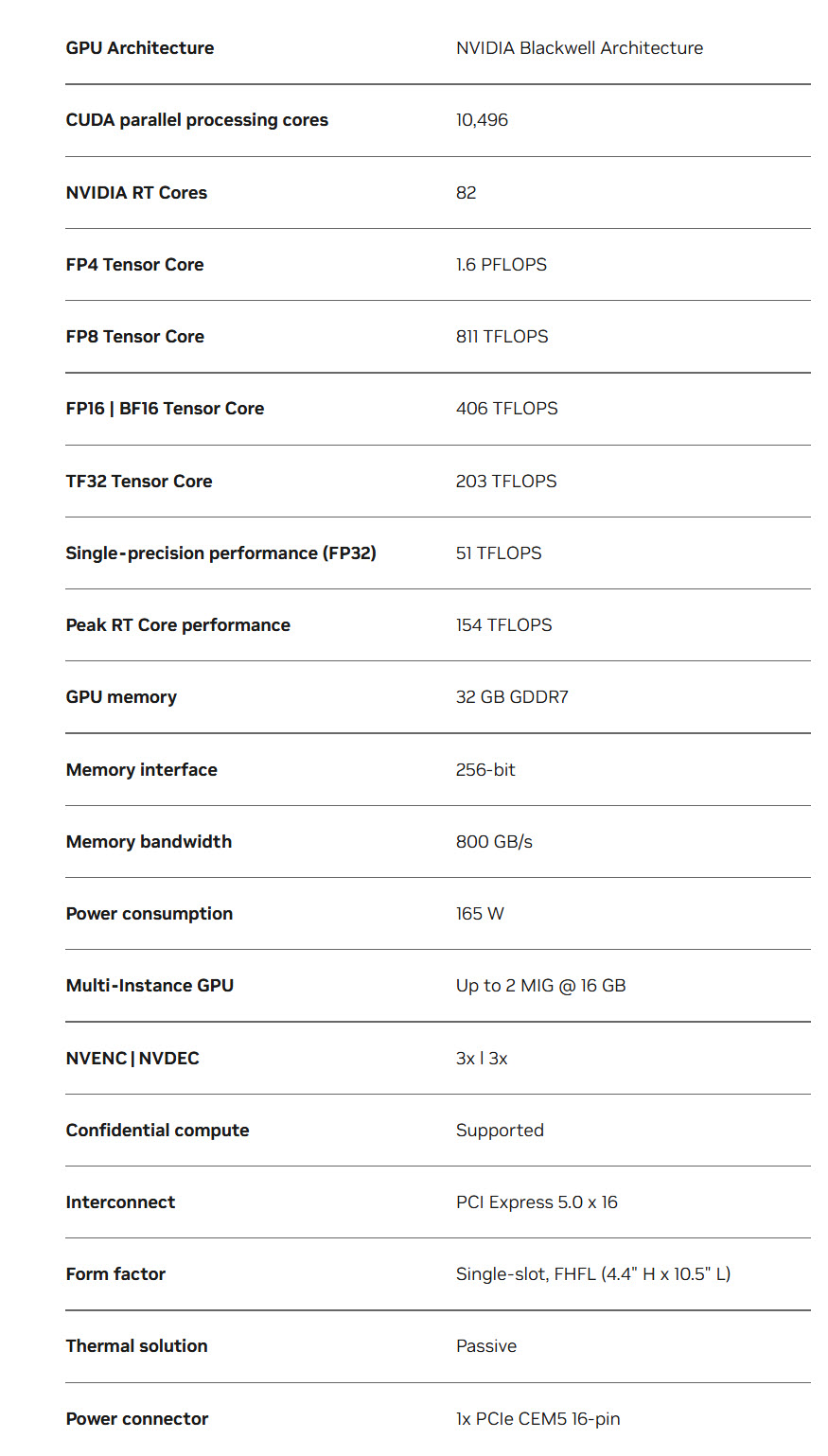
The physical design is arguably the most important part of the story. NVIDIA says the RTX PRO 4500 Blackwell Server Edition runs at just 165 W, uses a single slot FHFL form factor, relies on a passive thermal solution, and is powered through 1 PCIe CEM5 16 pin connector. In practical terms, this gives system builders a much more flexible option for mainstream enterprise servers, especially in scenarios where maximizing GPU count per chassis or supporting edge deployments is more valuable than chasing the absolute largest accelerator possible.
NVIDIA is also enabling a level of partitioning that should help multi tenant enterprise use cases. The company says the card supports Multi Instance GPU, with up to 2 isolated 16 GB instances, each with its own memory, cache, and compute allocation. That is an important detail for virtualization, shared enterprise infrastructure, and service environments where a single card may need to support multiple users or workloads at the same time while maintaining predictable quality of service.
On workload positioning, NVIDIA is clearly targeting a broad range of enterprise scenarios rather than only traditional rendering or graphics. The company highlights up to 50x higher performance for vector databases and up to 100x higher performance for vision AI understanding compared with CPU only systems, while also emphasizing lower server footprint and energy consumption. That positioning makes the RTX PRO 4500 Blackwell Server Edition look less like a niche graphics card and more like a universal acceleration option for modern enterprise infrastructure.
The bottom line is that NVIDIA is filling an important gap in its Blackwell lineup. Not every enterprise deployment needs a massive multi slot accelerator with extreme power draw. For many organizations, a 32 GB, 165 W, single slot GPU with over 10,000 CUDA cores may actually be the more strategic product, especially for AI inference, data pipelines, video intelligence, and edge servers where density and efficiency drive the buying decision as much as absolute peak throughput. For buyers and builders looking for a more practical Blackwell era server GPU, the RTX PRO 4500 Blackwell Server Edition looks positioned to be a very interesting option.
Do you think single slot enterprise GPUs like the RTX PRO 4500 will become the real sweet spot for AI inference and edge deployment, or will larger accelerators continue to dominate most enterprise builds?
