
NVIDIA RTX 5090 GPUs Are Being Dismantled in China and Rebuilt Into AI Accelerators
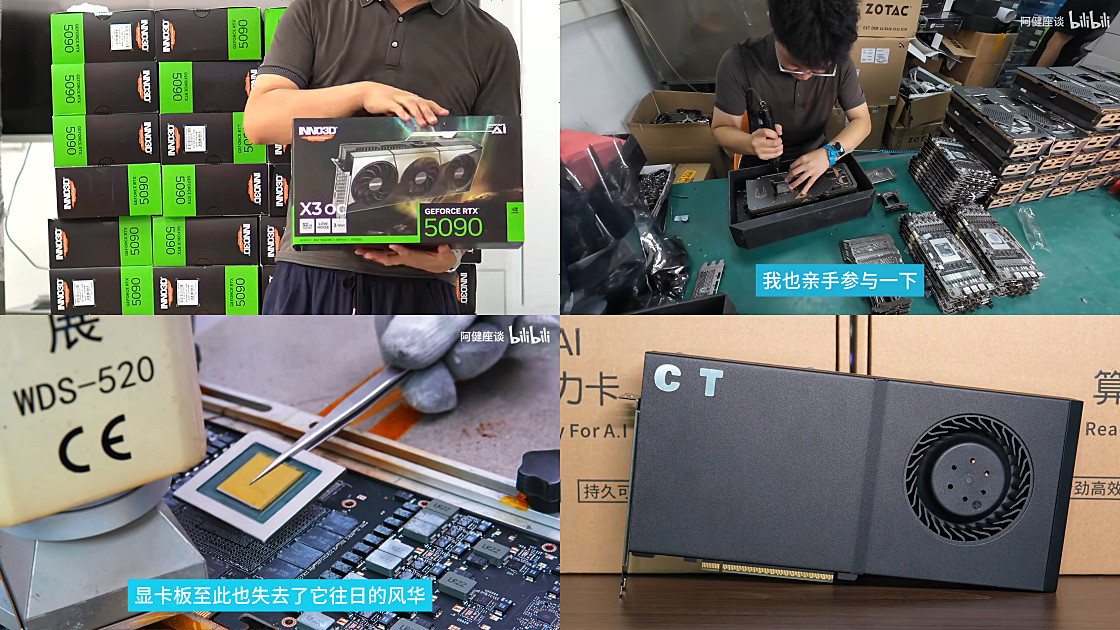
NVIDIA's GeForce RTX 5090 is increasingly finding its way into China's artificial intelligence industry instead of gaming PCs, with newly surfaced footage revealing large scale facilities converting consumer graphics cards into dedicated AI accelerators. The operations involve removing the flagship Blackwell GB202 GPU and 32GB of GDDR7 memory from retail graphics cards before transplanting them onto custom circuit boards designed for high density AI servers.
The footage, shared on October 23 by Hong Kong hardware publication HKEPC and documented by VideoCardz, shows hundreds of RTX 5090 graphics cards entering an organized modification process. The inventory includes models from ASUS, Gigabyte, PNY and NVIDIA Founders Edition, with workers systematically dismantling the original cooling assemblies, removing GPU and memory components, and installing them onto specialized PCBs.
The modified cards replace conventional gaming cooling solutions with compact dual slot blower coolers, allowing multiple GPUs to operate inside server chassis where space and airflow requirements differ considerably from gaming desktops. The completed boards reportedly undergo testing before being packaged for deployment in AI computing environments.
RTX 5090 Gaming vs Modified AI Configuration
| Specification | Retail RTX 5090 | Modified AI RTX 5090 |
|---|---|---|
| GPU | NVIDIA GB202 Blackwell | Reused GB202 Blackwell |
| Memory | 32 GB GDDR7 | 32 GB GDDR7 |
| PCB | Original manufacturer design | Custom server oriented PCB |
| Cooling | Gaming oriented cooling | Dual slot blower |
| Primary Application | Gaming, creation and AI | AI inference and computing |
| Multi GPU Deployment | Limited by card dimensions | Optimized for dense installations |
| Warranty | Manufacturer coverage | Unverified |
The reported conversions retain the original GPU and memory. Claims of 64GB or 96GB RTX 5090 modifications have not been independently validated with publicly demonstrated working hardware.
The discovery comes amid persistent concerns about RTX 5090 availability and discontinuation rumors. Despite reports suggesting that NVIDIA had stopped manufacturing its flagship gaming GPU, Senior Vice President Jeff Fisher explicitly denied those claims on October 16, confirming that the company intends to continue shipping RTX 5090 cards despite supply constraints.
【太精彩了吧 😱】近日,社交媒體 X 上流出多段顯示卡改裝工場內部影片,可以看到大量 GeForce RTX 5090 頂級遊戲顯示卡並未流向一般消費級零售市場,而是被整批運往大型改裝工廠。廠內工人在具備完整流水線的作業環境下,進行大規模拆解與改裝,將原本針對電競設計的三風扇散熱架構全數替換為 Dual Slot 渦輪散熱器,以符合 AI 伺服器機箱的高密度排列需求。 https://t.co/2wzPmweU3s 從曝光的工廠現場畫面可見,流水線工作枱上堆滿了來自各大廠商的 GeForce RTX 5090 零售彩盒包裝與全新裸卡,甚至連 NVIDIA 自家 GeForce RTX 5090 FE 也有。工人正以熟練的工序,迅速卸除原廠龐大的風扇與散熱鰭片模組,將完整的 PCB 電路板分離出來。隨後,GPU 與 VRAM 會被「吹」出來移植至另一片 PCB 上,再統一換裝上厚度僅有 2-Slot 的厚銅底座渦輪鼓風散熱系統。 改裝完畢後,廠方隨即將顯示卡送往專門的測試檢驗產線。在多組相連的開放式測試平台上,數十張已換裝渦輪散熱器的顯示卡正同步運行圖形效能負載與穩定性跑分測試,確保每張改裝後的繪圖卡皆能正常運作。通過嚴格檢測的顯示卡將被分層整齊陳列並重新裝箱,準備直接交付給相關客戶,流程非常專業。 傳統消費級高階顯示卡通常採用三風扇大型散熱設計,厚度普遍佔用 3 至 4 個插槽,且出風方向為機箱內部側吹,難以在 4U 伺服器或多卡並聯環境中並排安裝。換裝雙槽渦輪散熱系統後,散熱器能利用鼓風風扇將廢熱直接排出機箱後方,大幅提升多卡伺服器內部的散熱效率與空間相容性。 面對 AI 運算需求持續殷切,在算力緊缺的情況下,GeForce RTX 5090 遊戲顯示卡依然是 AI 算力市場的熱門替代品。目前,GeForce RTX 5090 售價已經被炒上接近一萬美元水平,這個價位遊戲玩家根本無力負擔。
— HKEPC (@hkepcmedia) October 23, 2026
The situation is particularly controversial because the full RTX 5090 is subject to United States export restrictions affecting China. Although the footage demonstrates substantial inventories undergoing modification, it does not establish how the cards entered the country, their original distribution channels or whether NVIDIA has any knowledge of the operations.
This is not an isolated development. Similar blower style conversions involving other RTX 50 Series graphics cards have previously emerged, highlighting growing commercial demand for consumer Blackwell GPUs in AI computing.
With RTX 5090 retail availability already constrained and some marketplace asking prices approaching $10,000, the diversion of additional inventory toward AI infrastructure could further intensify competition between gamers and AI developers. However, the footage does not establish the total number of cards being converted or their measurable impact on global retail supply.
The large scale conversion of RTX 5090 graphics cards highlights a significant shift in GPU economics. A product designed primarily for enthusiast gaming has become valuable enough for specialized companies to dismantle its original hardware and rebuild it for AI deployment.
From a technical perspective, the process demonstrates the flexibility of NVIDIA's Blackwell architecture, but it also exposes growing pressure on the consumer GPU market. With 32GB of GDDR7 memory and substantial AI computing capabilities, the RTX 5090 remains attractive for local LLM inference and other accelerated workloads.
The biggest concern is availability. Even if NVIDIA continues manufacturing the RTX 5090, growing demand from AI infrastructure operators could leave fewer cards available at reasonable prices for gamers. However, blaming these conversion operations for the entire shortage would overlook manufacturing constraints, distribution practices and broader market demand.
Do you think NVIDIA should prioritize keeping GeForce RTX 5090 graphics cards available to gamers, or is repurposing consumer GPUs into AI accelerators simply an inevitable consequence of growing AI demand?
