
NVIDIA has released the model weights for Nemotron Labs Image 30B A3B, an autoregressive AI image generator featuring 30 billion total parameters and only 3 billion active parameters per token. Available through Hugging Face, the model represents another expansion of NVIDIA's visual AI ecosystem, with its broader framework outperforming OpenAI's GPT Image 2 and Google's Nano Banana Pro in selected benchmarks.
Built upon Nemotron 3 Nano, the model utilizes NVIDIA's hybrid Nemotron H architecture, combining Mamba 2 state space layers with traditional attention mechanisms and a Mixture of Experts (MoE) design. Unlike conventional diffusion models, NVIDIA's solution generates discrete visual tokens sequentially before converting them into images through a dedicated visual tokenizer containing approximately 642 million parameters and a vocabulary of 196,560 visual tokens.

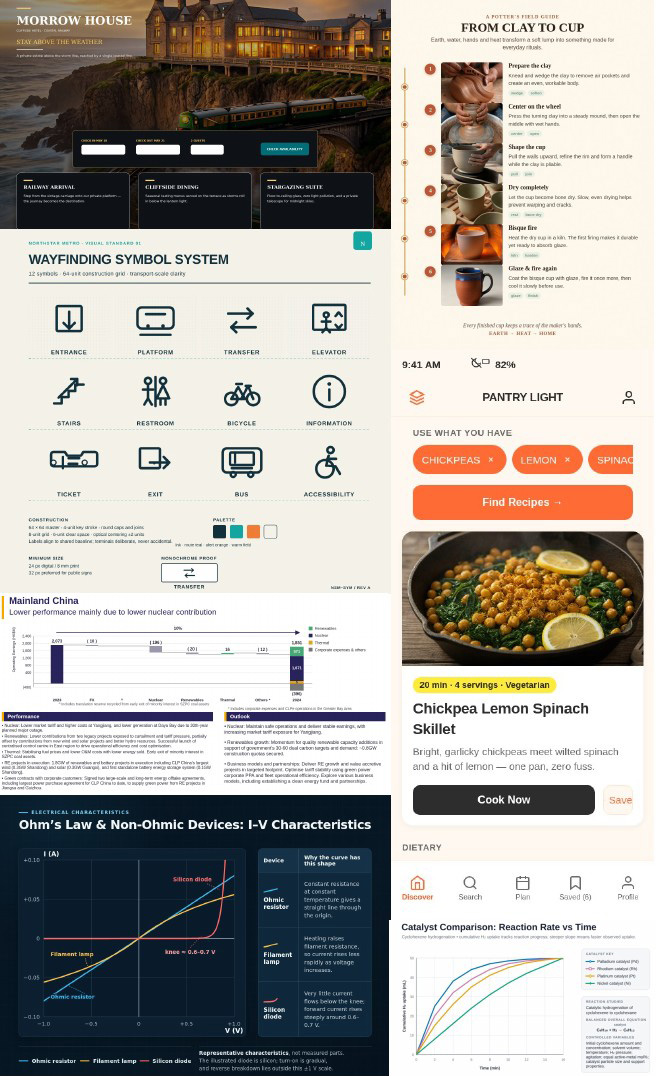
The model serves as the raster image generation component of NVIDIA's broader Nemotron Labs VisualCreation framework, introduced in its Pixel as Code technical report. The framework combines image generation with agentic reasoning, visual inspection, and structured code generation, enabling the creation of illustrations, infographics, presentations, webpages, and editable visual documents.
| Specifications | Nemotron Labs Image 30B A3B |
|---|---|
| Total Parameters | 30B |
| Active Parameters | 3B |
| Architecture | Hybrid Mamba and Transformer MoE |
| Generation Method | Autoregressive |
| Visual Tokenizer | 642M parameters |
| Visual Vocabulary | 196,560 tokens |
| Context Length | 262,144 tokens |
| Native Precision | BF16 |
| Recommended Resolution | 1024 x 1024 |
| Additional Resolutions | 1184 x 880, 1248 x 832, 880 x 1184 |
| Official Inference Configuration | 4x NVIDIA H100 80 GB |
| Software | PyTorch, Transformers, vLLM |
| License | Noncommercial research and evaluation |
NVIDIA reports significant improvements in visual tokenization efficiency compared with Emu3.5, achieving 7.13x faster encoding and 10.93x faster decoding on an NVIDIA A100 GPU. However, these improvements apply specifically to the tokenizer rather than the complete image generation process.
The company's published benchmarks also demonstrate substantial improvements when the image generator is combined with additional reasoning and visual inspection models.
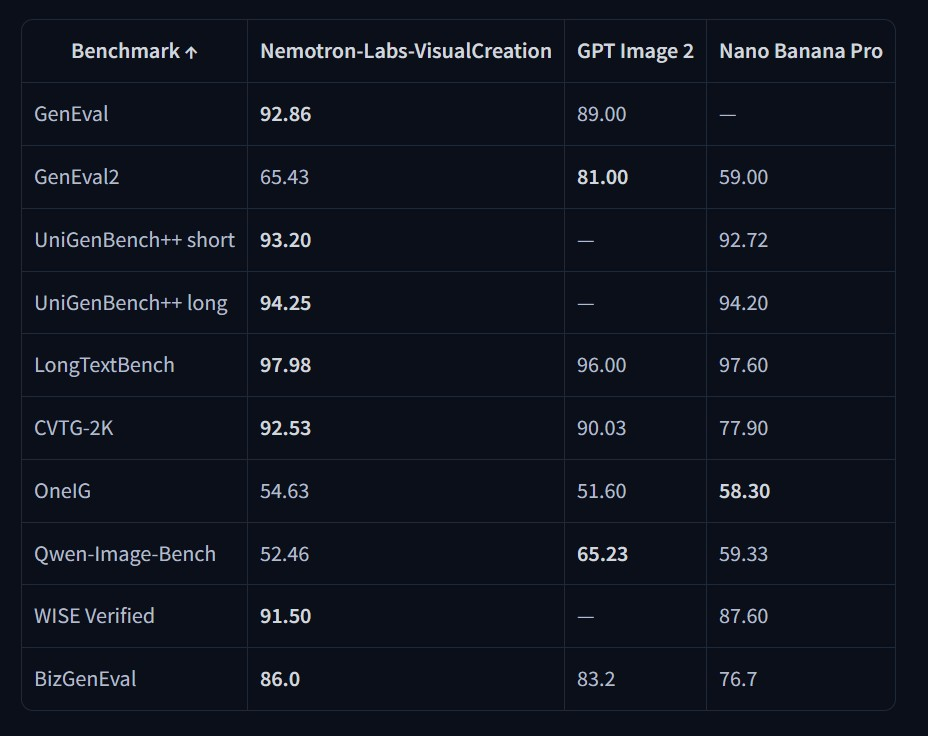
Importantly, NVIDIA's strongest benchmark results were achieved using its complete VisualCreation framework with GPT 6 assistance, rather than the standalone image generator currently available for download. The VisualCreation orchestration software and VisionCode models remain pending legal clearance.
For local AI enthusiasts, the 3B active parameter architecture reduces computational requirements but does not eliminate the memory requirements of storing the complete 30B model. At BF16 precision, 30B parameters alone represent approximately 60 GB of memory before accounting for the tokenizer, runtime allocations, and other overhead. Quantization could substantially improve accessibility across consumer graphics cards, complementing NVIDIA's expanding local AI ecosystem across RTX and DGX hardware.
However, the current NVIDIA license restricts usage to noncommercial research and evaluation, limiting its practical adoption among independent creators and professional studios.
NVIDIA's Nemotron Labs Image represents an interesting alternative to conventional diffusion based image generation, particularly as autoregressive architectures continue to improve visual reasoning, typography, and composition.
However, releasing downloadable model weights under a restrictive research license should not be confused with providing a fully open source alternative. NVIDIA should prioritize broader commercial licensing, consumer GPU optimization, and accessible quantized versions to enable independent creators to run these technologies locally without relying on expensive enterprise hardware or cloud subscriptions.
The future of AI should empower consumers to use their personally owned hardware, with greater software freedom, privacy, and creative control.
Would you consider running NVIDIA's Nemotron image generator locally if optimized versions became available for graphics cards with 16 GB or 24 GB of VRAM, or would its restrictive license prevent you from adopting it?
