
NVIDIA Pauses AI Cloud Credit Deals as Antitrust Concerns Surface
NVIDIA has reportedly paused parts of a recently introduced financing program that provided credit support to smaller AI cloud companies in exchange for a share of their future revenue, following internal concerns that the structure could attract antitrust scrutiny. According to Reuters, NVIDIA stepped back from some agreements less than 2 months after launching the initiative, although the broader program has not been cancelled and could be redesigned or incorporated into another financing model.
NVIDIA introduced the business model in July as a way to help emerging AI cloud providers finance increasingly expensive GPU infrastructure. Under the original NVIDIA AI Compute partnership model, participating companies purchase NVIDIA infrastructure while NVIDIA provides credit support and commits to portions of available cloud capacity. NVIDIA can then earn revenue from the original hardware sale while also receiving a share of revenue generated when that computing capacity is rented to other customers. Sharon AI and Firmus were among the first participants, with Sharon AI planning deployments of up to 40,000 Grace Blackwell GB300 GPUs and Firmus targeting as many as 170,000 NVIDIA GPUs at an AI factory campus in Batam, Indonesia.
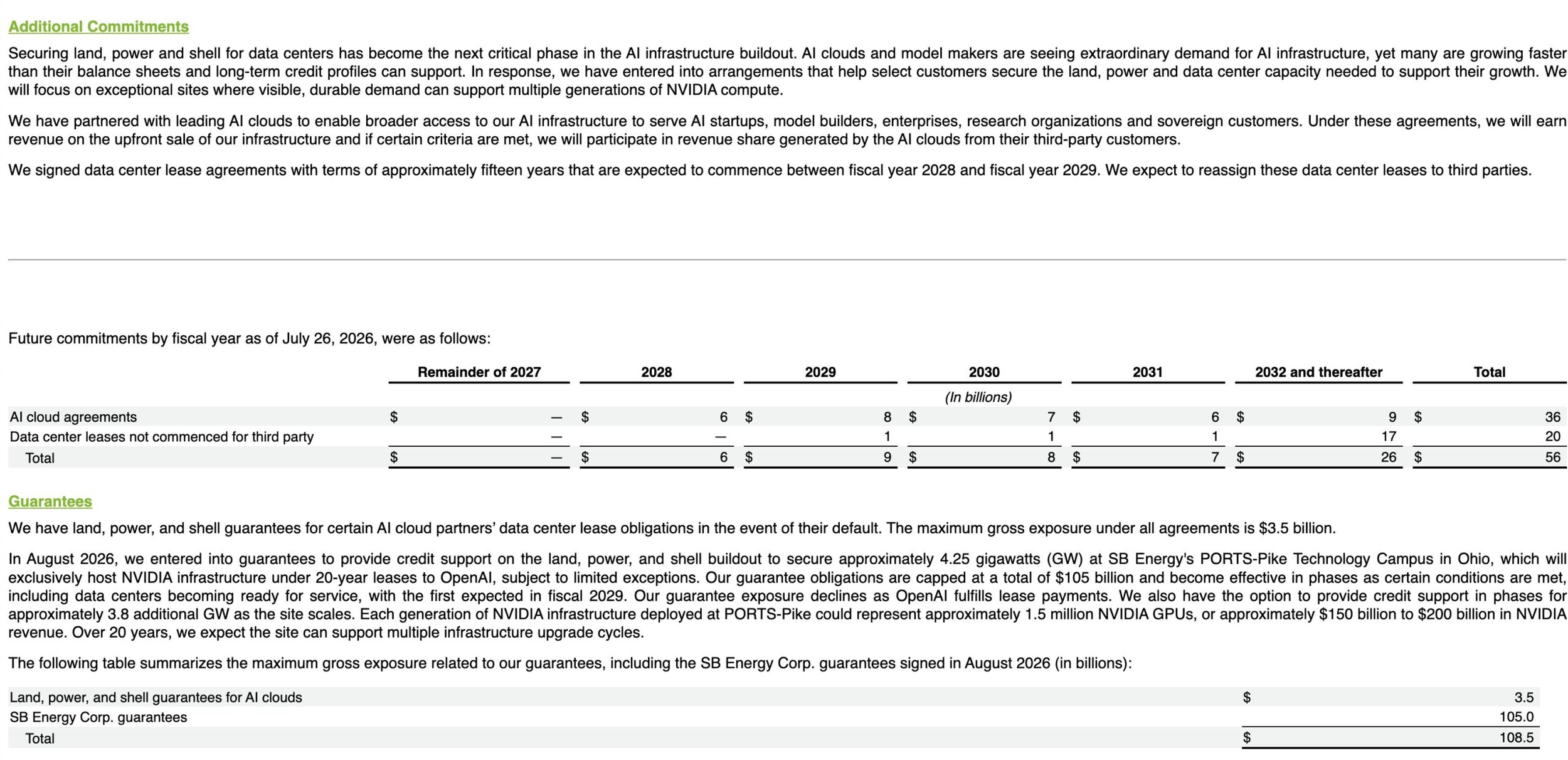
NVIDIA's latest regulatory filing provides additional context around the scale of these arrangements. As of July 26, 2026, the company had approximately $36 billion in commitments associated with selected AI cloud partners, with agreements typically lasting around 6 years. NVIDIA explained that participating cloud providers can redirect capacity toward third party customers when more favorable opportunities become available, reducing NVIDIA's own commitments as external utilization increases. The company can also receive a portion of revenue generated from qualifying third party customers.
The reported concern centers on how much influence NVIDIA can exercise over businesses that are simultaneously buying its GPUs, receiving its financial support and operating cloud capacity backed by NVIDIA commitments. Employees reportedly raised concerns about restrictions involving customer selection and how participating providers could distribute their computing capacity, creating potential questions around competition as NVIDIA already holds a dominant position in AI accelerator hardware. The pause does not mean regulators have formally ruled that the program violates antitrust law, and no such finding has been announced. Instead, the concern appears to be preventative as NVIDIA evaluates how the model should operate under increasing scrutiny.
NVIDIA maintains that the broader strategy remains active. The company has said its model for expanding access to AI computing continues to evolve in response to strong demand, while its financial involvement across the AI infrastructure market is becoming considerably larger. NVIDIA recently disclosed agreements with major capital providers intended to mobilize more than $500 billion in third party financing for AI infrastructure, alongside separate guarantees connected to projects including OpenAI's enormous Ohio data center expansion.
The situation highlights the increasingly unusual position NVIDIA occupies in the AI economy. It is not only the primary supplier of many of the accelerators powering AI clouds, but is also becoming an investor, infrastructure partner, customer and financial backstop for companies purchasing those systems. At the same time, demand from established hyperscalers remains enormous, with AWS preparing to expand its NVIDIA deployment beyond 3 million GPUs. NVIDIA therefore has substantial incentives to continue expanding financing options for smaller cloud providers while ensuring those arrangements do not create additional regulatory exposure.
NVIDIA's financing strategy solves a real problem for the AI industry. Smaller cloud providers may have customers ready to consume GPU capacity but still struggle to secure billions of dollars required for data centers, power and accelerator purchases. NVIDIA stepping in can accelerate those deployments while creating another source of recurring revenue beyond hardware sales.
The complication is that NVIDIA already sits at the center of the AI compute market. When the same company sells the GPUs, supports financing, guarantees capacity and potentially influences how that capacity is sold, the commercial relationship becomes considerably more complex. Pausing some agreements before those questions turn into a larger regulatory issue is therefore a logical move, but NVIDIA is unlikely to abandon infrastructure financing entirely while AI compute demand remains this strong.
Should NVIDIA continue financially supporting smaller AI cloud providers, or does its position across hardware, financing and cloud capacity give the company too much influence over the AI infrastructure market?
