
Microsoft DirectStorage 1.4 Adds Zstandard to Push Faster Game Load Times and Smoother Asset Streaming on Windows

Microsoft has officially released the public preview of DirectStorage 1.4, introducing Zstandard, also known as Zstd, as a new compression option for game assets on Windows. According to Microsoft’s official announcement, the update is designed to improve compression efficiency, accelerate load times, and support smoother asset streaming in content heavy games. The company also confirmed that the new release is available now through the official DirectStorage 1.4 developer announcement and the preview package on NuGet.
The addition of Zstandard is a meaningful step for PC gaming because DirectStorage has always been about reducing bottlenecks between fast NVMe storage and the GPU. Microsoft says it evaluated codecs based on compression ratio, decompression performance, hardware and software availability, and real world adoption, and concluded that Zstd offered the right balance across all four areas. In practical terms, that means Microsoft is not just adding another checkbox feature. It is standardizing around an open and already widely adopted compression format that could become a stronger long term foundation for Windows game asset delivery.
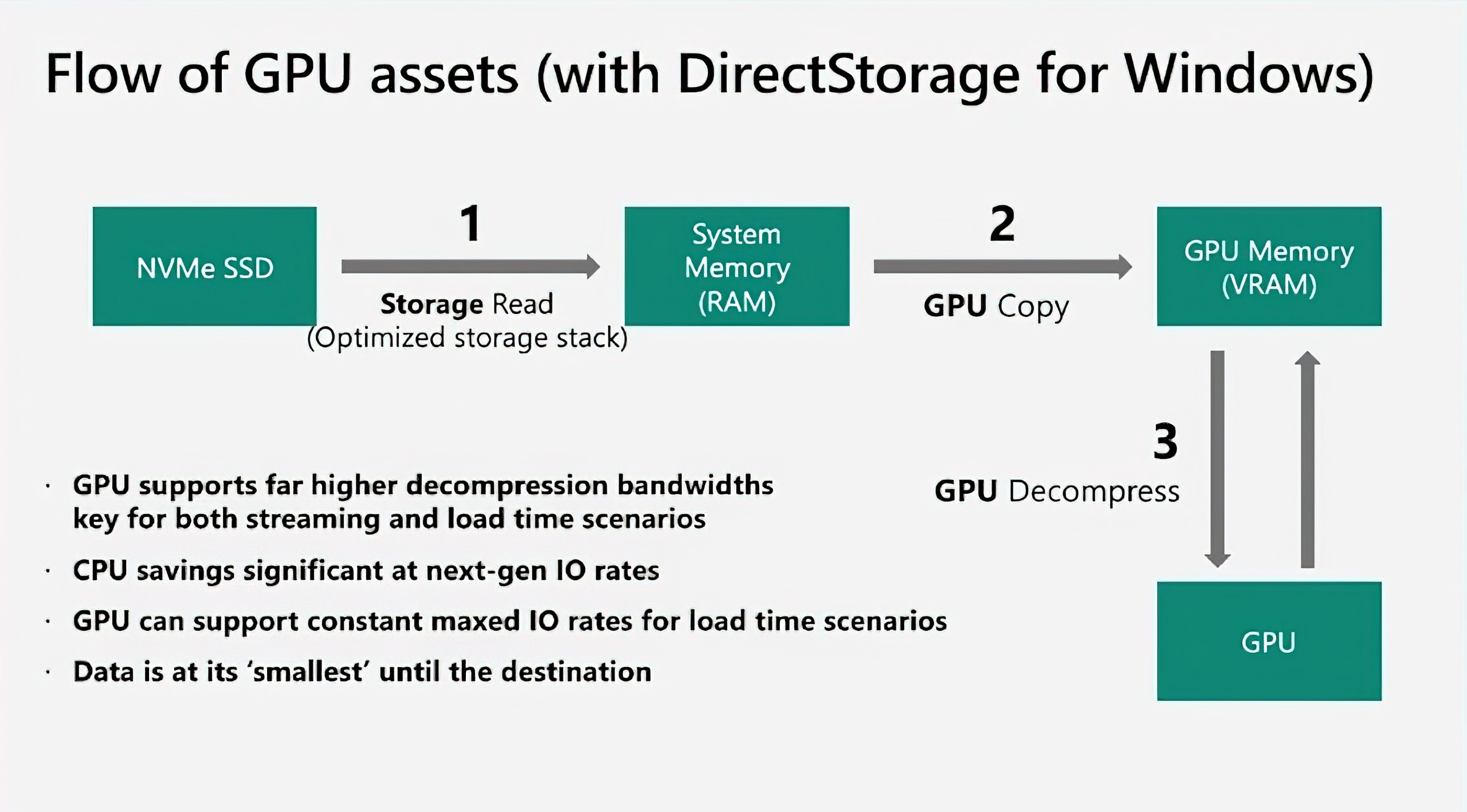
One of the most important technical points in this release is that Zstd support is being added to DirectStorage’s multi tier decompression framework with both CPU and GPU decompression support. That matters because it gives developers flexibility right now while GPU vendors continue building deeper platform specific optimizations. In other words, developers can begin evaluating the feature immediately without waiting for every future driver level enhancement to arrive first. Microsoft also says the initial release is meant to help studios start testing Zstd with minimal disruption to their existing build and content pipelines.
Microsoft is also making this a broader ecosystem push rather than a single vendor feature. The company said it is co engineering DirectStorage 1.4 Zstd support with AMD, Intel, NVIDIA, and Qualcomm. Microsoft’s blog includes public statements from each of those partners, with AMD saying public GPU optimizations are planned for the second half of 2026, NVIDIA saying GeForce RTX focused decompression optimizations are also coming in the second half of 2026, Qualcomm saying tuned driver updates are expected before the end of 2026, and Intel saying it will share tuned performance improvements in the coming months. That level of cross vendor alignment is one of the strongest signals in the announcement because it suggests Microsoft wants Zstd in DirectStorage to become a broadly supported PC gaming standard rather than a niche technical option.
Another notable piece of the rollout is Microsoft’s decision to open source its Zstd GPU decompression compute shader through the DirectStorage GitHub project. The company describes this shader as an early working baseline that GPU vendors can reference as they build their own implementations. Microsoft also notes that the shader is still in development and is initially optimized for content chunked to 256KB or smaller, which aligns with modern packaging patterns used in streaming heavy game workloads. That detail is important because it shows this is not just a software update aimed at legacy loading behavior. It is also designed for the kind of fine grained streaming pipelines that modern open world and high asset density games increasingly rely on.
From an industry angle, this is one of the more practical PC gaming infrastructure updates Microsoft has released in a while. DirectStorage itself has long promised faster access to assets and better use of modern SSD bandwidth, but the actual content pipeline and compression layer are just as critical to the end result. By adding an open compression standard with both CPU and GPU decompression support, Microsoft is giving developers another way to reduce friction in the asset path and prepare for richer worlds, heavier texture streaming, and more seamless scene transitions. The bigger story here is not just “faster load times.” It is that Microsoft is continuing to modernize the full chain between storage, decompression, and rendering for Windows games. This last point is an inference based on Microsoft’s published design goals and partner support statements.
The early state of the release also means expectations should stay realistic. This is still a public preview, not a final mature rollout with every hardware vendor optimization already in place. Real world gains will depend on how developers package assets, how engines integrate the workflow, and when the coming GPU driver optimizations actually land across vendors. Still, the foundation Microsoft is laying here looks strategically strong, especially because it combines an open format, ecosystem wide collaboration, and a reference implementation that developers and hardware makers can build around.
For PC gamers, the immediate impact may not show up overnight, but this is exactly the kind of update that can quietly improve the next wave of Windows games. As more studios adopt modern storage pipelines and tune around DirectStorage 1.4, the long term benefits could show up in shorter load waits, fewer streaming hitches, and more ambitious world design without the same decompression overhead that has limited asset flow in the past.
What do you think about Microsoft’s move here, could Zstandard become the compression standard that finally helps DirectStorage make a bigger difference in real world PC gaming?
