
Memory Shortages Could Last Into H2 2027 as AI Demand Keeps Tightening DRAM Supply

The global memory crunch may have a much longer runway than many buyers hoped. According to a Counterpoint Research summary shared via Jukan on X, DRAM shortages could persist until the second half of 2027, with the possibility of extending even further if supply remains constrained and AI driven demand continues accelerating. Recent market reporting also shows that the pressure is not theoretical. Multiple industry sources now describe memory pricing as being in a severe upcycle, with server DRAM and PC DRAM both seeing unusually sharp increases across 2026.
What is driving this is no longer just traditional PC or smartphone demand. The center of gravity has shifted toward AI infrastructure, where hyperscalers, GPU vendors, ASIC developers, and server builders are all competing for the same pool of DRAM and related memory capacity. HPE said this week that it expects elevated memory prices to persist into 2027, while analyst coverage ahead of Micron’s earnings pointed to DRAM prices potentially rising 171% in 2026 as hyperscaler spending keeps climbing.
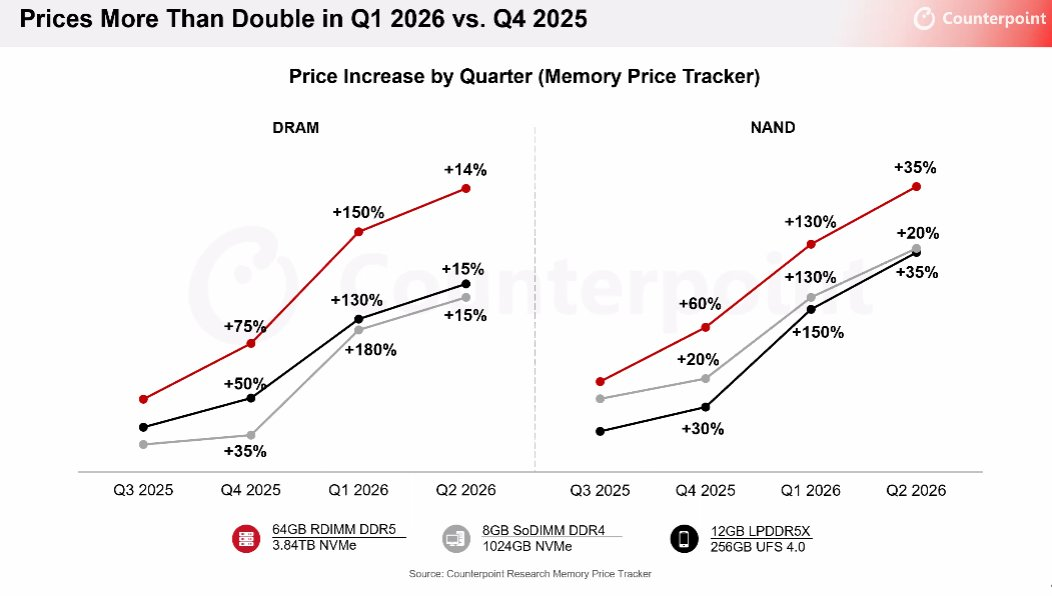
That broader market backdrop lines up with the Counterpoint view that shortages are being extended not just by demand growth, but by the type of demand now dominating the market. AI systems are not only consuming cutting edge memory products. They are also pulling in wider categories of supply, including server DRAM and even some legacy capacity, which limits how quickly the rest of the ecosystem can recover. Counterpoint’s own recent public materials also describe the memory market as a volatile capacity fight, with BOM pressure spreading beyond data center hardware into smartphones and PCs.
One of the more striking signals is pricing momentum. The Counterpoint summary shared by Jukan references memory product pricing rising by more than 180%, and while that exact figure is presented in the shared summary rather than a freely accessible full report, it matches the direction of broader market data showing extraordinary increases in both DRAM and NAND related pricing this year. Trend driven reporting this week also cited server DRAM price jumps of up to 90% in a single quarter and PC DRAM pricing that has more than doubled, reinforcing that the supply situation is worsening rather than easing.
The practical implication is that buyers should not plan around a near term normalization. Even if suppliers expand capacity, memory manufacturing does not rebalance overnight. Capacity additions take time, qualification takes time, and suppliers are still prioritizing segments with the highest margins and longest strategic value. In the current cycle, that means AI and data center customers continue to sit at the front of the line. This is an inference drawn from the supply prioritization trends described by Counterpoint, HPE, and recent market reporting.
For the broader tech market, this likely means continued pricing pressure on servers, PCs, smartphones, and storage products through the coming quarters. It also means that every next generation AI platform launch could tighten the market further, especially as memory per system keeps rising and supporting materials or logistics constraints create secondary bottlenecks. Recent reporting on helium supply risk and storage pricing pressure suggests that the memory problem is not isolated to DRAM alone, but part of a wider infrastructure squeeze tied to AI expansion.
At this point, the safer industry assumption is not that shortages will end soon, but that the market will remain structurally tight well into 2027 unless supply expansion meaningfully outpaces AI demand. Right now, there is little evidence that demand is slowing fast enough for that to happen.
Do you think the industry can realistically stabilize memory supply before H2 2027, or are we only at the beginning of a much longer AI driven shortage cycle?
