
Intel Xeon 698X Leak Signals 86 Cores, 508 MB Cache and Fresh Geekbench 6 Listing

Intel’s upcoming Xeon 600 series workstation lineup, often referred to as Granite Rapids WS, is continuing to surface through leaks and public benchmark entries. The latest spotlight is on the presumed flagship, the Xeon 698X, which is being positioned as an unlocked high end workstation part with headline core density and a massive cache pool.
A Geekbench 6 result has now appeared for an Intel reference platform labeled GNR WS, listing an Intel Xeon 698X with 86 cores and 172 threads. The entry also shows 336 MB of L3 cache and 2.00 MB of L2 cache per core, which totals 172 MB of L2 and 508 MB combined cache. The system reports roughly 251.32 GB of memory and ran Geekbench 6.5.0 for Linux using AVX2 on Ubuntu 24.04.3 LTS.
Geekbench scores landed at 2532 for single core and 21030 for multi core.
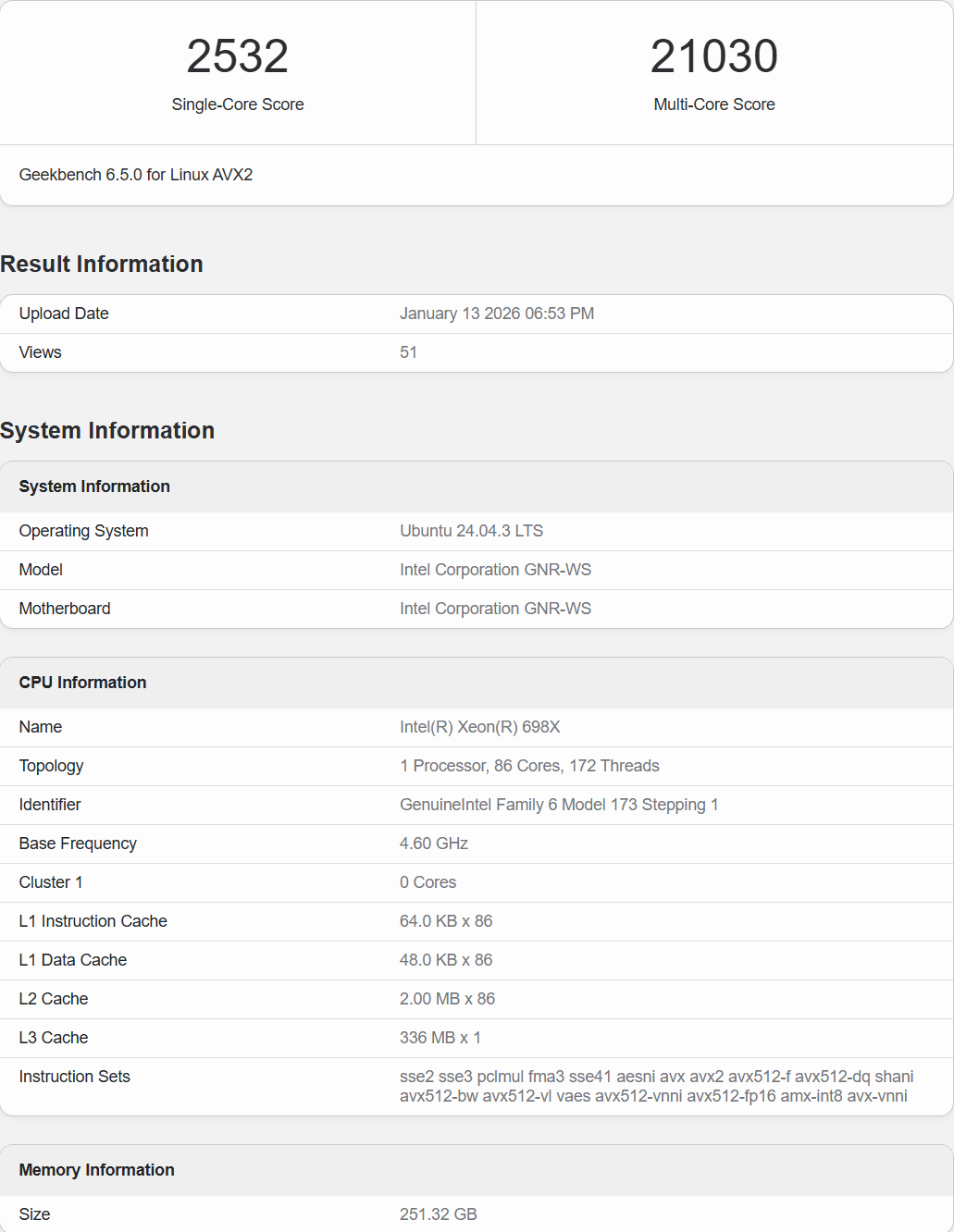
Leak chatter around Xeon 698X points to a base clock around 2.0 GHz with boost behavior up to roughly 4.60 GHz, built on Redwood Cove P cores, alongside a 350 W TDP. The Geekbench listing is interesting because it displays a 4.60 GHz base frequency field for the CPU. In practice, Geekbench frequency reporting can reflect how the platform is exposing clocks at that moment rather than a finalized retail base spec, so it is best treated as a signal, not a locked in product line statement.
[GB6 CPU] Unknown CPU
— Benchleaks (@BenchLeaks) January 13, 2026
CPU: Intel Core Ultra 9 290K Plus (24C 24T)
Min/Max/Avg: 4571/5791/5716 MHz
Codename: Arrow Lake
CPUID: C0662 (GenuineIntel)
Single: 3415
Multi: 23863https://t.co/4vORNR2UE8
Using the comparison you provided against the current Xeon W9 3595X, the generational delta looks meaningful on paper:
43.3% more cores
43.3% more threads
2.98x more L3 cache
43.3% more L2 cache
2.18x more total cache
35 W lower base TDP
200 MHz lower rated boost clock versus the listed W9 boost figure
If these specs hold, Intel is clearly prioritizing throughput and cache backed workstation performance, aiming at heavy parallel workloads where memory locality and cache capacity can move the needle.
The early Geekbench 6 numbers are not the best proxy for a monster core count CPU, because the benchmark does not always scale linearly once core counts get extreme. In this result, multi core performance looks modest for the core budget, which reinforces the need for additional benchmarks that better represent workstation buyer reality, such as compilation, rendering, simulation, content creation pipelines, and AI adjacent inference workloads.
For now, the key takeaway is pipeline momentum: an 86 core Xeon 698X is now appearing in public benchmark databases with the expected cache structure and platform labeling, which usually means validation is well underway and a broader SKU stack is not far behind.
Do you want Intel to optimize Granite Rapids WS for peak all core throughput, or would you rather see fewer cores with higher sustained clocks for creator workloads like editing, game dev builds, and mixed production tasks?
