
DLSS 5 Neural Rendering Runs on Intel Arc 140V Without CUDA
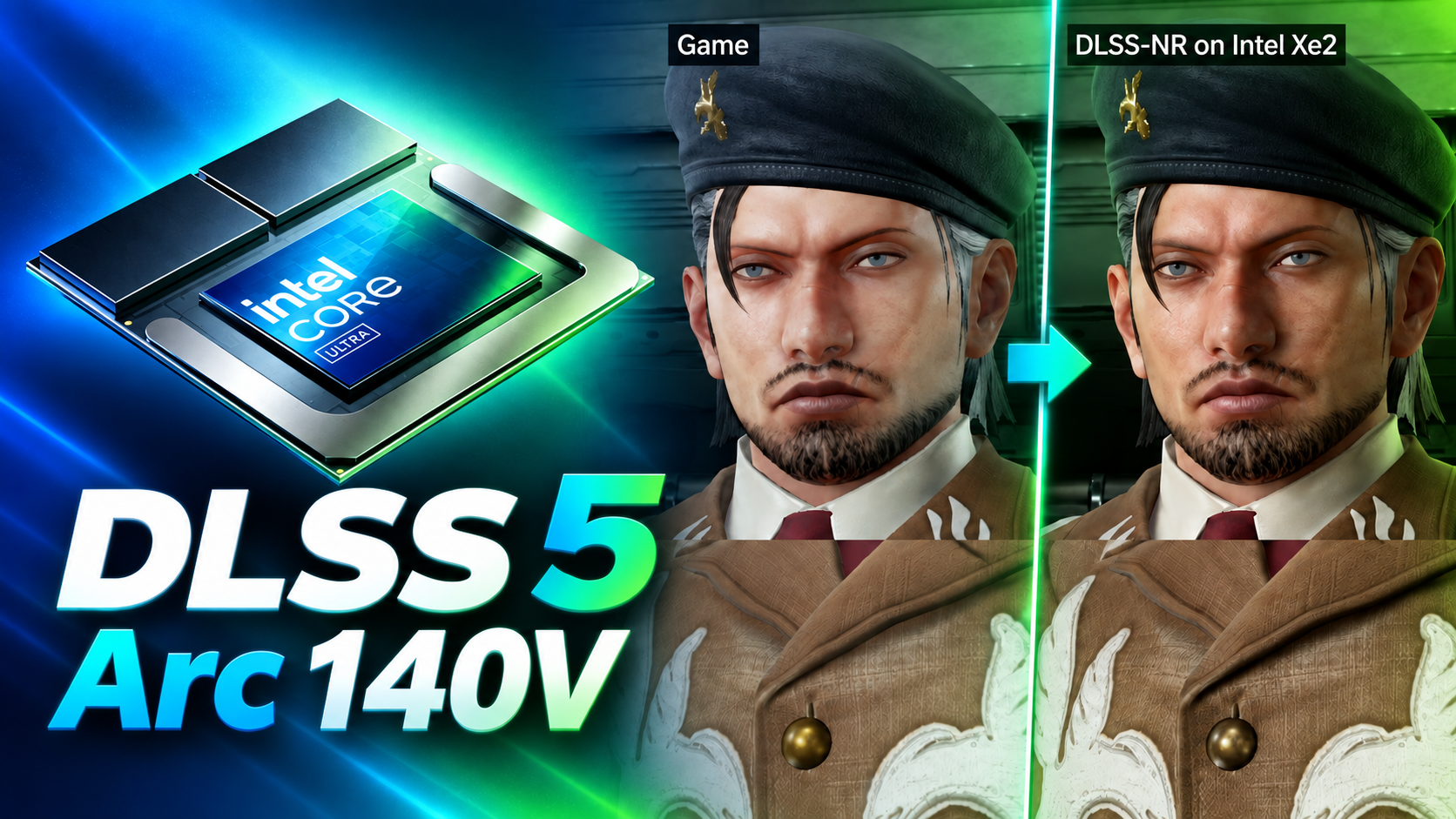
NVIDIA DLSS 5 Neural Rendering has now been demonstrated on Intel integrated graphics, with an independent project getting the technology running on an Arc 140V without NVIDIA hardware, CUDA, NGX, or NVIDIA execution libraries. The experiment is extremely slow and nowhere near practical gaming performance, but it provides another example of the Neural Rendering model being separated from the hardware environment NVIDIA officially designed it for.
The dlss nr on intel project targets the Arc 140V integrated GPU found in Intel Lunar Lake processors. Instead of attempting to reproduce the complete DLSS software stack, it independently rebuilds the DLSS 5 Neural Rendering inference pass and executes its 71 block neural network through Intel XMX matrix hardware using Vulkan cooperative matrix instructions. The implementation currently operates under Linux and can also process Windows games running through Proton.

That distinction is important. This does not mean Intel Arc GPUs have gained official DLSS support, nor does it bring NVIDIA Super Resolution, Frame Generation, or the rest of the DLSS feature set to Intel hardware. It is specifically an experimental reimplementation of the Neural Rendering stage. The repository also contains no NVIDIA binaries or model weights. Users must provide their own compatible NVIDIA DLL and extract the required weights before the system can operate.

The project has been tested with Tekken 7, Dead or Alive 5 Last Round, and Mortal Kombat 1. The results confirm that Intel XMX hardware can execute the network, but performance makes the experiment primarily technical rather than practical.
| Resolution | Neural Rendering Performance |
|---|---|
| 512 × 288 | Around 14 FPS |
| 640 × 360 | Around 12.5 to 13.5 FPS |
| 854 × 480 | Around 9.5 FPS |
| 1024 × 768 | Around 6 FPS |
| 1920 × 1080 | Around 2.4 FPS |
Those measurements represent the Neural Rendering pipeline itself. In an actual Tekken 7 fight, the project measured approximately 10.5 FPS at 640 x 360. At 720p, the implementation also requires around 2.3 GB of shared memory for its device buffers.
The experiment follows a rapidly expanding series of community attempts to move DLSS 5 beyond its official hardware targets. DLSS 5 Neural Rendering running on a Radeon RX 9070 XT, where the neural stage was similarly separated from the rest of the DLSS pipeline. Modders have also pushed the technology onto much older NVIDIA hardware, including an RTX 3080 experiment that collapsed to roughly 4 FPS.
The Intel project adds another layer because CUDA is removed from the equation entirely. Rather than translating CUDA instructions, the neural workload is reconstructed around Intel's XMX units and Vulkan. That makes the experiment less about bypassing an artificial software check and more about demonstrating that the underlying neural network can be mapped onto another vendor's matrix hardware when enough engineering work is applied.

There is another unusual element to the project. Its author states that the code, measurements, and technical notes were produced by AI agents, with the author providing the hardware, source binary, overall direction, and final decisions. The repository specifically credits Claude Opus 5 and Astra while documenting failed hypotheses and corrected measurements alongside the successful results.
The important result here is not the frame rate. At 2.4 FPS for a 1080p pass, nobody is about to use this instead of XeSS or official DLSS implementations.
What matters is that DLSS 5 Neural Rendering is increasingly looking like a neural workload that can be reconstructed across different GPU architectures rather than something fundamentally dependent on CUDA. The Radeon experiments already suggested that, and Intel Arc 140V strengthens the case by running the network through XMX and Vulkan.
That does not make DLSS 5 vendor independent as a commercial product. NVIDIA still controls the official models, integration, optimization, drivers, and supported ecosystem. But community work is showing that the underlying concept is considerably more portable than the DLSS branding might suggest.
If DLSS 5 style Neural Rendering can eventually run efficiently across NVIDIA, AMD, and Intel hardware, should neural graphics models become more open and vendor independent?
