
Cursor Launches Origin as an AI Focused Alternative to GitHub

Cursor has officially launched Origin, a new Git hosting platform designed around software development increasingly driven by AI coding agents. The early beta arrives only days after Cursor confirmed it had been acquired by SpaceX, giving the company control over another major layer of the software development stack as it expands beyond its AI editor, cloud agents, and coding models. SpaceX agreed to acquire Cursor parent Anysphere in a transaction valued at 60 billion$.
Cursor describes Origin as "a git forge for the agentic era," arguing that code is now being produced faster than existing development infrastructure was originally designed to handle. Origin began rolling out in early beta on August 17, 2026 across Cursor paid plans, initially offering repositories, pull requests, code browsing, search, and synchronization with GitHub. Cursor says additional agent native features will arrive later.
"Code is moving faster than any infrastructure was built to handle. Origin was designed for this moment."
— Quote by: Cursor
Origin can operate as a standalone Git host using standard Git commands, but Cursor is deliberately making migration from GitHub relatively low risk. Existing GitHub repositories can be mirrored into Origin while GitHub remains the source of truth. Git history, branches, tags, code, and pull requests can synchronize between the 2 services, while developers can browse and review their repositories directly through Cursor. Pushes made to mirrored repositories continue flowing back to GitHub.
The platform becomes more interesting when connected with Cursor's AI infrastructure. Cloud agents can clone repositories, create branches, modify code, commit changes, push updates, and open pull requests directly against Origin. Cursor Automations can also trigger agents when branches or pull requests change, allowing development tasks to continue without requiring a developer to manually launch every agent session.
Origin, our code hosting platform, is now live.
— Cursor (@cursor_ai) August 17, 2026
It's fast, easy to use, and deeply integrated with Cursor.
Get started by syncing your repos from GitHub. pic.twitter.com/aqRHavAOQg
Pull requests remain familiar rather than completely reinvented. Developers can inspect activity, commits, checks, and changed files, request reviewers, leave comments, and merge changes once review and continuous integration requirements have been satisfied. Origin currently integrates with Vercel for deployments and preview environments, alongside Depot and Buildkite for continuous integration workloads.
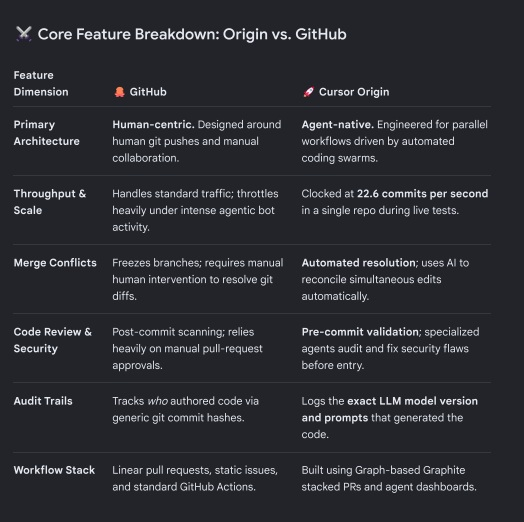
Some reports have described Origin as already providing automated AI merge conflict resolution, stacked pull requests, and detailed metadata showing which model and prompts generated individual lines of code. However, Cursor's current official Origin documentation does not list those capabilities as available in the early beta. Cursor explicitly says the initial release contains the essentials and that additional agent native features are still coming. The company's acquisition of code review specialist Graphite does give it technology and expertise around advanced review workflows, but features associated with Graphite should not automatically be treated as current Origin functionality until Cursor formally releases them.
That distinction matters because GitHub is not standing still. Microsoft's platform already supports autonomous GitHub Copilot coding agents capable of working on issues, modifying repositories, running tests, and creating pull requests. GitHub's Agent HQ has also expanded beyond Copilot to support external coding agents including Anthropic Claude and OpenAI Codex, positioning GitHub itself as a coordination layer for multiple AI development systems rather than simply a traditional code repository.
Origin therefore represents more than another GitHub clone. Cursor is gradually assembling its own integrated software development platform covering the editor, models, cloud agents, code review, repository hosting, automation, and deployment integrations. Following the SpaceX acquisition, it also gains access to considerably larger AI computing resources for model development. Cursor says this additional infrastructure will allow it to train more capable models while reducing operating costs.
The broader industry is moving toward the same agent focused development model. AMD recently introduced ROCm.ai, a platform specifically designed to help coding agents including Cursor, Claude, and Codex understand AMD hardware and optimize ROCm applications. As agents become capable of independently handling more software tasks, infrastructure for coordinating, reviewing, and integrating their output may become just as strategically important as the models generating the code.
Origin is not about replacing Git itself. It is about questioning whether the workflow built around Git is prepared for a future where 1 developer may supervise several agents producing branches and pull requests simultaneously.
That gives Cursor a credible strategic opening, but calling GitHub vulnerable today would be premature. Origin remains an early beta with a much smaller feature ecosystem, while GitHub already combines enormous repository scale with Actions, security tools, Copilot, Agent HQ, enterprise governance, and support for competing AI agents.
Cursor's advantage is vertical integration. If developers write code in Cursor, run Cursor agents, review changes in Cursor, and eventually host the repository on Origin, the company can optimize the complete workflow around agent generated software instead of adapting AI to infrastructure originally designed around human development speed. The challenge will be proving that this integration provides enough value to convince companies to move critical repositories away from one of the most entrenched platforms in software development.
Would you move a development project from GitHub to Cursor Origin if its AI agent workflows become significantly faster, or is GitHub's ecosystem too important to replace?
