
Crimson Desert Runs on Intel Arc Pro B70, But Shimmering and Broken XeSS Still Hold Back the Experience
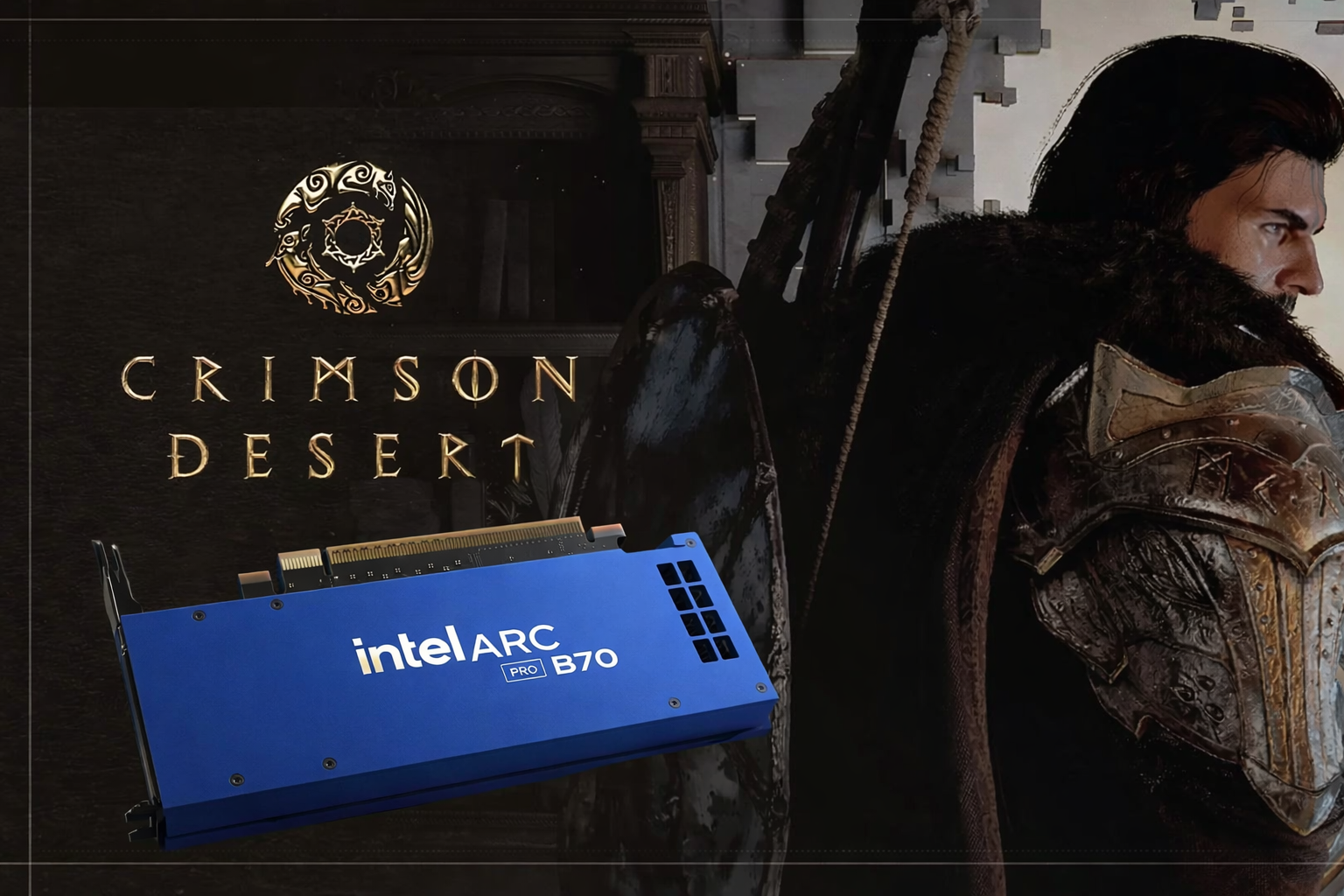
Crimson Desert has now moved one step further in its Intel GPU support rollout, and that includes Intel’s workstation side as well. Following Pearl Abyss’ official Patch 1.03.00, the studio confirmed that the game now supports Intel Arc GPUs, while also adding Intel XeSS 3.0 and Intel XeSS Frame Generation as selectable options on PC. That official wording does not split support between consumer and workstation branding, which is why recent testing on Intel’s new Arc Pro B70 is especially interesting.
In practical terms, the Arc Pro B70 does appear to run the game. Testing published by Tech Guy Beau shows Crimson Desert launching and playing successfully on the workstation card, which is notable because the Pro B70 is based on Intel’s larger BMG G31 Battlemage silicon rather than the consumer Arc configurations players are more familiar with. Based on the demonstrated run, performance is already respectable, with averages hovering around the 70 FPS to 80 FPS range and 1% lows staying in the 60 FPS territory during the showcased gameplay. That gives Intel’s workstation flagship a solid baseline in a demanding modern title, at least from a raw frame rate perspective.
The bigger issue is image quality, not whether the game launches. According to the showcased test, Crimson Desert suffers from heavy shimmering and visible artifacts on the Arc Pro B70 when using anything below the Ultra preset. On Medium and High, the presentation becomes unstable enough to noticeably hurt the experience, while switching to Ultra appears to remove or at least dramatically reduce the problem. That behavior points to a rendering or settings level bug rather than a simple lack of horsepower, because performance itself is not collapsing in the same way the image quality is.
That odd behavior also fits the broader reality of Crimson Desert’s Intel support right now. Pearl Abyss’ own patch notes make it clear that Arc support is still in an early optimization phase, explicitly stating that compatibility and performance across various Intel GPUs will continue to improve over time. The same notes also include a direct warning that on Intel Arc A series GPUs, the screen may not display properly when using Intel XeSS 3.0 or Intel XeSS Frame Generation. While the Arc Pro B70 is not an A series card, the presence of that warning reinforces the point that Intel specific rendering behavior is still not fully mature in the current build.
XeSS itself also does not appear to be in a strong state yet. In the Arc Pro B70 test, XeSS 3.0 reportedly boosts performance to some extent, but the image quality hit is significant enough to undermine the feature’s value. The reported effect is closer to asset degradation and visible detexturing than the kind of clean upscale reconstruction Intel would ideally want to show off in a flagship title. In contrast, FSR 3.1 appears to provide a more stable visual result in the same testing scenario. That is not a great outcome for Intel, especially now that official Arc support is finally in place and this should be one of the moments where XeSS helps strengthen the platform narrative rather than weaken it.
From a broader PC graphics perspective, this is a mixed but still important development. The good news is that Crimson Desert no longer shuts Intel users out, and the fact that even the workstation focused Arc Pro B70 can run the game at a playable level is a positive sign for Battlemage’s flexibility. The bad news is that support on paper is not the same as a polished experience in practice. If players have to move to Ultra just to avoid severe shimmering, and if XeSS remains visually unreliable, then the game is still not where it needs to be for Intel users to feel fully included.
Pearl Abyss has at least shown a willingness to keep improving the PC version post launch, and that matters here. Crimson Desert’s Patch 1.03.00 was not a minor line item update. It included platform level graphics changes, new options, broader fixes, and stability improvements, which suggests the studio is actively iterating rather than simply checking a support box and moving on. If that continues, Arc Pro B70 owners and consumer Arc users alike may see a much better experience over the next few updates.
For now, though, the verdict is clear. Crimson Desert does support Intel Arc Pro B70, and that is meaningful progress. But until the shimmering on lower presets is resolved and XeSS stops introducing obvious visual problems, the experience still feels more like an early compatibility milestone than a finished optimization success.
Do you think Intel’s Arc platform is finally gaining real momentum in major AAA games, or do issues like this still make it too hard to recommend outside enthusiasts?
