
Claude Helps PC User Trace BSODs to Faulty G.SKILL RAM and Complete RMA
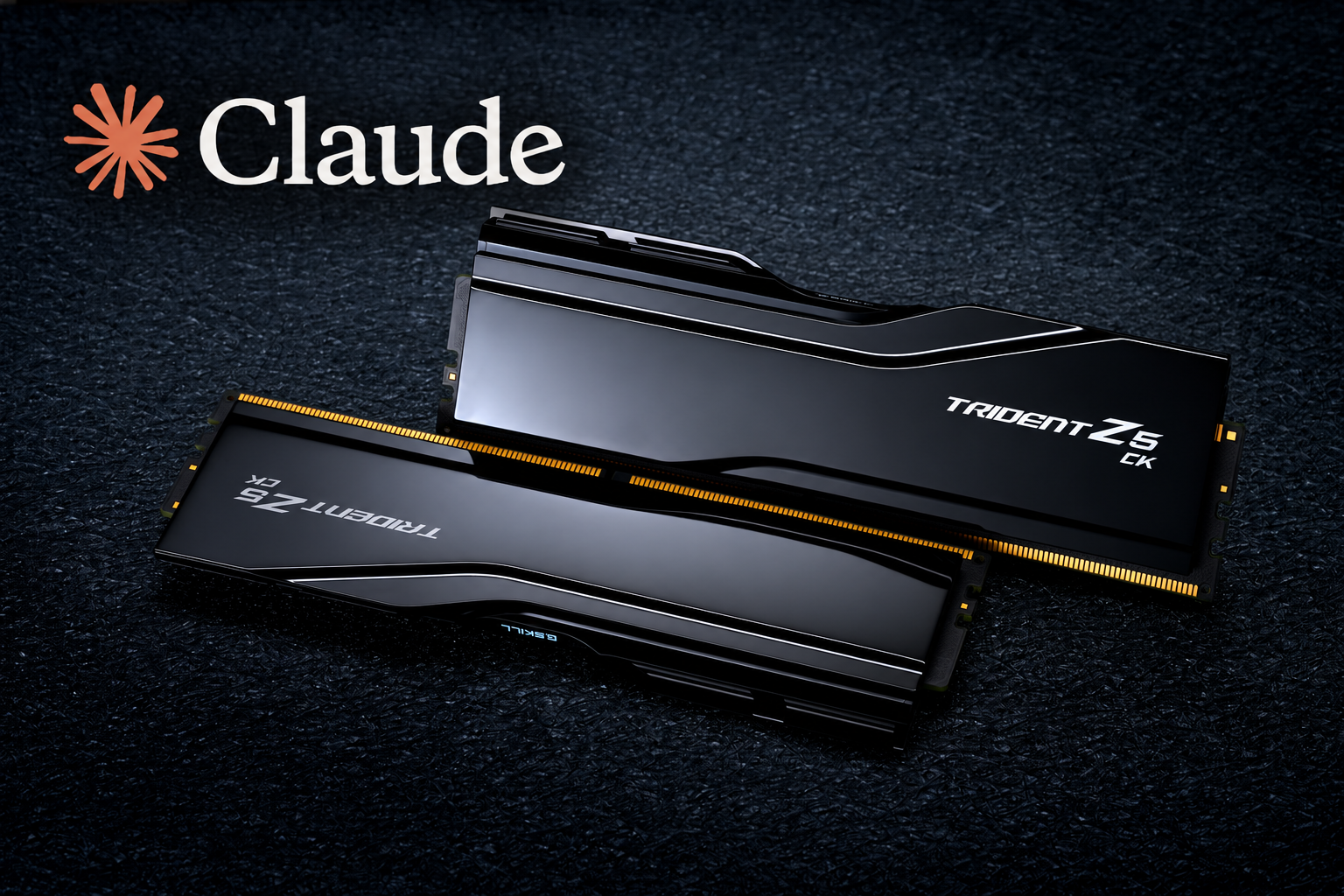
A PC owner says Anthropic's Claude helped troubleshoot persistent Windows crashes, narrow the problem down to a faulty G.SKILL memory kit, and navigate the RMA process that ultimately resulted in both RAM modules being replaced under warranty.
The case originated from a Reddit, the user built the custom PC in 2021 and had recently begun experiencing seemingly random Blue Screen of Death crashes carrying several different stop codes, including 0x0A, 0x1E, 0x3B, and 0x1A. With multiple errors pointing toward different possible causes, the user turned to Claude to help structure the troubleshooting process.
The strongest evidence came from conventional memory testing. A memory test reportedly produced more than 10,000 errors in less than 4 minutes, strongly indicating a problem somewhere in the memory subsystem. Follow up isolation testing then pointed toward both modules in the G.SKILL kit being faulty.
Claude's role was primarily to help interpret the symptoms, suggest diagnostic steps, and organize the sequence of tests rather than independently identifying a failed component. Once the RAM became the likely source of the instability, it also helped the owner understand how to begin the warranty process.
G.SKILL subsequently replaced both modules under its warranty program. The owner said the replacement kit itself cost nothing, although shipping and tariff expenses still applied.
G.SKILL's official memory warranty policy provides limited lifetime coverage for many of its retail U DIMM, CU DIMM, and SO DIMM product families, subject to the company's warranty conditions. Memory purchased as a kit must generally be returned as the complete kit when an RMA is required.
The outcome is particularly useful in the current memory market, where replacing a failed kit can be considerably more expensive than it was only a few years ago. G.SKILL itself has previously pointed to AI driven demand and global DRAM supply constraints as major contributors to rising memory prices, making warranty coverage increasingly important for owners of older systems.
The Reddit user also acknowledged that Claude made several mistakes during the process. That makes the case a realistic example of how general purpose AI can assist with PC diagnostics without replacing established tools.
The discussion around the post reflected that distinction. Some users argued that the failed memory test itself identified the problem, while others pointed out that an AI assistant can still be useful for people who do not already know which tests to run, how to isolate individual DIMMs, or what information a manufacturer may require during an RMA.
For less experienced PC owners, that may be the most practical use case. Diagnostic utilities still provide the evidence, while AI can help make the process easier to understand and follow.
This is a good example of AI being useful in PC troubleshooting without deserving credit for the actual hardware diagnosis.
The memory test found the errors, isolation testing narrowed down the faulty kit, and G.SKILL handled the warranty replacement. Claude mainly helped connect those steps into a more understandable workflow.
That can still be valuable. PC troubleshooting often becomes difficult because users do not know which test to run next or how to interpret the result, even when the correct tools already exist.
AI can make that process more approachable, but hardware failures should still be confirmed through established diagnostic tools and manufacturer procedures.
Would you trust an AI assistant such as Claude to guide your PC troubleshooting, or would you rather diagnose hardware problems entirely through traditional tools and forums?
