

ASUS has officially introduced the XG Core Radeon RX 9060 XT LP, a compact external graphics solution designed to upgrade laptops, gaming handhelds, and mini PCs without requiring internal hardware modifications. Powered by AMD's RDNA 4 architecture, the device features 16 GB of GDDR6 memory, USB4 connectivity with 40 Gbps bandwidth, and a portable chassis measuring just 144 × 117 × 39 mm. However, its extremely compact design introduces a significant performance limitation, with the GPU restricted to 75W, less than half the power consumption of a conventional desktop Radeon RX 9060 XT.
According to ASUS's official announcement, the XG Core targets users who need additional graphics performance for gaming, content creation, 3D rendering, and local artificial intelligence workloads. The external GPU retains 2,048 stream processors, a 128 bit memory interface, and 16 GB of GDDR6 memory operating at 20 Gbps. However, its power restrictions significantly reduce operating frequencies compared with standard desktop models. ASUS lists a default game clock of just 1,010 MHz and a maximum boost clock of 1,600 MHz, while OC mode increases those figures slightly to 1,030 MHz and 1,620 MHz.
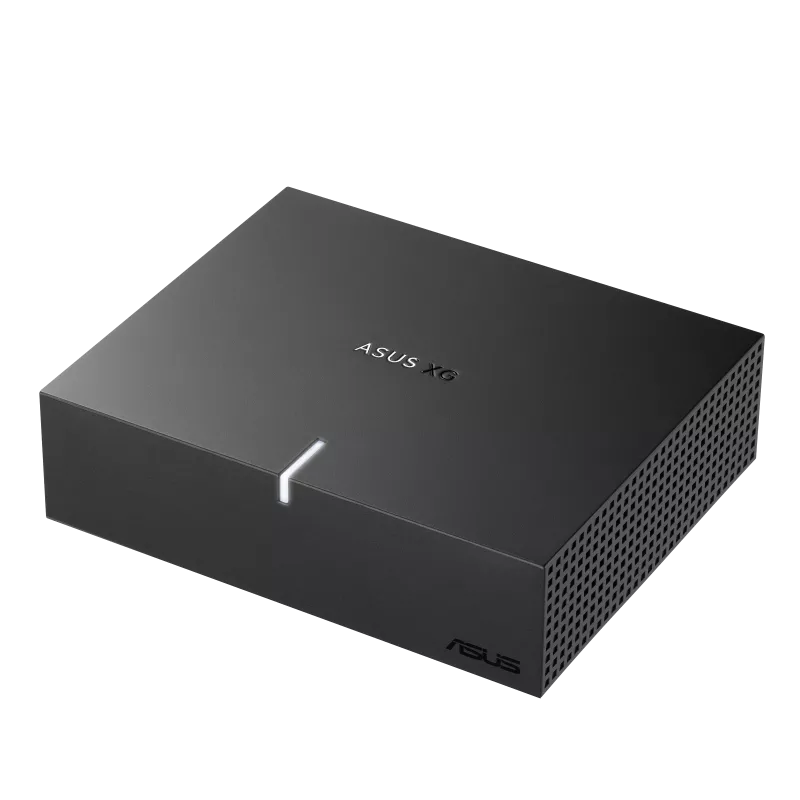
By comparison, AMD's standard Radeon RX 9060 XT features a 2,530 MHz game clock and boost frequencies reaching 3,130 MHz, alongside a typical board power of 160W for the 16 GB model. Although the XG Core retains the same GPU architecture and memory capacity, its lower frequencies and restricted power budget will limit performance in demanding games. The external USB4 connection also introduces additional bandwidth limitations compared with a graphics card installed directly through a PCIe slot.
ASUS XG Core Radeon RX 9060 XT LP Specifications
| Specification | Details |
|---|---|
| GPU | AMD Radeon RX 9060 XT LP |
| Architecture | RDNA 4 |
| Stream Processors | 2,048 |
| Memory | 16 GB GDDR6 |
| Memory Speed | 20 Gbps |
| Memory Interface | 128 bit |
| Default Game Clock | 1,010 MHz |
| Default Boost Clock | 1,600 MHz |
| OC Boost Clock | 1,620 MHz |
| GPU Power | 75W |
| AI Performance | Up to 406.3 TOPS, INT4 sparse |
| Host Interface | USB4, 40 Gbps |
| Display Outputs | HDMI 2.1b, DisplayPort 2.1a |
| Maximum External Displays | 2 |
| Dimensions | 144 × 117 × 39 mm |
| Pricing | Not announced |
The XG Core supports compatible USB4 laptops and gaming handhelds, including the ROG Ally X and ROG Xbox Ally X, while also offering compatibility with supported Thunderbolt 3 systems. Its dedicated HDMI 2.1b and DisplayPort 2.1a outputs allow users to connect external monitors, while ASUS GPU Tweak III provides GPU monitoring, clock adjustments, and fan control.
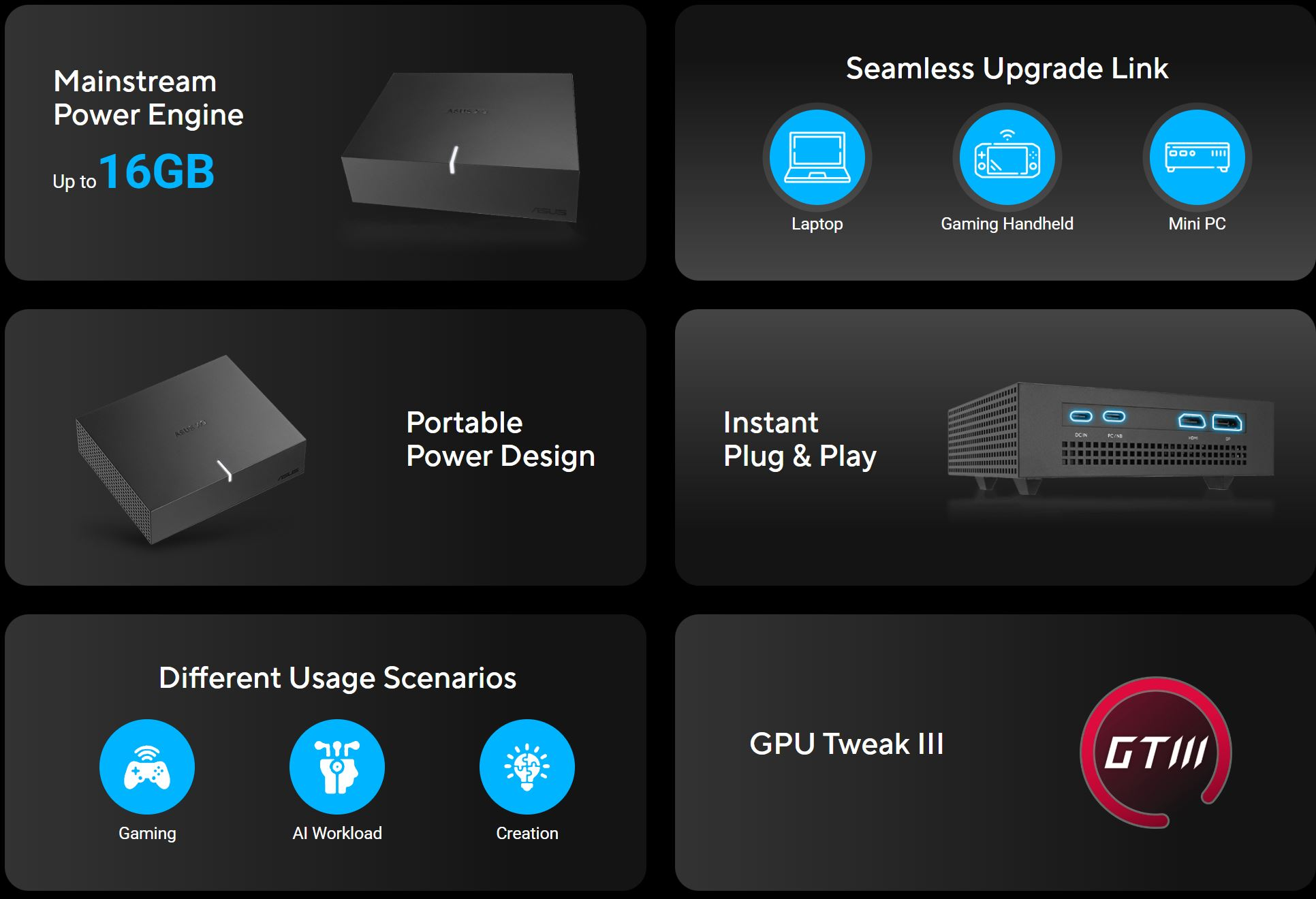
Beyond gaming, ASUS positions the XG Core as a portable solution for local AI applications such as ComfyUI, LM Studio, and Ollama. Its 16 GB VRAM capacity could benefit supported image generation and language model workloads, although software compatibility and performance depend on the specific application.
Unlike the larger ROG XG Station 3, which supports replaceable desktop graphics cards through Thunderbolt 5, the XG Core prioritizes portability and convenience over maximum GPU performance. ASUS has not confirmed official retail pricing or availability.
The ASUS XG Core represents an interesting alternative for gaming handheld owners and laptop users who want additional graphics performance without replacing their entire system. Its 16 GB of VRAM is particularly attractive for modern games and local AI workloads, while USB4 compatibility provides greater flexibility than proprietary external GPU connections.
However, reducing an RX 9060 XT to just 75W raises questions about its overall value. The significantly lower GPU frequencies, combined with USB4 bandwidth limitations, mean buyers should not expect performance comparable to a desktop RX 9060 XT.
The concept is promising, but pricing will determine whether it makes financial sense. An external GPU should provide a meaningful performance upgrade without approaching the cost of building a dedicated desktop PC. For consumers who prioritize hardware ownership and upgradeability, a solution with a replaceable graphics card may ultimately offer better long term value.
Would you consider a compact 75W external RX 9060 XT for your gaming handheld or laptop, or would you prefer a larger external GPU enclosure that allows full desktop graphics performance?
