
AMD Launches Zen 5 Based EPYC 8005 Sorano Server CPUs With Up To 84 Cores For Edge, Telco, vRAN, And Storage
AMD has officially launched its new EPYC 8005 Sorano server CPU family, expanding its Zen 5 data center portfolio with a platform designed for power constrained and space constrained deployments. Positioned as a compact but capable server solution, the new lineup targets edge systems, cloud storage, telco infrastructure, vRAN, and other environments where platform efficiency, modern I/O, and lower power envelopes matter as much as raw performance.
Unlike the higher end EPYC 9005 Turin series, the EPYC 8005 lineup operates within a more restrained 70 W to 225 W TDP range. This makes it a different class of server product, aimed less at traditional high density dual socket deployments and more at single socket platforms where customers need strong compute, efficient thermals, modern connectivity, and lower total platform footprint.
One of the biggest architectural changes with EPYC 8005 Sorano is AMD’s decision to use full Zen 5 cores instead of Zen 5c cores. This marks a clear shift from the previous generation EPYC 8004 Siena family, which used Zen 4c cores. By moving to full Zen 5 cores, AMD is targeting stronger per core performance, higher clocks, and larger cache configurations while keeping the platform within a power range suitable for edge and infrastructure deployments.
The EPYC 8005 Sorano lineup scales from 8 cores and 16 threads up to 84 cores and 168 threads, giving system builders a wide range of configurations depending on workload requirements. At the top of the stack, the flagship EPYC 8635P features 84 cores, 168 threads, 384 MB of L3 cache, and a default 225 W TDP. Boost clocks reach up to 4.5 GHz across selected SKUs, giving the lineup a stronger balance between core density and frequency compared with previous edge focused EPYC platforms.
The lower core count models also play an important role in the product stack. Not every edge server, storage system, or telco deployment requires a massive core count, but many still need server class I/O, DDR5 memory support, PCIe Gen 5 connectivity, and long term platform reliability. By offering models as low as 8 cores, AMD gives customers a way to access the EPYC ecosystem without overbuying compute capacity.
AMD is positioning Sorano for workloads where compact infrastructure and operational efficiency are critical. This includes cell tower installations, outdoor cabinets, quiet edge servers, storage applications, telco systems, and virtualized radio access network deployments. In these environments, power draw, physical size, platform cost, and heat output can become major design constraints.
The company also emphasizes that EPYC 8005 is not simply a reduced version of a larger data center CPU. Instead, Sorano is being presented as a right sized single socket platform with modern server features. High PCIe 5.0 lane counts, faster DDR5 memory support, large cache capacity, and single socket efficiency are all key parts of the value proposition.
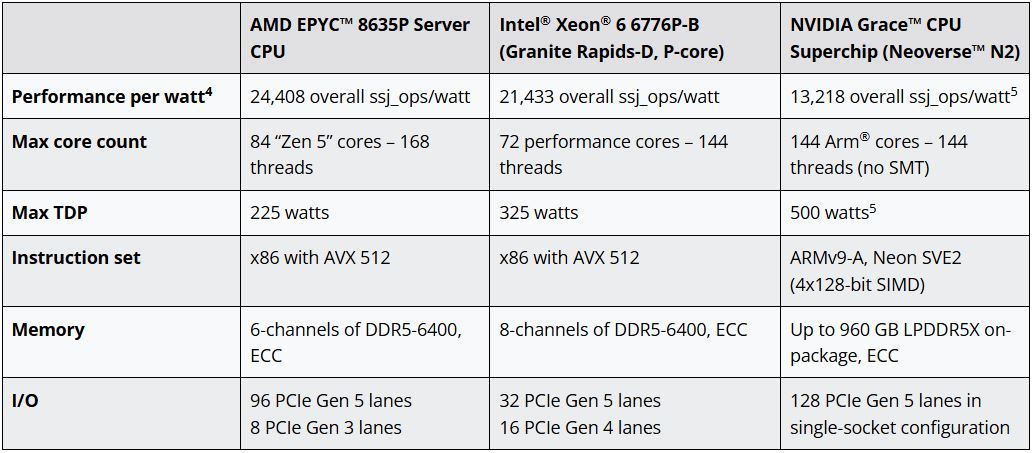
Performance claims are also central to AMD’s positioning. According to AMD, the EPYC 8635P delivers 40% higher top stack integer performance and 9.5% higher performance per watt compared with the previous flagship 64 core EPYC 8004 processor. Against Intel’s 40 core Xeon 6716P B, AMD claims up to 91% higher integer performance while operating at 10 W lower TDP.
For server buyers, those figures could make the EPYC 8005 family especially attractive in deployments where power efficiency and platform density directly affect operating costs. Modern edge infrastructure needs to process more data closer to users, devices, and applications, but not every deployment has the space, cooling, or budget for a larger EPYC 9005 class platform. Sorano gives AMD a more targeted option for customers who need modern Zen 5 performance in a smaller and more efficient server footprint.
The launch also strengthens AMD’s broader data center segmentation. EPYC 9005 Turin remains the high performance option for more demanding data center environments, while EPYC 8005 Sorano now addresses lower power single socket use cases with full Zen 5 cores. This gives AMD a more complete server portfolio at a time when edge computing, AI adjacent infrastructure, cloud storage, and telco modernization continue to increase demand for specialized CPU platforms.
From a market perspective, EPYC 8005 could be one of AMD’s more strategic server launches because it addresses a segment where platform efficiency and cost control are increasingly important. Enterprises, telco operators, and storage providers are no longer looking only at peak performance. They are also evaluating performance per watt, deployment size, thermals, PCIe bandwidth, memory capacity, and long term infrastructure scalability.
With up to 84 cores, 384 MB of L3 cache, 225 W default TDP, PCIe Gen 5 support, DDR5 memory support, and a single socket design, AMD’s EPYC 8005 Sorano family gives system builders another tool for compact server deployments. For customers who do not need the scale or cost of EPYC 9005 but still want modern Zen 5 server performance, Sorano could become a strong platform choice for edge, telco, vRAN, and storage systems.
Do you think AMD’s EPYC 8005 Sorano lineup is a stronger fit for edge servers, telco infrastructure, or cloud storage deployments?
