

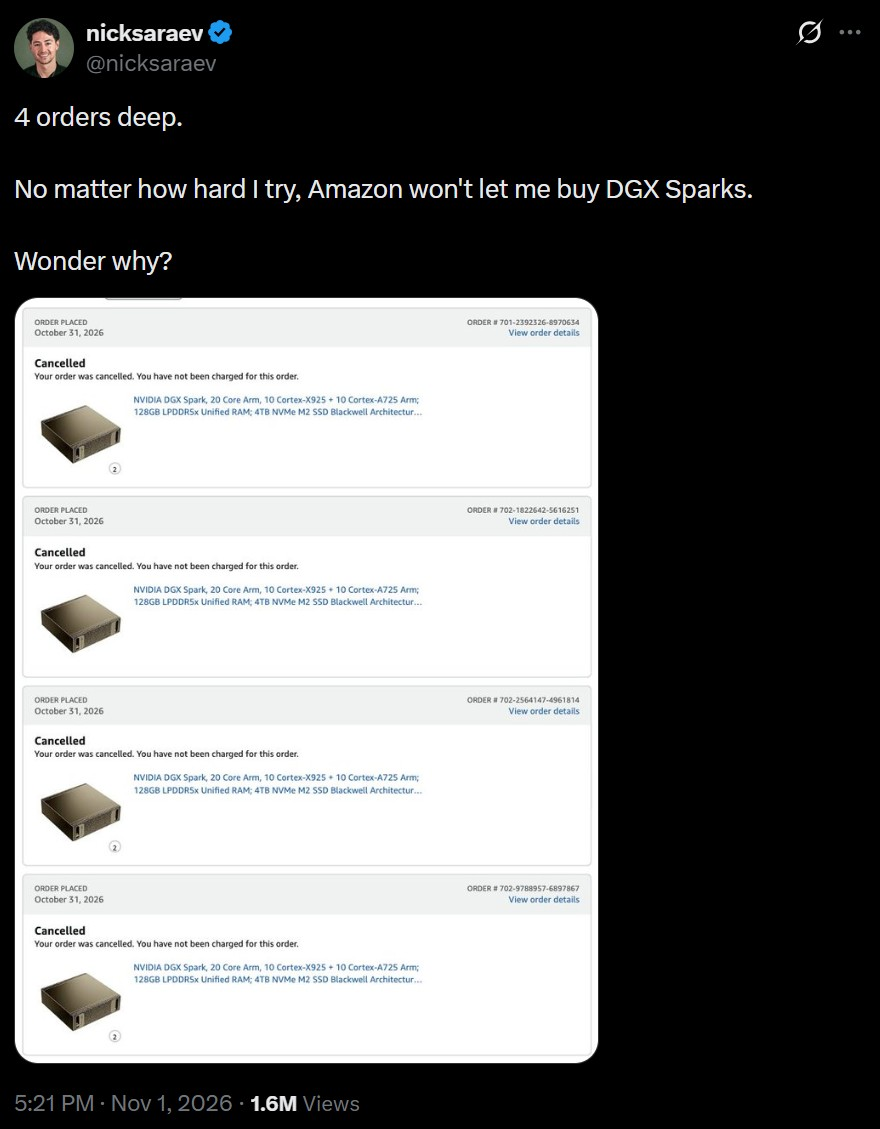
Amazon is facing criticism after reports emerged of canceled NVIDIA hardware orders and an alleged customer account closure involving purchases of high performance computing equipment. One customer claims the retailer canceled 4 separate orders for NVIDIA DGX Spark AI systems before permanently closing his account, while Epic Games CEO Tim Sweeney reported similar ordering problems after attempting to purchase 2 NVIDIA graphics cards. The incidents raise questions about Amazon's verification procedures and how retailers handle increasingly expensive computing hardware.
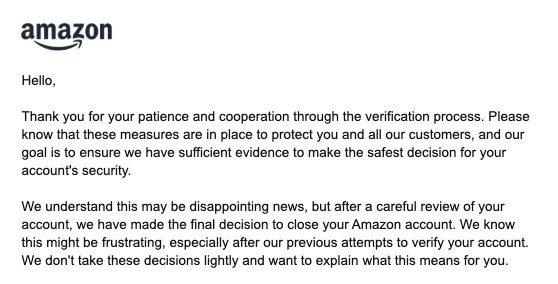
The controversy began when AI developer Nick Saraev shared his experience on X on November 1, explaining that Amazon had repeatedly rejected his attempts to purchase 4 NVIDIA DGX Spark systems. Despite completing additional account verification procedures, Saraev later reported that Amazon had closed his account. A screenshot of the alleged notification indicated that Amazon had reviewed his account before making the decision, although no detailed explanation was provided. Saraev speculated that purchasing significant computing hardware had triggered additional scrutiny, but there is no evidence that Amazon maintains a special watchlist targeting AI hardware buyers.
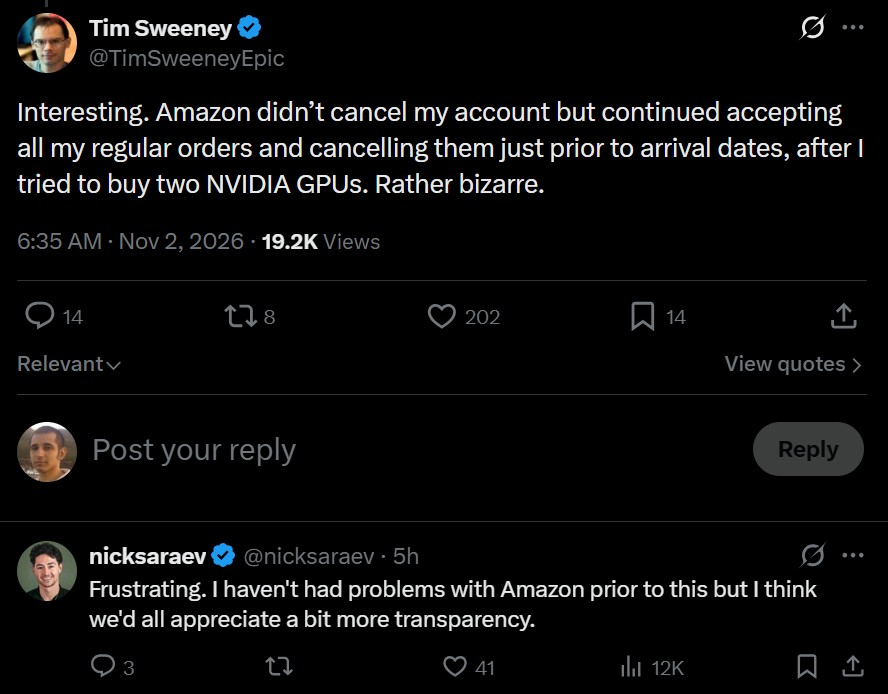
The situation attracted further attention when Epic Games CEO Tim Sweeney responded, revealing that his regular Amazon purchases had also experienced unexpected cancellations after he attempted to buy 2 NVIDIA GPUs. Unlike Saraev, Sweeney confirmed that his account remained active, but orders were reportedly canceled shortly before their expected delivery dates. Neither customer has established why Amazon rejected the transactions, and the company has not publicly explained the individual cases.
The affected hardware is particularly relevant to developers working with local artificial intelligence. NVIDIA's DGX Spark is a compact AI computer powered by the Grace Blackwell GB10 Superchip, featuring a 20 core Arm processor, up to 128GB of unified LPDDR5X memory, and up to 1 PFLOP of theoretical FP4 AI performance. Unlike conventional gaming graphics cards, the system is specifically designed to run and develop AI models locally without relying entirely on cloud infrastructure.
The reported cancellations arrive as memory shortages continue affecting the availability of consumer and enterprise hardware. With demand for GPUs and AI systems remaining elevated, retailers may employ additional fraud prevention or resale detection procedures when processing expensive purchases. However, there is currently no confirmation that such measures caused these incidents, nor evidence that Amazon has introduced a broader restriction on consumer AI hardware purchases.
Purchasing computing hardware should not become an unnecessarily complicated process for legitimate customers, particularly when those components are essential for gaming, software development, creative work, and local AI.
Retailers have legitimate reasons to prevent fraud and scalping, but unexplained cancellations and account closures undermine consumer confidence. Customers spending thousands of dollars on hardware deserve transparent purchasing limits, reasonable verification procedures, and meaningful opportunities to resolve disputed transactions.
More importantly, personal computing should remain accessible to everyone. As AI infrastructure continues consuming manufacturing capacity and hardware prices increase, individual developers and PC enthusiasts should not face additional obstacles simply because they want to own powerful computing equipment.
Amazon's actual reasons remain unknown, and these individual complaints do not establish a systematic restriction. Nevertheless, the incidents demonstrate why transparency and consumer protection are increasingly important in the high performance hardware market. Users should have the freedom to purchase, own, and operate their computing hardware without unnecessary dependence on centralized cloud services.
Should retailers have the authority to cancel expensive GPU purchases and close accounts without providing a detailed explanation, or should consumers receive stronger protections when purchasing computing hardware?
