

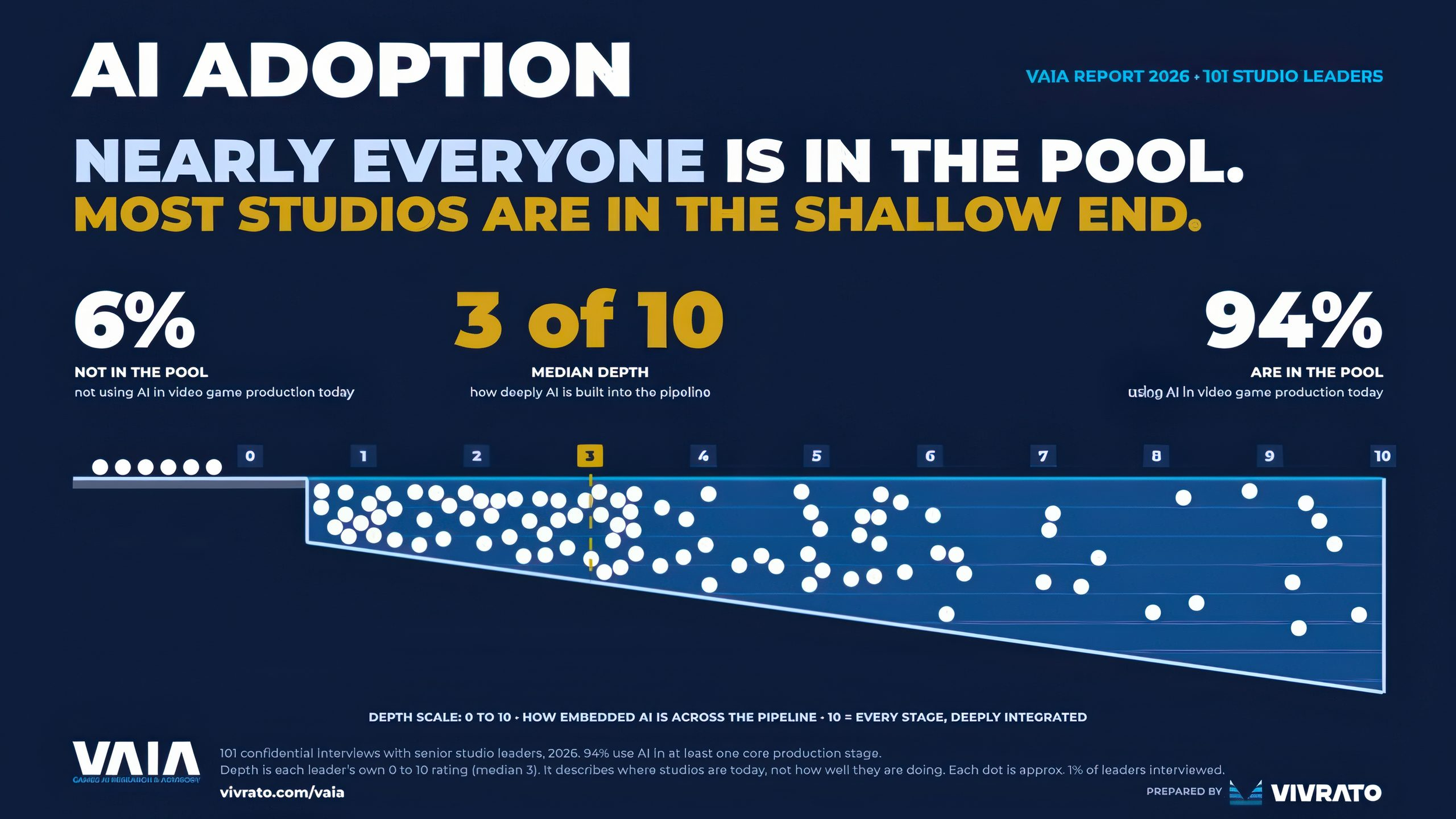
Artificial intelligence is becoming increasingly common throughout video game development, but a new industry report reveals that most studios are still experimenting with the technology rather than fully integrating it into their production pipelines. According to the 2026 Vivrato AI Adoption Report, 94% of the surveyed studio leaders reported using AI in at least 1 stage of game development, while the median level of integration was just 3 out of 10. The findings have renewed discussions about AI transparency in gaming, particularly Epic Games CEO Tim Sweeney's argument that mandatory AI disclosure labels on digital storefronts are becoming increasingly unnecessary.
The research, conducted by games consultancy Vivrato under former PlayStation executive Adam Boyes, involved 101 confidential interviews with senior studio leaders between April and September 2026. Most participants represented PC and console developers headquartered in North America and Europe. According to the original GamesBeat investigation, 97% of respondents had experimented with AI in some capacity, while 94% were already using it during production. However, 52% rated their level of integration at 3 or lower on a 10 point scale, demonstrating that widespread adoption does not necessarily mean artificial intelligence has become central to game creation.
The report examined several technologies beyond generative AI, including conventional machine learning, automated testing, retrieval augmented generation, and autonomous AI systems. Coding and engineering represented the most common applications at 86%, followed by general productivity at 83% and concept development at 79%. More creative areas showed lower adoption, with 60% reporting some AI use in art, assets, and animation, while 55% identified applications in narrative development and worldbuilding. These figures measure whether AI appears in a particular production stage, not how much of the finished game was created using it.
The distinction is important because an AI coding assistant helping developers identify programming errors is fundamentally different from generating character artwork, dialogue, voice performances, or other content delivered directly to players. A studio using automated tools for internal scheduling should not automatically be considered equivalent to one replacing substantial portions of its creative production with generative AI.
The findings also require careful interpretation. The 94% figure represents the 101 studio leaders interviewed, not a verified percentage of every game studio worldwide. The research also includes several forms of AI beyond the generative technologies most commonly associated with the current controversy. For comparison, the 2026 GDC State of the Game Industry report found that 36% of surveyed industry professionals personally used generative AI at work, including 30% of respondents employed at game studios. These figures are not directly comparable because the surveys examine different populations and definitions of AI.
The renewed debate connects directly to Tim Sweeney's criticism of Steam's AI disclosure requirements. In November 2025, the Epic Games CEO argued that AI would eventually become so common in production that requiring disclosure labels would provide little meaningful information. Boyes believes the Vivrato findings support the broader argument that simply asking whether a studio uses AI fails to explain how deeply the technology influences development.
However, Valve's current Steamworks documentation makes an important distinction. Steam does not require developers to disclose every use of AI during production. Its policy focuses on generative AI content included in the finished game and consumed by players, such as artwork, audio, narrative, and localization, alongside content generated dynamically during gameplay. Internal productivity tools and efficiency improvements are not the focus of its disclosure requirements.
This means the widespread use identified by Vivrato does not automatically qualify 94% of studios for Steam's public AI disclosure. The central question is therefore whether existing labels provide enough information about the AI generated content that actually reaches players.
The Vivrato report provides useful evidence that artificial intelligence is becoming part of everyday game development, but it also demonstrates why the industry's AI debate needs greater technical precision. AI assisted programming, automated quality assurance, and production management should not be treated as identical to generating finished artwork, writing, or voice performances.
The problem is not necessarily the technology itself, but how companies implement it and whether players understand what they are purchasing. AI can help smaller developers reduce repetitive work, accelerate prototyping, and experiment with ideas that would otherwise require substantial resources. However, those benefits should support human creativity rather than justify replacing artists, programmers, writers, and performers simply to reduce operating costs.
Sweeney raises a reasonable concern about overly broad labels becoming meaningless, but Valve's current requirements already distinguish internal tools from content delivered to consumers. Removing disclosure entirely would eliminate information that some players consider important when making purchasing decisions.
A more productive approach would involve clear descriptions of where generative AI appears in a game, whether it affects final assets or gameplay, and how developers maintain creative control. This would provide consumers with meaningful transparency without unnecessarily stigmatizing legitimate development tools.
AI should help developers create better games, but players should retain the freedom to decide whether and how they support AI generated content.
Should Steam continue requiring developers to disclose AI generated content, or do you agree with Tim Sweeney that these labels are becoming unnecessary as more studios adopt AI tools?
