
OpenAI has launched GPT 6.2 Astra, becoming the first AI model to achieve a 100% score on ARC AGI 3 under a specialized testing configuration, while delivering significantly lower operating costs than Anthropic's Claude Fable 5.2. However, despite impressive benchmark results, early users have reported problems with lengthy tasks, confusing responses, and inconsistent performance in real applications.
Released on November 17, 2026, GPT 6.2 Astra introduces improvements in scientific reasoning, coding, computer interaction, and 3D content creation. According to the ARC Prize official results, the model achieved a perfect 100% score on ARC AGI 3 using its XHigh reasoning configuration and a specialized provider adapter that preserves internal reasoning information between interactions. Under the standard testing configuration, however, Astra reached 70.3% at maximum reasoning effort, demonstrating how significantly testing conditions influence benchmark performance.
The ARC AGI 3 benchmark evaluates artificial intelligence through interactive environments resembling video games, requiring models to explore unfamiliar situations, identify rules, and complete objectives efficiently. The result represents a major advancement in autonomous reasoning, although it does not establish that the model can solve every unfamiliar real world problem.
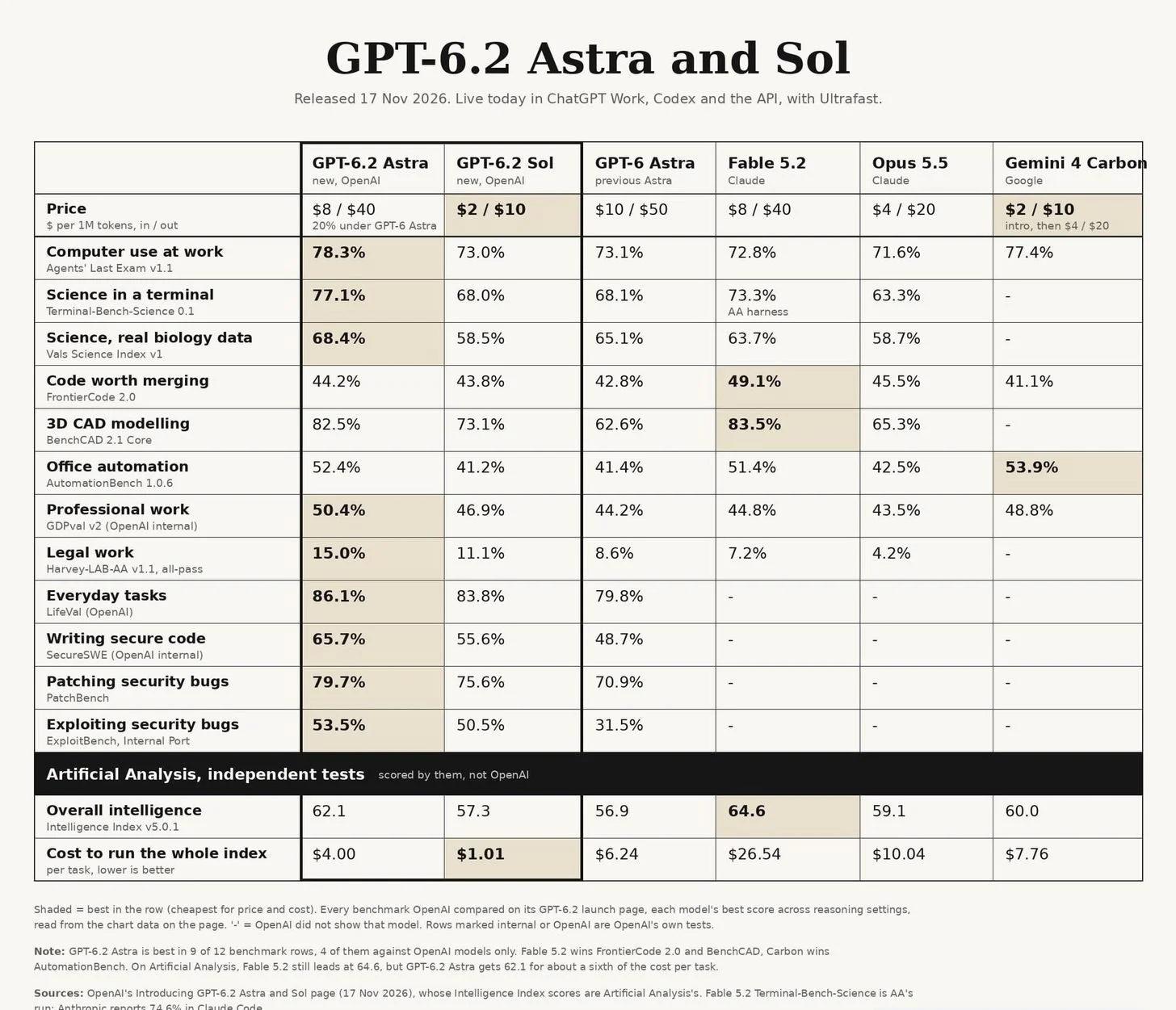
Independent evaluations present a more competitive picture. According to Artificial Analysis, GPT 6.2 Astra scores 62 on its Intelligence Index, behind Claude Fable 5.2 at 65. However, Astra costs approximately $4 per evaluated task, compared with $26.54 for Anthropic's competing model at maximum reasoning effort, making it approximately 6.6 times less expensive in that evaluation. Both models have standard API prices of $8 per million input tokens and $40 per million output tokens, meaning the cost advantage comes from computational efficiency rather than lower token prices. Astra also leads in selected scientific, robotics, and 3D development benchmarks, while its Coding Agent Index shows no improvement over the original GPT 6 Astra.
Early feedback has been considerably more mixed. Several developers have reported difficulties with complex projects, including the model repeatedly requesting unnecessary clarification, producing difficult to interpret responses, and entering unproductive loops during extended coding sessions. Some testers nevertheless praised its 3D design, visual reasoning, and computer interaction capabilities.
OpenAI researcher Tibo Sottiaux acknowledged the criticism, explaining that substantial changes were introduced during the final days before release, potentially contributing to differences between early reviews and public experiences. The company maintains that the new models represent meaningful improvements while recognizing that usability still requires refinement.
GPT 6.2 Astra is available through eligible ChatGPT subscriptions, Codex, and the OpenAI API. However, its model weights remain proprietary, requiring users to depend on OpenAI's infrastructure rather than deploying it locally.
GPT 6.2 Astra demonstrates that impressive benchmark results do not automatically translate into a better user experience. Its achievements in interactive reasoning and 3D development are particularly interesting for game development, automation, and content creation, but reliability remains essential when handling complicated projects.
Lower computational costs are also encouraging, although proprietary access continues limiting the independence of developers and PC enthusiasts. With open weight alternatives such as Kimi K3.1 Pro becoming increasingly competitive, the industry should prioritize practical performance, transparent evaluation, and local AI accessibility rather than benchmark rankings alone.
Would you choose GPT 6.2 Astra for its strong benchmark results and lower operating costs, or do real world reliability and the ability to run AI locally matter more to you?
