
NVIDIA’s New CUDA Tile Update Aims to Simplify GPU Programming While Quietly Reinforcing the CUDA Ecosystem
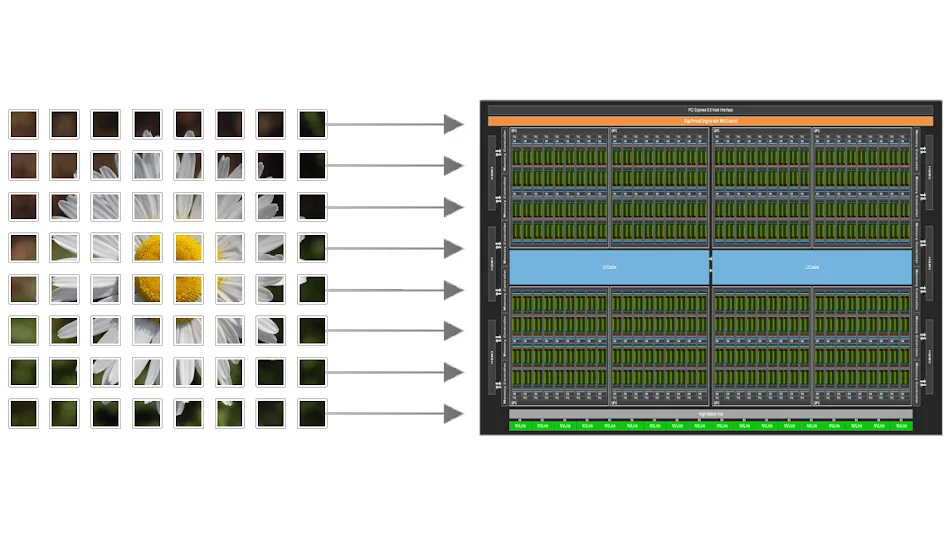
NVIDIA has unveiled one of the most significant evolutions to CUDA in years introducing CUDA Tile, a new tile based programming model that shifts away from traditional SIMT paradigms and dramatically simplifies GPU development. The update is detailed in NVIDIA’s official developer announcement, available via the CUDA Tile overview, and represents a strategic expansion of the company’s already dominant AI software stack.
CUDA has been the backbone of NVIDIA’s AI leadership for over a decade. While competitors have attempted to recreate comparable ecosystems, none have successfully matched CUDA’s breadth of libraries, optimizations, and developer tooling. With AI adoption booming across industries, NVIDIA’s ability to abstract complexity and accelerate developer onboarding has become more crucial than ever.
The largest advancement of the CUDA platform since its creation in 2006 is here 👀
— NVIDIA AI Developer (@NVIDIAAIDev) December 5, 2025
Introducing CUDA Tile, a tile-based programming model that provides the ability to write algorithms at a higher level and abstract away the details of specialized hardware, such as tensor cores.… pic.twitter.com/C9eloDN0Wn
CUDA Tile Introduces a New Abstraction Layer Through Tiling and Tile IR
Historically, CUDA allowed developers to manually fine tune low level parameters including block sizes, tile shapes, shared memory layouts, and execution resource mapping. While extremely powerful, this approach required deep architectural knowledge of NVIDIA GPUs.
CUDA Tile changes this dynamic entirely. The model introduces:
A tile based programming paradigm
Tile IR, a new low level virtual machine
A compiler directed execution strategy
Instead of forcing developers to dictate tile sizes or shared memory usage, CUDA Tile lets them express algorithms at a higher level of abstraction. The compiler then determines the correct GPU configuration, freeing programmers from architecture specific micro optimizations.
This dramatically reduces developer workload for highly regular operations such as:
Structured matrix multiplications
Convolution kernels
Common AI and HPC computation patterns
Although hand tuned CUDA will still outperform abstraction driven code, CUDA Tile significantly broadens access to GPU computing for scientists, analysts, and emerging AI developers who lack deep CUDA expertise.
Industry Reactions Jim Keller Calls It the End of the CUDA “Moat”
Renowned chip architect Jim Keller suggested the tiling model could weaken NVIDIA’s long standing CUDA moat. Because tiling is widely used in frameworks like Triton, he argues that:
CUDA Tile raises abstraction in a way that makes CUDA code easier to port
Developers may be less tied to NVIDIA specific hardware semantics
Framework pathways (CUDA → Triton → AMD AI chips) could become more feasible
The logic is clear: fewer hardware specific constructs in CUDA means fewer hurdles when migrating workloads to non NVIDIA ecosystems.
But CUDA Tile May Actually Strengthen NVIDIA’s Software Dominance
There is a counterargument gaining traction one that suggests CUDA Tile deepens NVIDIA’s moat rather than weakening it.
CUDA Tile’s underlying technologies, including Tile IR, are optimized specifically for NVIDIA hardware. While tiling increases portability at the algorithmic level, actual performance and implementation details remain deeply tied to NVIDIA’s proprietary GPU execution model.
In practice:
Porting may become easier conceptually, but
Real world implementation still depends heavily on NVIDIA optimized semantics
By lowering the barrier to entry, NVIDIA expands the CUDA developer base. More developers using CUDA means more long term ecosystem lock in even if the abstraction appears to be hardware neutral.
This is why many in the AI engineering community describe CUDA Tile as a revolution in GPU programming not only for accessibility but for ecosystem consolidation.
NVIDIA’s strategy is clear elevate abstraction to grow the audience while ensuring the deepest optimizations remain exclusive to NVIDIA hardware.
Do you think CUDA Tile increases or decreases NVIDIA’s long term dominance? Will higher abstraction levels help AMD and future AI chip competitors catch up? Share your view.
