
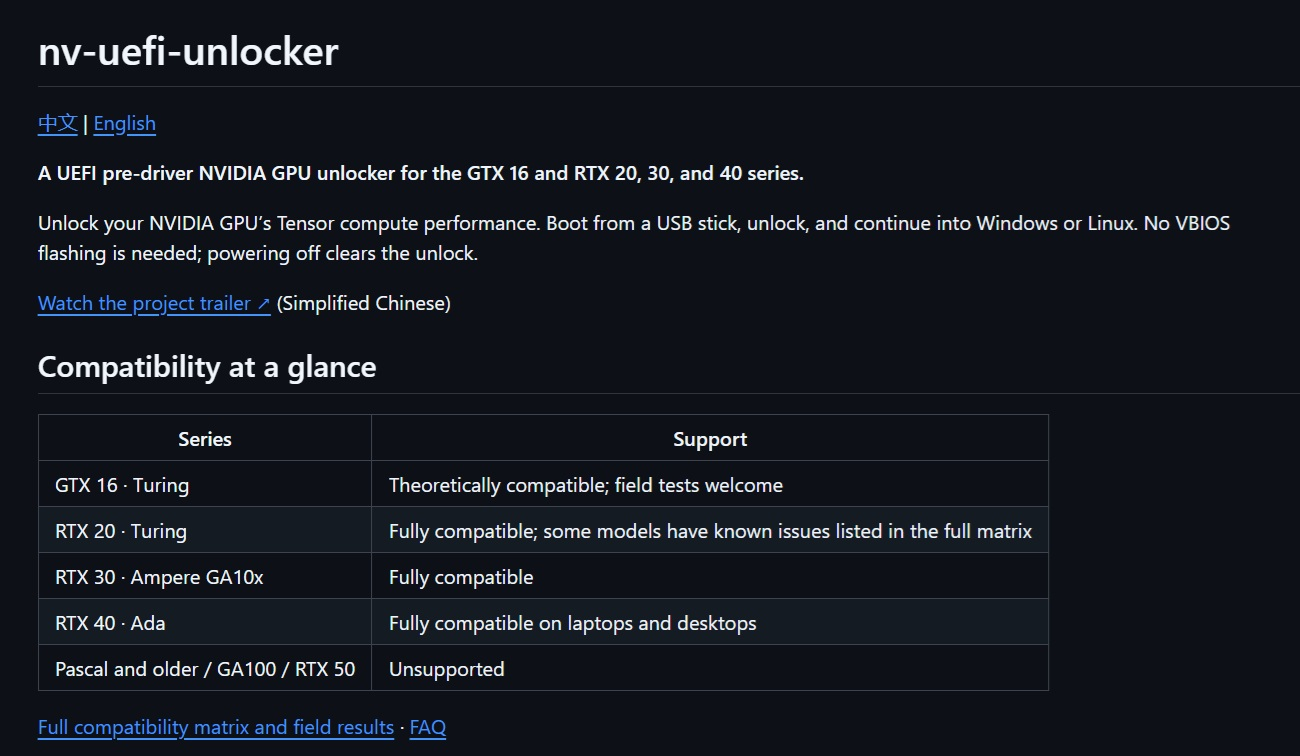
A new open source utility called NV UEFI Unlocker is allowing NVIDIA GeForce RTX 20, 30 and 40 Series graphics cards to achieve significantly higher AI computing performance on Windows and Linux. Developed by GitHub contributor physicsdolphin, the tool removes certain Tensor Core processing restrictions through a UEFI modification applied before NVIDIA's graphics driver initializes. According to the official GitHub project, early testing demonstrates performance improvements reaching 75% in specific matrix multiplication workloads, potentially extending the usefulness of older GeForce graphics cards for local AI applications.
Unlike traditional firmware modifications, NV UEFI Unlocker does not require permanently flashing the graphics card's VBIOS or modifying NVIDIA's installed drivers. Instead, the utility operates during the UEFI initialization process, applying temporary register changes before transferring control to Windows, Linux, or another compatible operating system. The modification is cleared after a complete system shutdown, meaning users must reapply it following a cold boot. This approach expands upon earlier community experiments that nearly doubled AI compute throughput on RTX 30 and 40 Series GPUs, which previously relied primarily on Linux modifications.
Initial benchmarks highlight the potential performance improvements. An RTX 2070 reportedly increased its FP32 accumulation matrix multiplication throughput from 36 TFLOPS to approximately 60 to 63 TFLOPS, representing gains of 67% to 75%. Meanwhile, an RTX 4060 Laptop GPU improved its FP16 compute performance from 29.89 TFLOPS to 49.33 TFLOPS, an increase of approximately 65%. The project also reports higher improvements in selected FP16, BF16 and TF32 workloads, although actual results depend heavily on GPU architecture, available power, memory bandwidth and software implementation.
NVIDIA GPU Unlocker Performance Results
| GPU | Standard Performance | Unlocked Performance | Improvement |
|---|---|---|---|
| RTX 2070 | 36 TFLOPS | 60 to 63 TFLOPS | +67% to 75% |
| RTX 4060 Laptop | 29.89 TFLOPS | 49.33 TFLOPS | +65% |
Results represent reported Tensor Core compute benchmarks rather than gaming performance or guaranteed application improvements.
According to the official compatibility documentation, the tool supports the Turing, Ampere and Ada Lovelace architectures, including desktop and selected laptop graphics cards. RTX 30 and 40 Series support is relatively mature, although not every individual model has been independently validated. RTX 20 Series compatibility remains subject to additional hardware specific requirements, while GTX 16 Series support is still experimental. NVIDIA's RTX 50 Series Blackwell GPUs are currently unsupported.
Installation requires a prepared USB drive and access to the system's UEFI boot environment. Secure Boot must either be disabled or configured to trust the EFI application, introducing potential security and compatibility concerns. Some RTX 20 Series cards also require additional GSP firmware configuration. Although the changes are temporary, the utility remains experimental and could cause boot failures, system instability or other unexpected behavior.
For AI enthusiasts, the potential benefits extend to local language models, image generation, and other Tensor Core accelerated workloads. However, increased theoretical compute throughput does not automatically translate into equivalent application performance, particularly when workloads are limited by VRAM capacity or memory bandwidth. There is also currently no verified evidence that the modification improves gaming frame rates, ray tracing performance, or DLSS processing.
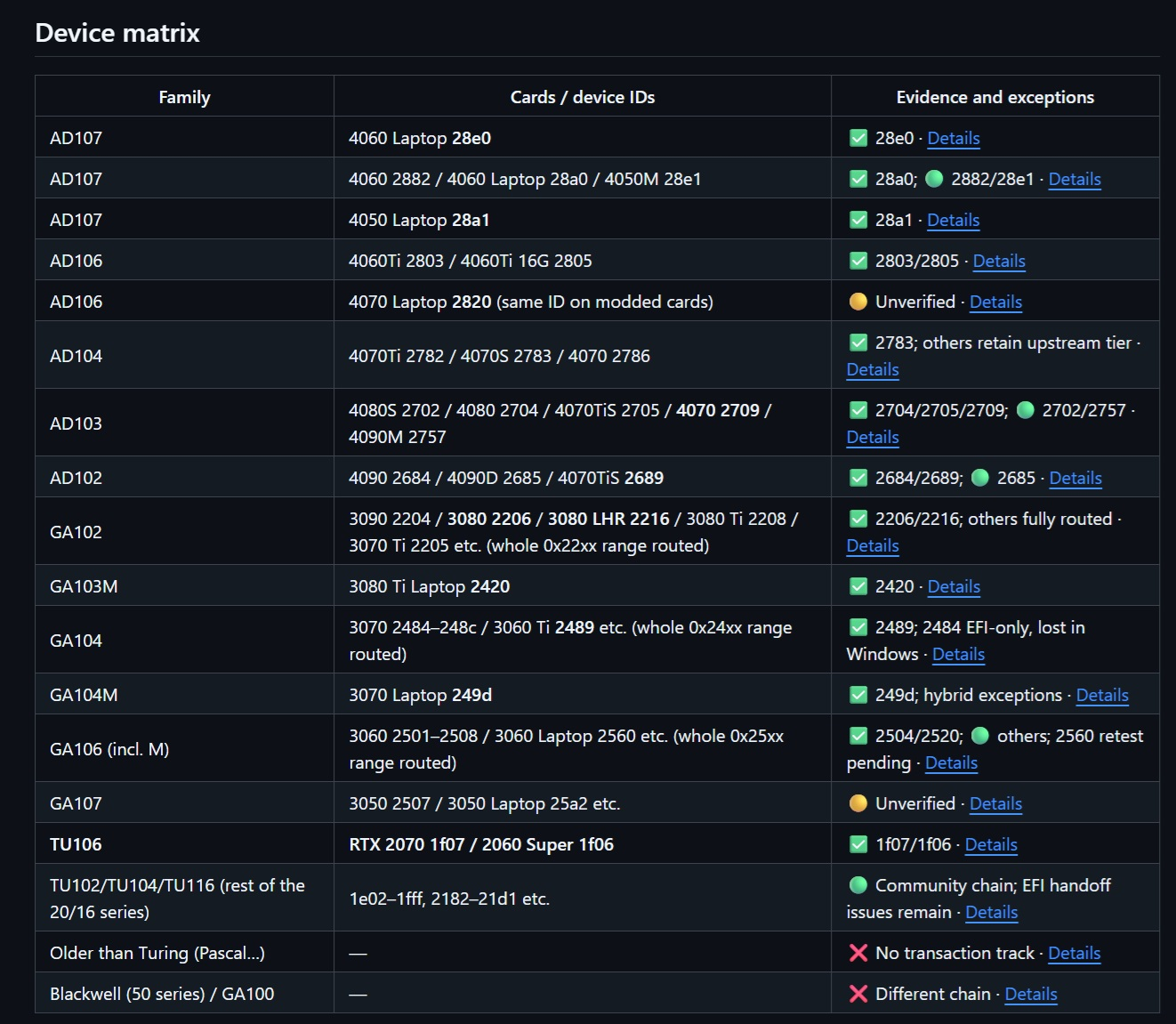
NV UEFI Unlocker demonstrates how much additional computing potential may remain within older NVIDIA graphics cards, particularly as local AI development continues increasing demand for affordable GPU acceleration. The ability to improve Tensor Core performance without purchasing new hardware could benefit developers working with RTX 3090, RTX 3080 and other capable GPUs. However, raw compute improvements are only part of the equation. VRAM capacity, memory bandwidth, power consumption and software optimization remain equally important for practical AI workloads. The security implications of modifying the UEFI boot process also make this a tool better suited to experienced enthusiasts than everyday gaming systems.
Would you use an experimental GPU unlocker to gain up to 75% more AI compute performance from your existing RTX graphics card, or would you avoid the potential stability and security risks?
