
NVIDIA Re-Enters China, But Its Newly Approved H200 AI Chip Faces Limited Adoption Prospects
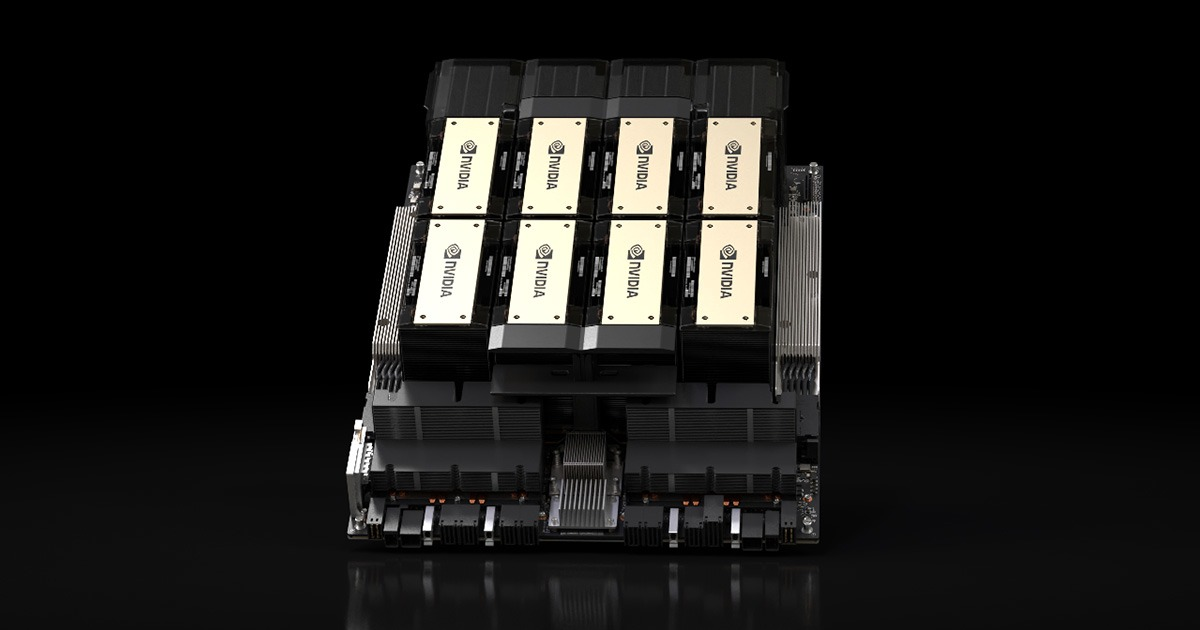
NVIDIA’s presence in China has been in decline for more than a year, with CEO Jensen Huang openly stating that the company had “zeroed” its position in the region following a series of tightening US export controls. Huang has repeatedly argued against restricting the flow of American technology and maintained that NVIDIA must remain competitive in China to preserve long-term global leadership. Now, in a surprising policy reversal, the firm has been granted permission to re-enter the Chinese market with its Hopper H200 AI accelerator, according to an announcement published by President Trump on Truth Social.
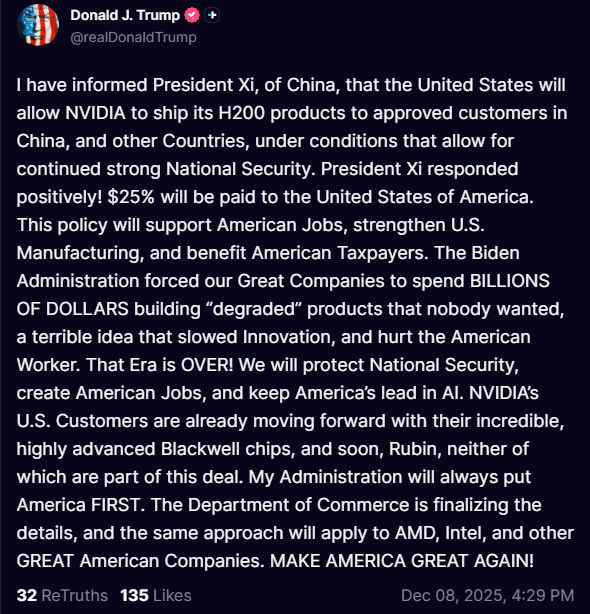
Although NVIDIA is now technically allowed to sell the H200 into China, the reality is far more complex. The company faces significant commercial and strategic constraints that severely limit the chip’s prospects in the region. For one, Jensen Huang previously stated that Hopper-class chips would no longer be introduced to China, and in a past interview with Bloomberg, he dismissed speculation that the H200 would be accepted in the country, saying “they won’t accept that.” Beijing has relied on variants of the Hopper architecture for years, and China’s domestic AI chip ecosystem has matured rapidly during this time.
Huawei’s Ascend 910C is already claimed to surpass NVIDIA’s H100 in performance, and Chinese vendors have accelerated investment into homegrown accelerators to minimize reliance on US-origin technologies. As a result, the H200 does not arrive in a vacuum; it enters a fiercely competitive market where domestic alternatives are increasingly prioritized by both industry and national policy.
Compounding the challenge, NVIDIA must pay a 25 percent fee for every H200 shipped into China. To preserve margins, the company can either raise prices substantially or absorb the cost directly both of which sharply reduce competitiveness. Given that NVIDIA’s AI accelerators already command premium pricing globally, it is unlikely that Chinese firms will adopt the H200 widely under these economic constraints. The approval may reopen the door to the Chinese market, but access comes with strict limitations that weaken NVIDIA’s ability to operate as it once did.
Historically, Chinese tech giants aggressively pursued constrained NVIDIA chips such as the H20, but the landscape has changed. Domestic hardware ecosystems, including Huawei’s Ascend and other AI accelerator initiatives, have matured significantly. Yet adoption barriers remain. Chinese firms have repeatedly reported difficulties training large models on domestic AI chips due to the absence of a software framework comparable to CUDA. Hardware performance alone is insufficient without a mature, scalable development ecosystem supporting it.
Given this imbalance, NVIDIA’s realistic prospects in China may not lie in its compute hardware portfolio, where domestic vendors are rapidly catching up, but in the software ecosystem advantage the company continues to maintain. CUDA remains unmatched, and the lack of an equivalent Chinese framework continues to slow down widespread deployment of local accelerators.
In this new phase of NVIDIA’s constrained re-entry into China, the company retains strategic value but under far tighter guardrails and far less advantageous conditions than before.
Do you believe NVIDIA can regain meaningful traction in China under these new terms? Or will domestic AI ecosystems finally overtake foreign hardware dominance? Share your perspective.
