
MSI Launches AI Edge Series Desktop In A Compact 4L Chassis With Ryzen AI Max Plus 395 And Up To 126 Total TOPS
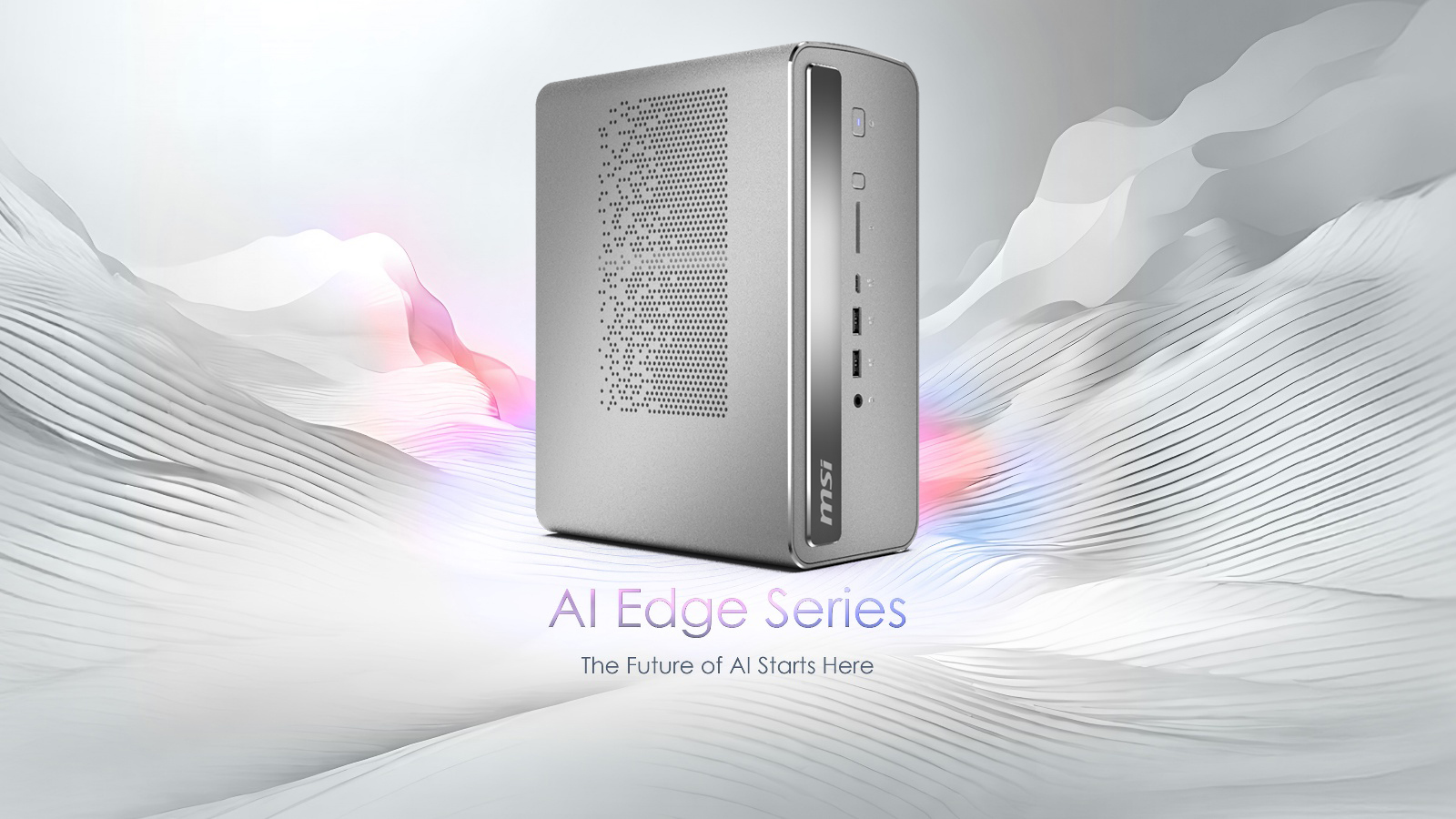
MSI is officially stepping deeper into the AI Mini PC race with its new AI Edge Series desktop, a compact 4 liter system designed to deliver high on device AI performance without the footprint and power draw of a traditional tower plus discrete GPU. MSI is positioning the AI Edge as its flagship AI Mini PC class solution, built around AMD’s Strix Halo platform and tuned for developers, engineers, and creators who want strong AI acceleration alongside data privacy and local workflow control.
At the center of the AI Edge desktop is the AMD Ryzen AI Max Plus 395, a 16 core 32 thread Zen 5 processor that also integrates an XDNA 2 NPU capable of 50 TOPS. MSI is framing the overall AI capability as 126 total TOPS, combining the NPU contribution with additional AI throughput coming from the CPU and integrated GPU. MSI breaks this down as 76 TOPS coming from the processor and iGPU portion of the platform, while the dedicated NPU provides the remaining 50 TOPS, giving the full 126 TOPS aggregate figure for AI workloads.
The integrated graphics side is a major part of why this product matters for gamers and creators who do not want to move to a bulky desktop GPU build. The Ryzen AI Max Plus 395 includes the RDNA 3.5 based Radeon 8060S iGPU with 40 compute units, which MSI positions as capable for both gaming and AI workloads. The pitch is straightforward: deliver fast local inference and playable gaming performance in a 4 liter box while consuming significantly less power than desktops that rely on dedicated GPUs.
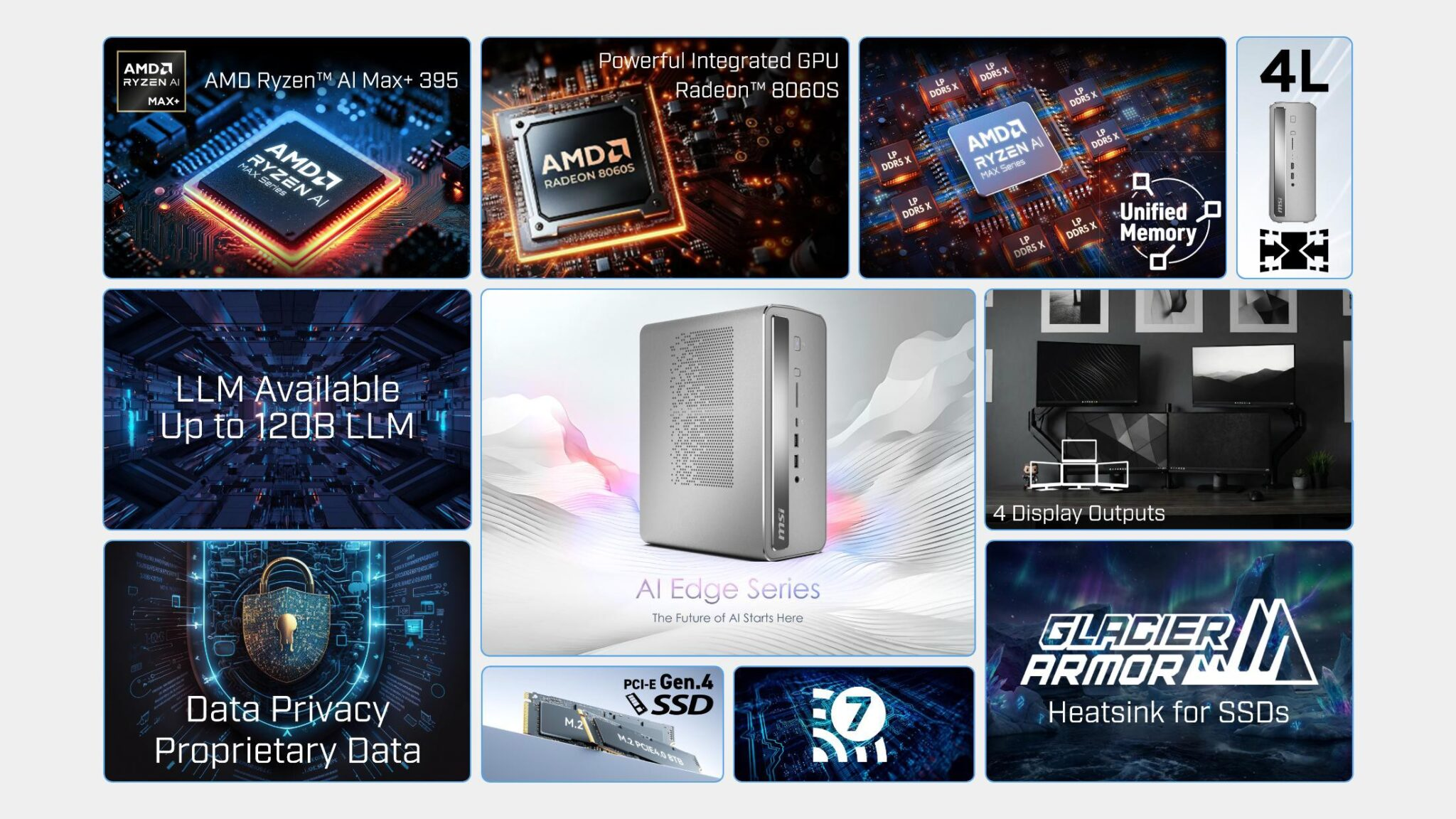
MSI is also emphasizing memory capacity and memory architecture, which is critical for modern AI workloads. The AI Edge series desktop will be available with up to 128 GB LPDDR5X 8000 memory in a unified configuration, meaning the memory pool is shared and accessible by both CPU and GPU. MSI highlights this as important for large model inference, claiming the AI Edge can handle LLMs up to 120B parameters and deliver an output of 15 tokens per second in that scenario. For edge AI developers and creators, that unified memory plus high bandwidth approach is a practical value proposition because it reduces bottlenecks that usually show up when you try to run larger models locally.

On the platform and usability side, MSI frames the AI Edge as a flexible daily driver that supports both Windows and Linux, not just a niche dev box. For sustained performance, MSI is using its Glacier Armor thermal solution and is deploying heatsinks across most components to improve heat dissipation and long duration stability. This is an important detail for real world workloads, because small systems often throttle if the thermal design is not built for continuous AI inference or mixed CPU plus GPU loads.
MSI describes the positioning clearly, calling the AI Edge Series a powerhouse solution for developers, engineers, and creators who require maximum AI performance and data privacy for on device AI workloads, with the AI Edge desktop as the first product launching under the series.
Would you rather run local AI workflows on a compact unified memory desktop like MSI AI Edge, or do you still prefer a traditional tower with a discrete GPU for maximum upgrade flexibility?
