
Kingston Expands Enterprise SSD Capacity With 30.72 TB As AI And Cloud Data Centers Push For Higher Density
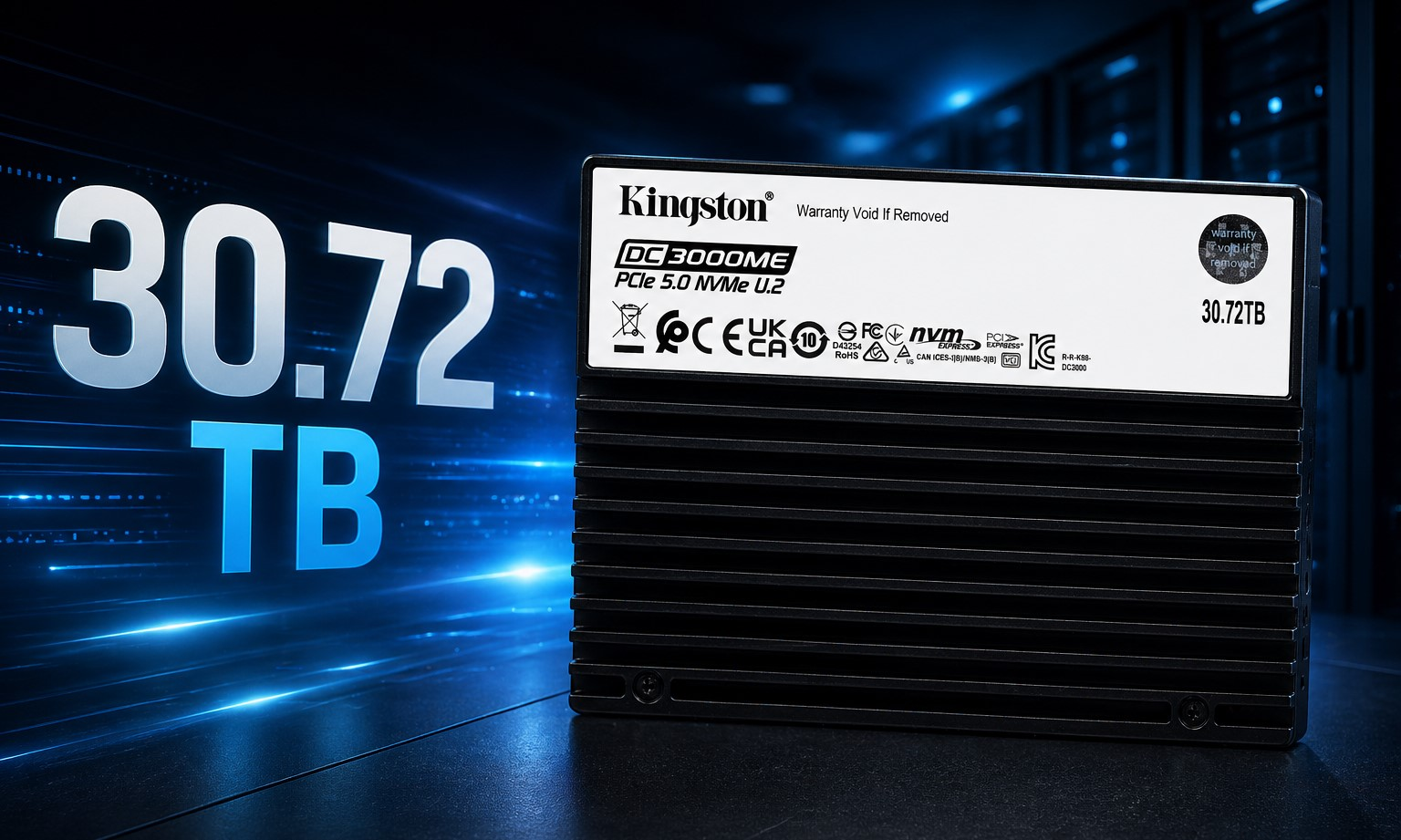
Kingston has officially expanded its enterprise storage lineup with a new 30.72 TB version of the DC3000ME, a PCIe 5.0 U.2 NVMe SSD aimed at modern data center deployments. The company says the new model is designed for AI, HPC, and cloud environments that need higher storage density without giving up throughput, reliability, or predictable performance.
At the headline level, the new DC3000ME pushes up to 14,000 MB/s sequential read speeds and up to 2.8 million random read IOPS, putting it firmly in the high performance enterprise category. Kingston says the drive uses a PCIe 5.0 x4 interface, while also retaining backward compatibility with PCIe 4.0 servers and backplanes, which gives operators a smoother upgrade path for mixed generation infrastructure.
The 30.72 TB capacity point is the real strategic move here. AI clusters, cloud providers, software defined storage deployments, and high density server racks all benefit when more storage can be packed into fewer drive bays. That can reduce the number of drives needed for a given capacity target, simplify cabling, and improve rack level efficiency, especially in environments where power, airflow, and physical space are all tightly managed variables. Kingston directly positions the DC3000ME family for AI, HPC, cloud services, edge computing, RAID, and general server use.
Kingston is also leaning hard on enterprise reliability features. The DC3000ME uses 3D eTLC NAND and includes on board power loss protection to help preserve in flight data during unexpected shutdowns. On the security side, the drive supports AES 256 bit encryption and TCG Opal 2.0 self encrypting drive capabilities, features that matter for organizations balancing performance with compliance and data protection requirements.
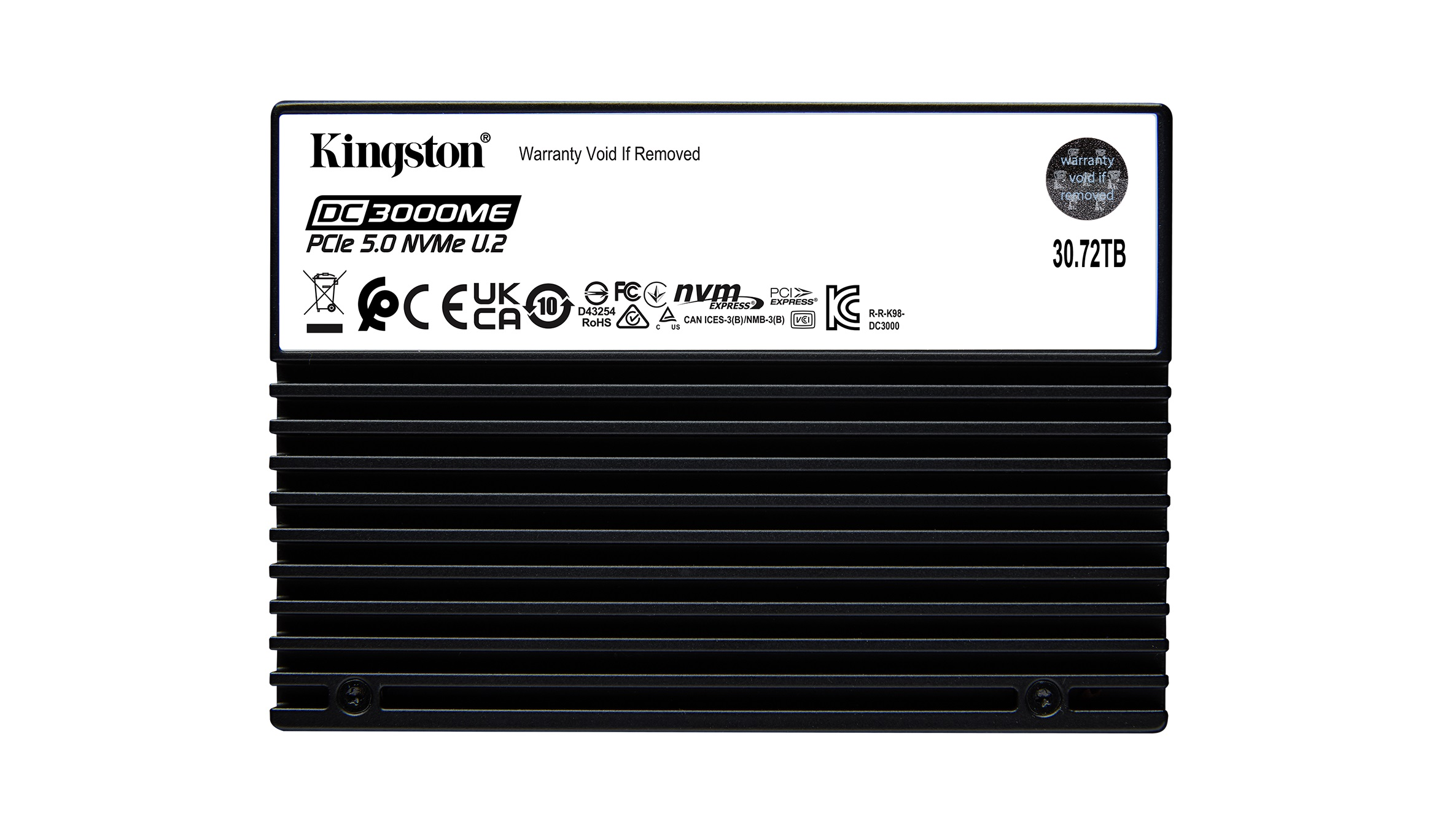
Looking deeper into the specifications, the 30.72 TB model is rated for up to 9,700 MB/s sequential write performance and up to 2.6 million random read IOPS, with endurance rated at 56,064 TBW and 1 DWPD over 5 years. Kingston also lists the drive at 9 W idle and 9.5 W maximum read power for the 30.72 TB version, alongside a U.2 2.5 inch 15 mm form factor and a 5 year limited warranty. Those numbers reinforce that this is not just a bigger capacity SKU, but a full scale enterprise part designed for sustained deployment.
Kingston framed the launch as an important milestone for its data center SSD portfolio. Cameron Crandall, data center SSD business manager at Kingston, said customers in AI, HPC, and cloud environments are increasingly looking to maximize storage density without compromising performance or reliability, and positioned the new 30.72 TB model as a direct answer to that demand.
From a market perspective, the timing makes sense. AI infrastructure is scaling quickly, and storage is now a much bigger part of the performance conversation than it was in earlier waves of server expansion. Training pipelines, checkpoint storage, vector databases, inference serving layers, and large scale cloud environments all create demand for denser, faster, and more power conscious SSD deployments. Kingston is clearly using the DC3000ME to strengthen its position in that enterprise segment, where capacity per drive and predictable latency can matter just as much as raw throughput. This is an inference based on Kingston’s stated workload targets and the drive’s published specifications.
No pricing has been disclosed so far, which is not unusual for enterprise storage products that are often sold through volume quotes, system integrators, and data center procurement channels rather than fixed consumer retail pricing. What is clear, however, is that Kingston is pushing its enterprise portfolio further up the density ladder at a time when AI storage demand is rising fast.
Do you think higher capacity SSDs like this will become the new standard for AI and cloud racks faster than expected, or will cost still keep deployments focused on smaller capacity drives for a while?
