
Jailbroken PS5 Runs 27B AI Model at 20 Tokens per Second Using Its GPU

Sony's PlayStation 5 has been transformed into a local AI server capable of running a 27 billion parameter language model entirely on its own hardware. Using a modified version of llama.cpp, a homebrew developer has successfully executed Qwen 3.8 27B on the console's AMD GPU, achieving approximately 20 tokens per second without requiring cloud computing or an external PC.
The project builds on PS5LM, an open source initiative created by developer Mert Cobanov, also known as u/metover. The original implementation introduced llama.cpp support for jailbroken PlayStation 5 consoles, initially relying on the CPU and approximately 6 GiB of accessible memory. However, this configuration severely restricted model sizes and inference performance.
Developer u/AdIllustrious7246 subsequently expanded the project into a native GPU accelerated application called PS5LM Plus. By utilizing Vulkan through a port of AMD's open source RADV graphics driver, the modified implementation gains access to approximately 11.44 GiB of GPU accessible memory, enabling considerably larger language models.
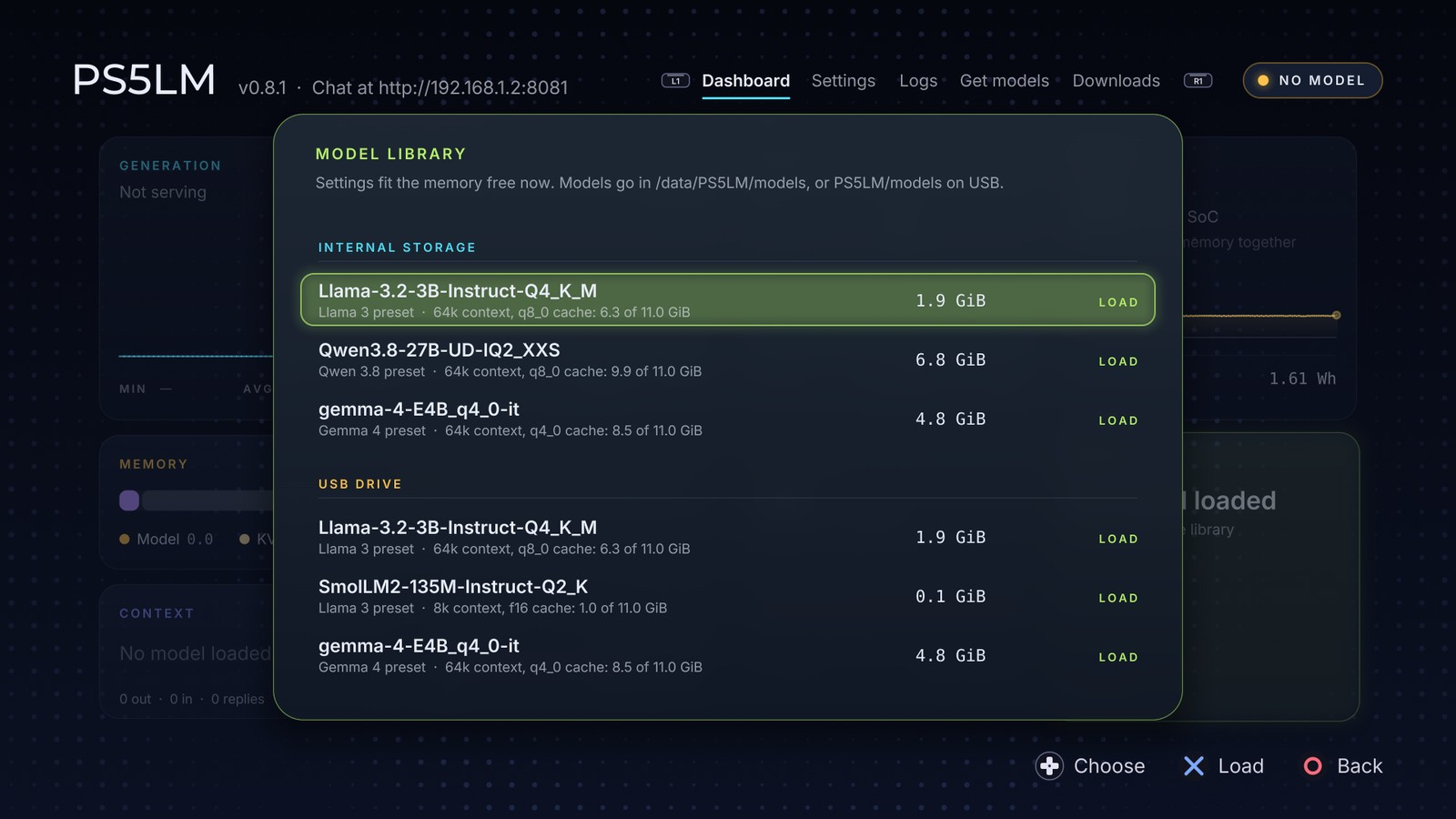
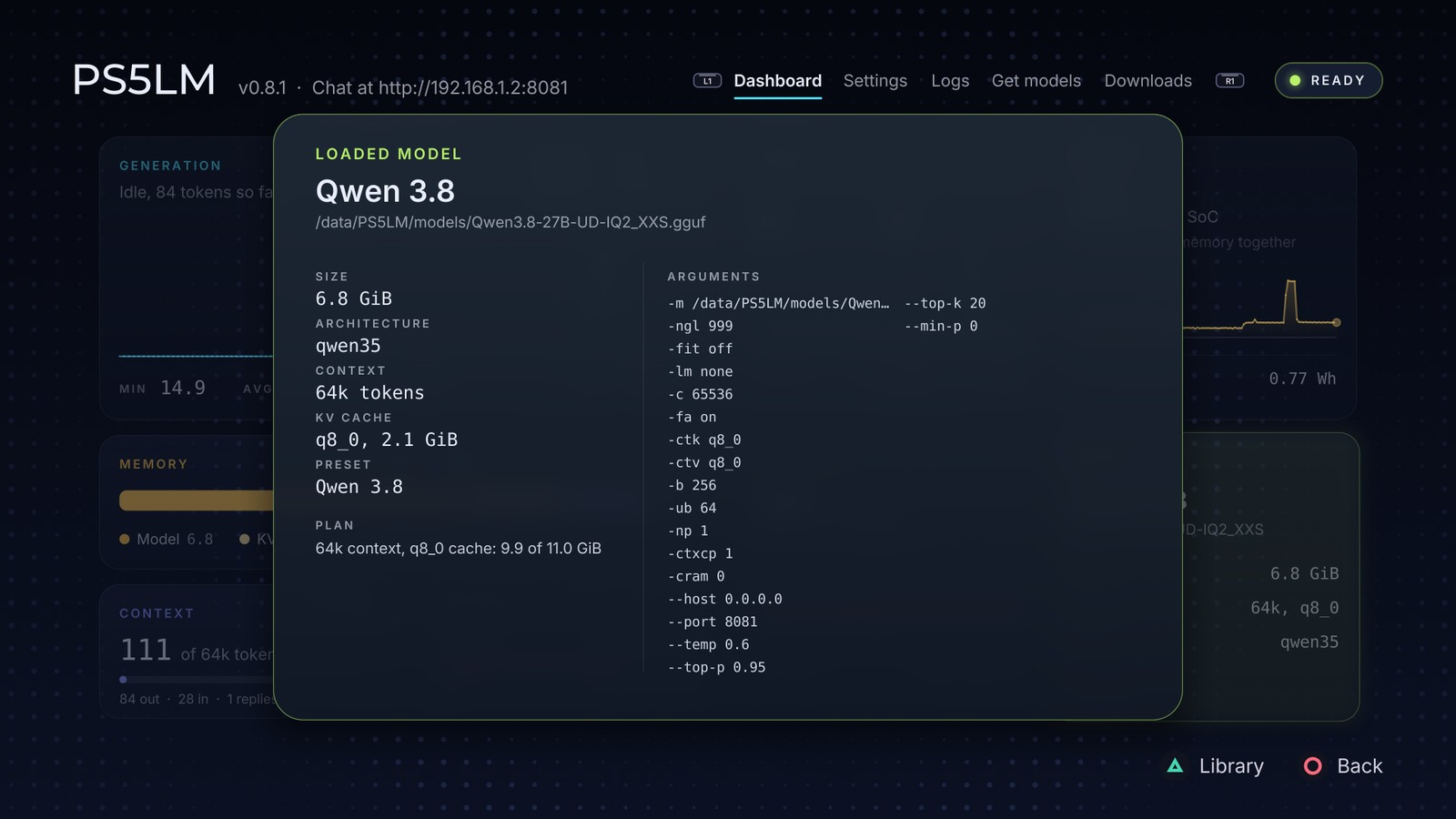
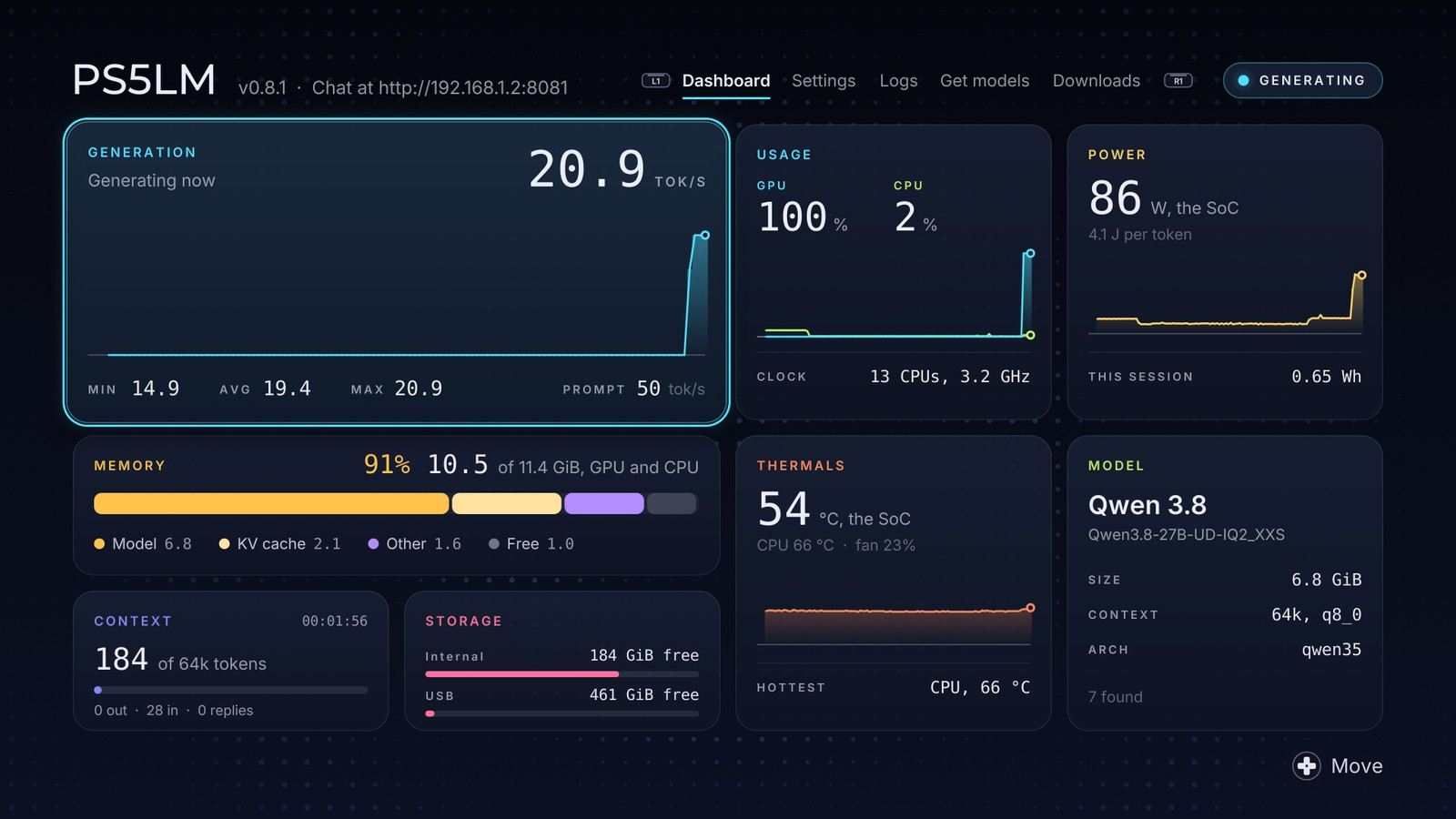
The PlayStation 5 features 16 GB of unified GDDR6 memory with 448 GB/s of bandwidth, making its memory architecture particularly interesting for local AI inference. While the console cannot accommodate a full precision 27B model, aggressive quantization reduces the required memory considerably. The tested Qwen 3.8 27B configuration uses IQ2_XXS quantization, occupying approximately 6.8 GiB while supporting a 64K context window.
PS5 Local AI Performance
| AI Model | Model Size | Context | Generation Speed |
|---|---|---|---|
| Qwen 3.8 27B IQ2_XXS | 6.8 GiB | 64K | 20.7 tokens/s |
| Qwen 3.8 27B Q2_K_XL | 9.2 GiB | 32K | 20.3 tokens/s |
| Gemma 4 E4B QAT | 4.8 GiB | 64K | 61 tokens/s |
| Llama 3.2 3B | 1.9 GiB | 64K | 124 tokens/s |
Performance figures were reported by the developer and have not been independently benchmarked.
According to the developer's Reddit demonstration, the optimized application includes a console dashboard displaying GPU utilization, memory consumption, power draw, temperatures, and AI generation speeds. Users can load GGUF models from internal storage, USB drives, or M.2 SSDs, while a built in model browser supports downloading compatible files from Hugging Face.
The software also provides a local web interface and an OpenAI compatible API, allowing smartphones and computers on the same network to interact with models running directly on the PS5. Once a model has been downloaded, inference can operate without an internet connection.
However, the results come with important limitations. Running a 27B model within the PS5's memory constraints requires aggressive quantization, which can reduce reasoning accuracy and output quality. The system also requires a jailbroken console and several homebrew components, making it unsuitable as a conventional plug and play AI solution.
The achievement follows other PlayStation homebrew developments, including The Legend of Zelda: Breath of the Wild running at 4K on jailbroken PS5 hardware. Together, these projects demonstrate how developers are extending the console's capabilities beyond its original gaming environment.
Running a 27B AI model on a PlayStation 5 is an impressive demonstration of how unified memory and GPU acceleration can repurpose consumer gaming hardware for entirely different workloads.
The console's 448 GB/s memory bandwidth provides a useful foundation for inference, but its limited accessible memory remains the biggest restriction. Quantization makes larger models possible, although it introduces compromises that dedicated AI workstations with greater memory capacity can avoid.
What makes PS5LM Plus particularly interesting is its local API functionality. Instead of simply running an AI chatbot on a television, the console can potentially serve as a private inference endpoint for other devices on a home network.
It is unlikely to replace a dedicated AI system, but for enthusiasts with an existing jailbroken PS5, the project demonstrates another practical application for hardware originally designed exclusively around gaming.
Would you repurpose a PlayStation 5 as a local AI server, or would you prefer building a dedicated PC with a more powerful GPU and expandable memory?
