
IDC Slashes 2026 PC Outlook to an 11.3% Shipment Decline as Memory Shortages Stretch Into 2027
IDC has sharply revised its global PC market forecast, and the new picture is much worse than the industry was hoping for. In its latest outlook, IDC says global PC shipments are now expected to decline 11.3% in 2026, a major downgrade from the 2.4% decline it projected back in November 2025. The firm says the cut is being driven by memory shortages, rising component prices, and broader supply constraints, all of which are now expected to limit production well into 2027.
That new forecast is significant because it confirms the pressure from DRAM shortages is no longer isolated to a few high end or enterprise focused segments. IDC explicitly says the PC market is being hit by a convergence of memory disruption, higher component costs, and supply chain problems, while also warning that the situation became even more fragile as geopolitical tensions worsened after the forecast was prepared. IDC notes that the conflict in the Middle East had already become another major challenge for technology and hardware industries, adding more instability to an already fragile market.
IDC’s updated message is blunt. Ryan Reith, group vice president for Devices and Consumer, said the overall tech industry is facing “uncontrollable headwinds” that are making both planning and survival much harder across multiple sectors. That language matters because it shows IDC is not treating this as a routine cyclical slowdown. It is framing the market as being under compound pressure from several overlapping crises at once.
At the same time, IDC says the total value of the PC market is still expected to rise 1.6% to 274 billion dollars in 2026, even as shipment volume drops. That apparent contradiction comes down to one thing: higher average selling prices. In other words, fewer PCs are expected to ship, but those that do will cost more. IDC is effectively signaling that the era of cheap, easy value in consumer PC hardware is being pushed further away by supply side reality.
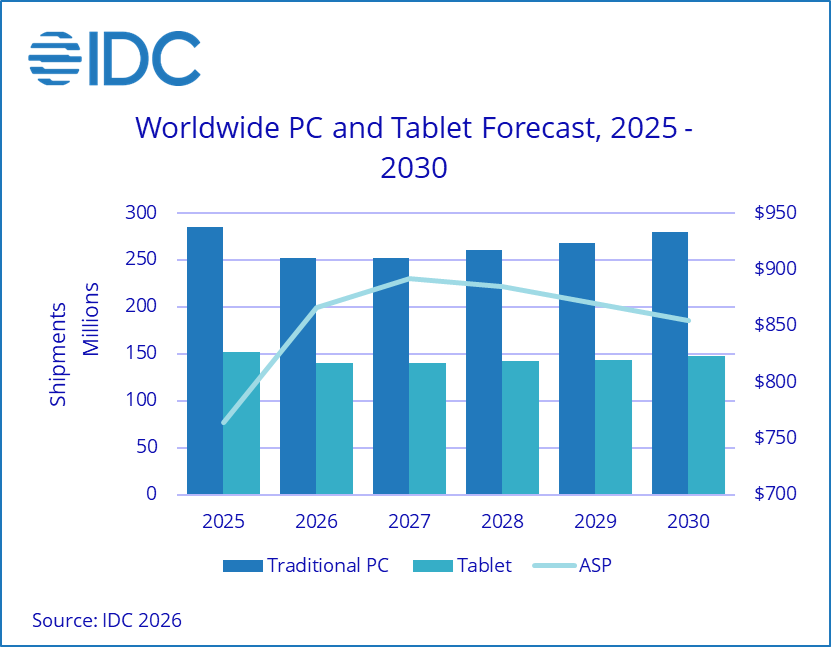
Jitesh Ubrani, research manager for IDC’s Worldwide Mobile Device Trackers, made that point even more clearly. He said memory shortages will persist well into 2027, and while IDC expects some easing to begin in 2028, the market is unlikely to return to 2025 pricing levels. Instead, IDC expects a new normal of structurally higher ASPs and weaker long term demand. That is one of the most important lines in the report because it shifts the discussion from a temporary shortage to a broader reset in pricing expectations across the PC industry.
IDC also says vendors are likely to respond by focusing on supply chain resilience, more flexible component sourcing, and down specced product options designed to keep pricing from running too far ahead of consumer budgets. That means OEMs may increasingly look for ways to protect margins and maintain shipment flow through specification changes rather than waiting for memory costs to normalize quickly. This is especially relevant for the consumer market, where price sensitivity remains much higher than in enterprise or AI adjacent segments.
From a market strategy perspective, the implication is straightforward. PC makers will likely keep leaning harder into business and premium segments where higher prices are easier to absorb, while entry level and mainstream consumer categories face the most pressure. That interpretation follows directly from IDC’s combination of lower unit expectations, higher market value, and structurally elevated ASP guidance.
The broader takeaway is that recovery is no longer something the market can comfortably place just around the corner. IDC’s latest revision suggests the PC industry is now operating inside a longer and more painful adjustment cycle, one where memory constraints and supply disruption are not just causing short term turbulence, but reshaping pricing and demand for the next several years.
What do you think, will consumers accept this new normal of higher PC pricing, or could prolonged memory pressure push the market into an even deeper slowdown?
