
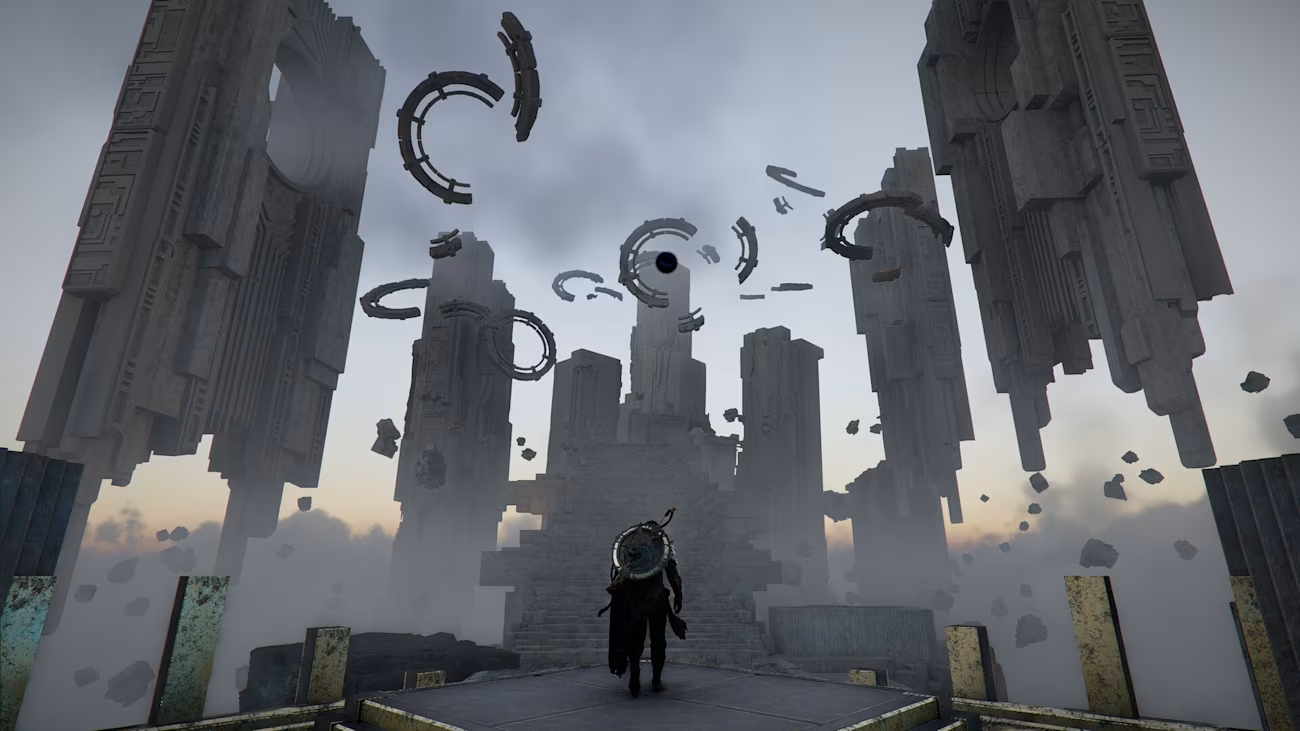
Pearl Abyss has officially revealed that Crimson Desert's continent of Pywel covers approximately 200 km², making it more than twice the size of the estimated open worlds in Elden Ring, Red Dead Redemption 2, and Grand Theft Auto V. The confirmation came during G CON 2026 on November 19 in Busan, South Korea, where developers detailed the technology behind the game's enormous environments and explained how the proprietary BlackSpace Engine maintains visual quality, environmental interactions, and seamless exploration across the continent.
During the G CON 2026 technical presentation, Pearl Abyss Art Level Director Ahn Geun tae and Game Engine Graphics Director Yoon Jin ho explained how the studio developed the massive world while maintaining environmental variety and meaningful exploration. With approximately 200 km² of terrain, Pywel is considerably larger than many established open world games, including Elden Ring, The Witcher 3, and Skyrim. However, these comparisons use commonly cited map estimates from different sources, meaning they should be treated as approximate rather than standardized measurements of playable terrain.
Open World Map Size Comparison
| Game | Estimated Map Size | Crimson Desert Comparison |
|---|---|---|
| Crimson Desert | 200 km² | 1x |
| Elden Ring | 79 km² | 2.5x larger |
| Grand Theft Auto V | 81 km² | 2.5x larger |
| Red Dead Redemption 2 | 75 km² | 2.7x larger |
| Zelda: Breath of the Wild | 75 km² | 2.7x larger |
| The Witcher 3 | 135 km² | 1.5x larger |
| Skyrim | 37 km² | 5.4x larger |
Figures are approximate. Map boundaries, bodies of water, underground locations, and accessible terrain are not measured consistently between games.
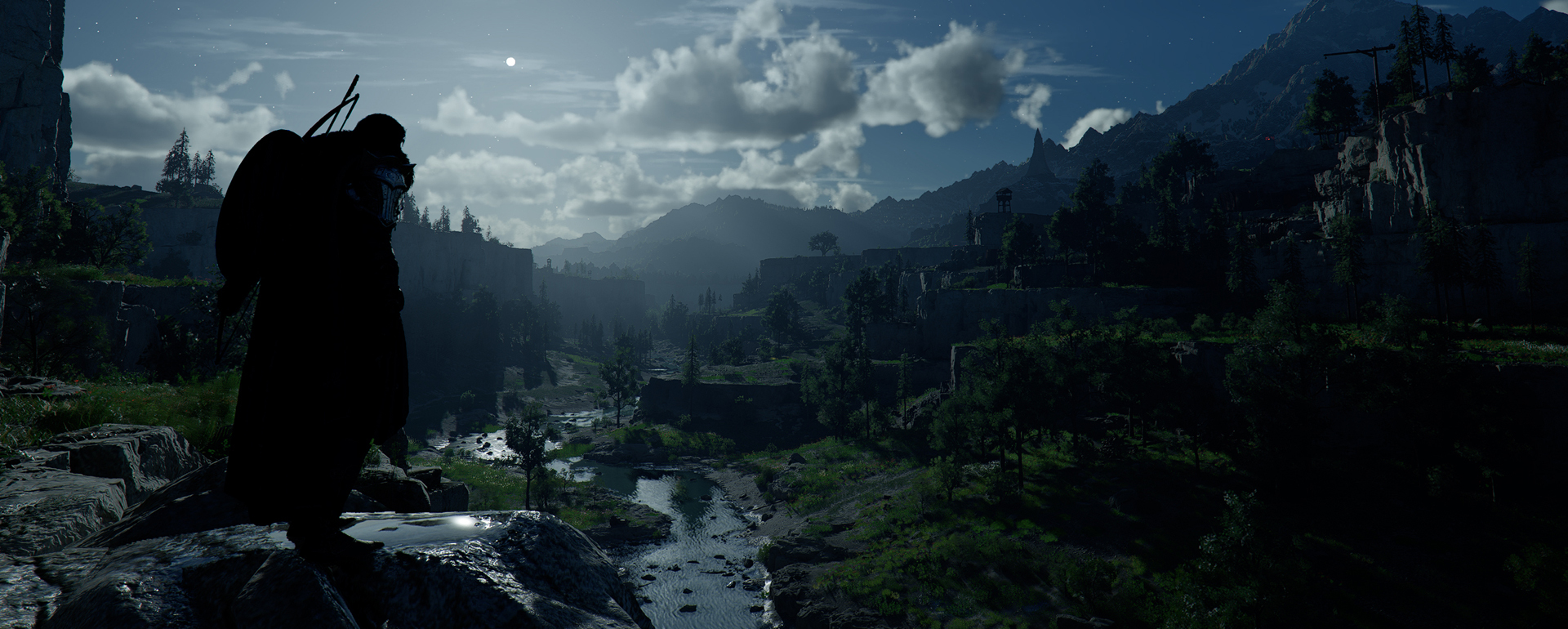
Beyond its impressive geographical scale, the most significant achievement comes from how Pearl Abyss manages such an enormous environment through the BlackSpace Engine. Developers revealed that Pywel is divided into more than 20,000 independent Level Units, which are dynamically loaded according to the player's position, viewing direction, and movement. This approach allows the engine to maintain a continuous world while controlling memory consumption and rendering workloads. The GPU also handles vegetation visibility, distance based geometry selection, and rendering calculations to reduce unnecessary processing.
Pearl Abyss combined manually designed environments with procedural generation tools such as Houdini to maintain consistency across its massive landscape. Developers initially created representative regions by hand, establishing rules for terrain erosion, vegetation density, slopes, and landmark placement before extending those rules across the continent. While natural environmental elements could be generated automatically, important locations, quests, and events received individual attention to maintain the quality of exploration.
The studio emphasized that its goal was not simply to create the largest possible map, but to encourage players to discover new locations naturally. Distant towers, mountains, and recognizable landmarks were positioned to guide exploration without relying exclusively on quest markers. This philosophy also explains why Pearl Abyss developed Crimson Desert around its proprietary BlackSpace Engine instead of Unreal Engine 5, allowing the studio greater control over environmental simulation, world streaming, and rendering technologies.
Environmental interactions also remain a major technical focus. The BlackSpace Engine synchronizes weather and time across the continent, dynamically adjusting lighting, reflections, visibility, and atmospheric conditions. Wind simulation influences vegetation, water, fog, and dust, while grass reacts to movement and trees can be climbed, damaged, or broken through physical interactions. These systems create a world that responds to player actions rather than simply functioning as a large static environment.
The confirmed scale also provides additional context for Crimson Desert's Charting the Unknown expansion, which introduced maritime exploration, naval combat, islands, and underwater environments in October 2026. However, the developers' 200 km² figure refers to the continent of Pywel and does not establish the total navigable area after including the expansion's ocean regions.
Crimson Desert's 200 km² world demonstrates that Pearl Abyss has delivered more than a visually impressive open world. The combination of large scale environmental simulation, seamless world streaming, interactive physics, and extensive exploration represents an impressive technical achievement for a modern action adventure game.
Map size alone does not determine quality, but creating an enormous world where players can meaningfully interact with their surroundings is considerably more challenging than simply increasing terrain dimensions. This is where the BlackSpace Engine distinguishes itself from many conventional open world implementations.
The technology also reinforces the value of proprietary game engines. Pearl Abyss has maintained direct control over its rendering systems, development tools, and optimization priorities, allowing engineers to implement technologies specifically designed around the needs of Crimson Desert.
For PC gaming, the most important achievement is demonstrating how an enormous, visually complex environment can operate across different hardware configurations without depending entirely on excessive system requirements. As the gaming industry continues adopting standardized engines, Crimson Desert provides an example of why investment in independent rendering technology and engine optimization remains valuable.
With a world covering approximately 200 km², do you believe Crimson Desert has set a new standard for open world gaming, or do you think games like Elden Ring and Red Dead Redemption 2 still offer a better exploration experience despite their smaller maps?
