
CPU-Z 2.19 Adds Support for AMD Ryzen AI 400 “Kraken Point 2” APUs and Preliminary Intel Wildcat Lake Support

CPUID has released CPU-Z version 2.19, and the latest update brings support for several new and upcoming processor platforms, including AMD Ryzen AI 400 desktop APUs based on Kraken Point 2 and preliminary support for Intel Wildcat Lake. According to the official CPU-Z version history, the new release adds support for AMD Ryzen AI 7/PRO 450G/E, AI 5/PRO 440G/E, and 435G/E, alongside AMD Ryzen AI 9 HX 470.
This is a notable update for AMD users because it means CPU-Z is now ready to properly identify the company’s newest Ryzen AI 400 lineup in the utility’s database. For enthusiasts, system builders, and reviewers, CPU-Z support is often one of those small but important milestones that helps signal broader ecosystem readiness around a newly launched CPU family. It also makes validation, identification, and reporting cleaner for anyone testing or deploying these chips in real systems.
On the Intel side, the same release notes confirm preliminary support for Intel Wildcat Lake, which is an interesting addition because CPU-Z typically begins adding early platform recognition before hardware reaches wider market visibility. While CPUID did not publish any architectural or product tier details in the notes themselves, the inclusion strongly suggests that support groundwork is already being laid for Intel’s upcoming low power platform.
Another important addition in CPU-Z 2.19 is CQDIMM memory support, which CPUID specifically labels as “4-ranks CUDIMM” support in the changelog. That is a meaningful move for the memory ecosystem because it shows the software is also evolving alongside newer DDR5 module categories, not just new processors. For hardware enthusiasts and memory overclocking watchers, this kind of support is especially relevant as next generation high capacity and clock driver equipped modules continue to gain attention across the enthusiast and workstation space.
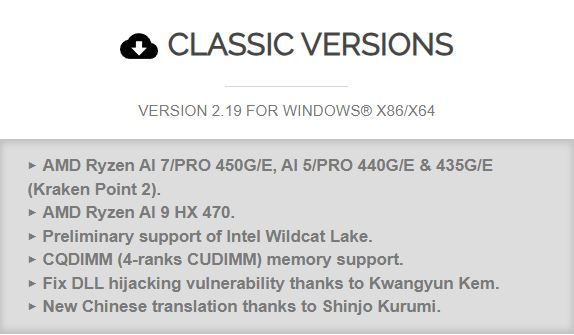
Outside of platform support, CPU-Z 2.19 also fixes a reporting issue where the AMD Ryzen 5 5500U was incorrectly shown as 7350U, addresses a DLL hijacking vulnerability, and adds a new Chinese translation. In other words, this is not just a database refresh, but a broader maintenance and compatibility release that improves the utility across several fronts.
For the PC hardware crowd, this update is one more sign that the 2026 platform cycle is continuing to pick up pace. New AMD desktop APU support is now in place, Intel Wildcat Lake has entered the utility in preliminary form, and CQDIMM is starting to show up in monitoring software. CPU-Z might be a small tool on the surface, but these kinds of updates often give an early read on where the broader hardware roadmap is moving next.
Do you think AMD’s Ryzen AI 400 desktop APUs will become a strong mainstream choice for compact AM5 builds, or are you more interested in seeing what Intel Wildcat Lake brings to low power devices?
