
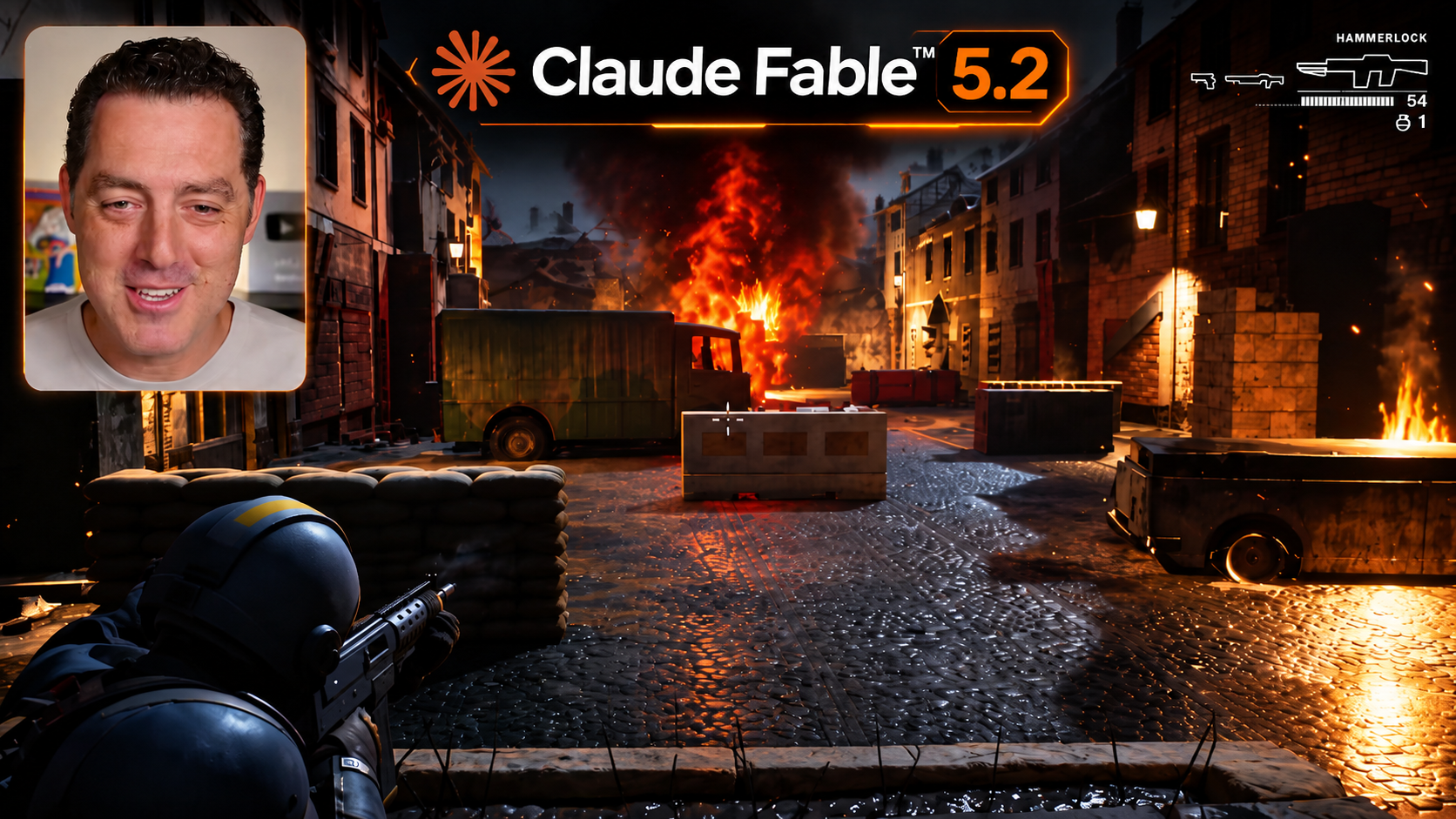
Anthropic's newly released Claude Fable 5.2 has demonstrated the ability to create a playable Unreal Engine 5 shooter inspired by Gears of War: E-Day using an initial prompt consisting of just 3 lines. AI researcher and YouTuber Matthew Berman showcased the experiment on November 9, revealing a functional third person shooter featuring cover mechanics, enemy AI, detailed environments, and combat systems resembling Microsoft's popular franchise. However, the experiment also highlights the substantial computing costs associated with autonomous AI development, with the project consuming approximately 8.63 billion tokens and reaching an estimated API equivalent cost of $14,710.
In his video demonstration, Berman explained that he instructed Claude to recreate a single level from Gears of War: E-Day in Unreal Engine, attempting to reproduce the original game's visuals, characters, and gameplay as closely as possible. He then activated an intensive autonomous coding configuration called Ultra Code, allowing the AI to continue developing the project with minimal additional direction. The resulting prototype includes sprinting, environmental cover, shooting mechanics, active reloading, and enemies capable of engaging the player in combat. Friendly NPCs can also assist during encounters and revive the player after being defeated.
The AI reportedly generated much of the project's programming, environmental assets, textures, and lighting while iteratively testing and refining its work. However, the original 3 line instruction should not be confused with an instantaneous generation process. According to additional reporting from Decrypt, the experiment required approximately 43 hours and 48 minutes of automated development, processing billions of tokens through repeated coding and debugging operations.
| Development Metric | Reported Result |
|---|---|
| AI Model | Claude Fable 5.2 |
| Game Engine | Unreal Engine 5 |
| Initial Instructions | 3 lines |
| Development Time | 43 hours, 48 minutes |
| Token Consumption | 8.63 billion |
| Estimated API Cost | $14,710 |
| Playable Content | 1 prototype level |
| Main Features | Cover combat, enemy AI, active reload, NPC revives |
Importantly, the reported $14,710 represents estimated API pricing rather than a confirmed amount personally paid by Berman. Anthropic currently charges $8 per million input tokens and $40 per million output tokens for Claude Fable 5.2. These costs illustrate how extended autonomous workflows can become expensive even when the initial user instructions are relatively simple.
The experiment follows Anthropic's official launch of Claude Fable 5.2 on November 9. The company claims the model offers improved coding, reasoning, and visual capabilities, with output generation up to 30% faster than its predecessor. Anthropic specifically positions Fable as a solution for demanding engineering projects rather than everyday programming tasks.
Nevertheless, Berman's demonstration is not equivalent to creating a complete AAA game. The project contains only 1 playable level, with visible animation imperfections and no independently verified benchmarks for performance, stability, or long term maintainability. It also raises intellectual property questions because the original instructions explicitly requested a recreation of an existing commercial franchise.
Berman additionally demonstrated other ambitious AI generated projects, including an Excel inspired spreadsheet application and a multiplayer game resembling Fall Guys. These experiments suggest autonomous coding agents are becoming increasingly capable of producing complex interactive software, but their development costs and reliability remain significant limitations.
Claude Fable 5.2 producing a playable Unreal Engine 5 shooter from minimal instructions is an impressive demonstration of how far autonomous AI development has progressed. However, spending nearly $15,000 in estimated computing resources to produce 1 playable level is hardly evidence that traditional game development has become obsolete.
Professional game development involves considerably more than generating functional code. Gameplay balance, artistic direction, animation quality, optimization, storytelling, accessibility, and quality assurance all require extensive attention. A technically functional prototype does not automatically become a commercially viable game.
The experiment also reinforces concerns about the economics of AI development. As previously discussed in the context of AI assisted game porting, automated processes can consume substantial computing resources without guaranteeing production quality.
For independent developers, AI coding tools could eventually reduce repetitive work and accelerate prototyping. However, a future where creating games depends on expensive cloud computing subscriptions could introduce another financial barrier for smaller studios.
The most beneficial direction would be making these capabilities more efficient, affordable, and accessible through local hardware wherever practical, while preserving creative control and ownership of development projects.
Would you trust AI to develop a complete video game if it could create a playable prototype in less than 48 hours, or do you believe professional developers remain essential regardless of how advanced autonomous coding becomes?
