
Car Owner Connects an LLM Directly to Vehicle Diagnostics in Cyberpunk AI Experiment
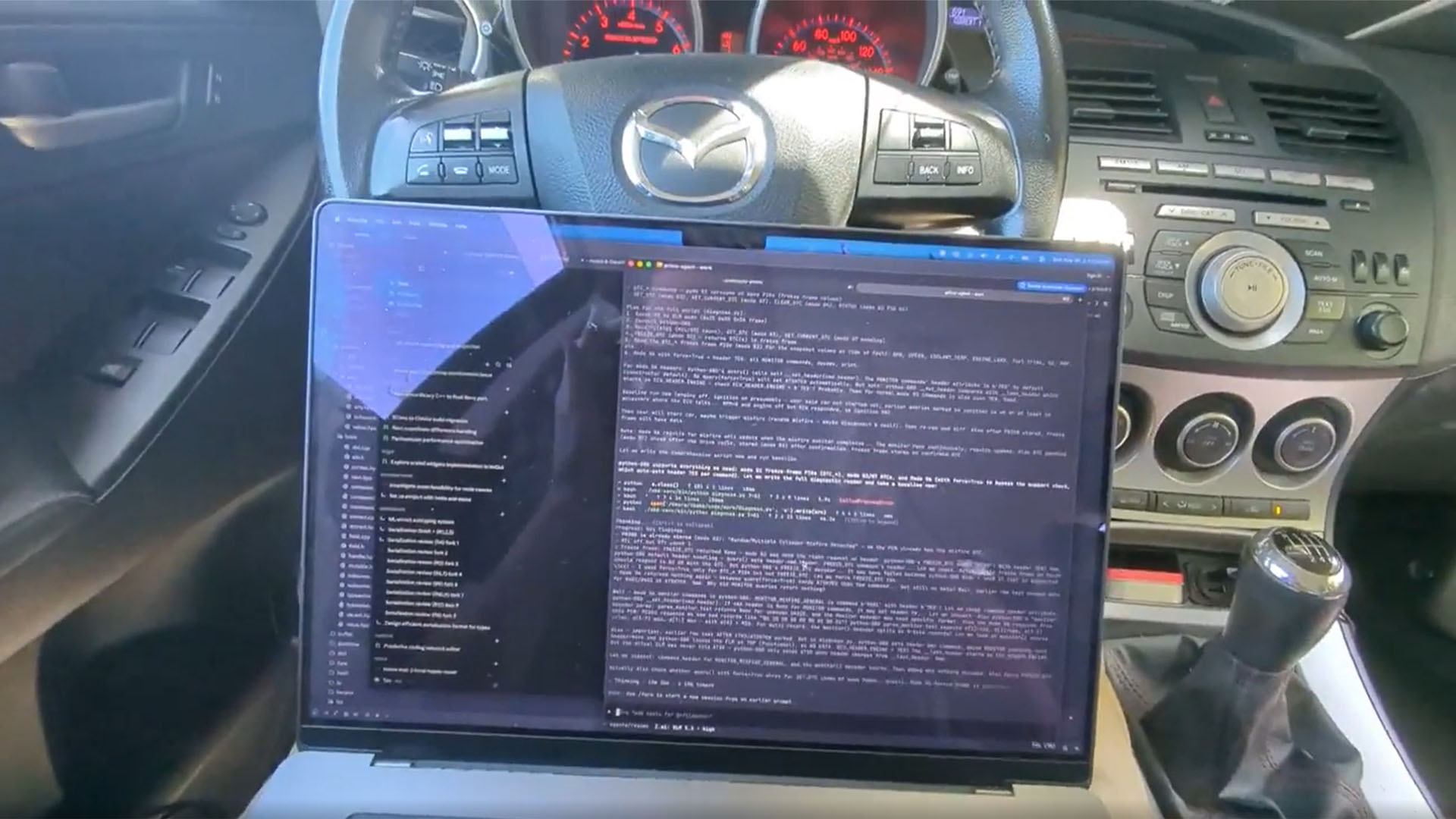
A car owner has demonstrated an unusual use for modern AI by connecting a laptop running a large language model directly to a vehicle diagnostic interface and allowing the AI to analyze an engine trouble code. The experiment was shared by Reddit user Torouse, who described the setup as "unbelievably cyberpunk" while showing the laptop communicating with the vehicle diagnostic system.
The demonstration appears to use a laptop connected through the vehicle's OBD II interface, although the exact adapter, language model and software stack were not disclosed. Instead of manually reading the diagnostic trouble code and researching possible causes, the idea is to give the AI access to the diagnostic information and let it interpret what the vehicle is reporting.
That immediately created debate because inexpensive OBD II scanners have performed the basic part of this job for decades. A conventional reader can retrieve diagnostic trouble codes that identify where the vehicle detected abnormal behavior, after which the owner or mechanic can investigate the underlying cause. Several users therefore argued that connecting a complete AI system to the car simply adds complexity to something that could be accomplished with a basic scanner and a search.
The more interesting possibility emerges when an AI system goes beyond reading a single code. OBD II and manufacturer diagnostic systems can expose live information covering parameters such as throttle position, oxygen sensor readings, ignition timing, airflow and other sensor data. An AI agent capable of collecting several of these values simultaneously could theoretically compare them, identify unusual relationships and guide the user through additional diagnostic tests. One commenter highlighted exactly this potential, arguing that an LLM could combine multiple readings rather than treating a fault code as the complete diagnosis.
There is already serious research exploring similar concepts. A 2026 study called DRIVE combines machine learning, visual explanations and large language models to produce structured vehicle engine fault reports for technicians. Researchers from Tata Motors and Tata Technologies have also published work examining LLM based interpretation of diagnostic trouble codes for powertrain diagnosis and maintenance.
That does not mean an unrestricted AI agent should be allowed to modify vehicle systems. Language models can generate incorrect information, and giving an autonomous model write access to critical electronic control units would introduce considerably greater risk than simply allowing it to read diagnostic information. The Reddit demonstration does not establish that the AI had this level of control.
The experiment arrives as AI becomes increasingly integrated into automotive computing. Qualcomm and Google are already developing Gemini powered automotive AI systems, while manufacturers are exploring how local models could understand vehicle information without depending entirely on cloud services.
Using a laptop and an LLM simply to translate one engine code is definitely overengineered. A cheap OBD II scanner can accomplish that part quickly.
The idea becomes much more interesting once the AI can analyze multiple live sensors, compare symptoms against technical documentation and guide a diagnostic process step by step. That could eventually turn an ordinary vehicle diagnostic interface into something closer to an interactive technical assistant.
The important boundary should be control. Letting AI interpret vehicle telemetry could be useful. Allowing an unverified language model to autonomously rewrite critical vehicle settings is a completely different proposition.
Would you trust an AI assistant to diagnose your car if it could directly analyze live OBD II data, or would you still prefer a traditional scanner and mechanic?
