
AMD Reportedly Readies Radeon RX 9050 With 2048 Shaders, 8 GB VRAM, and Lower Clocks
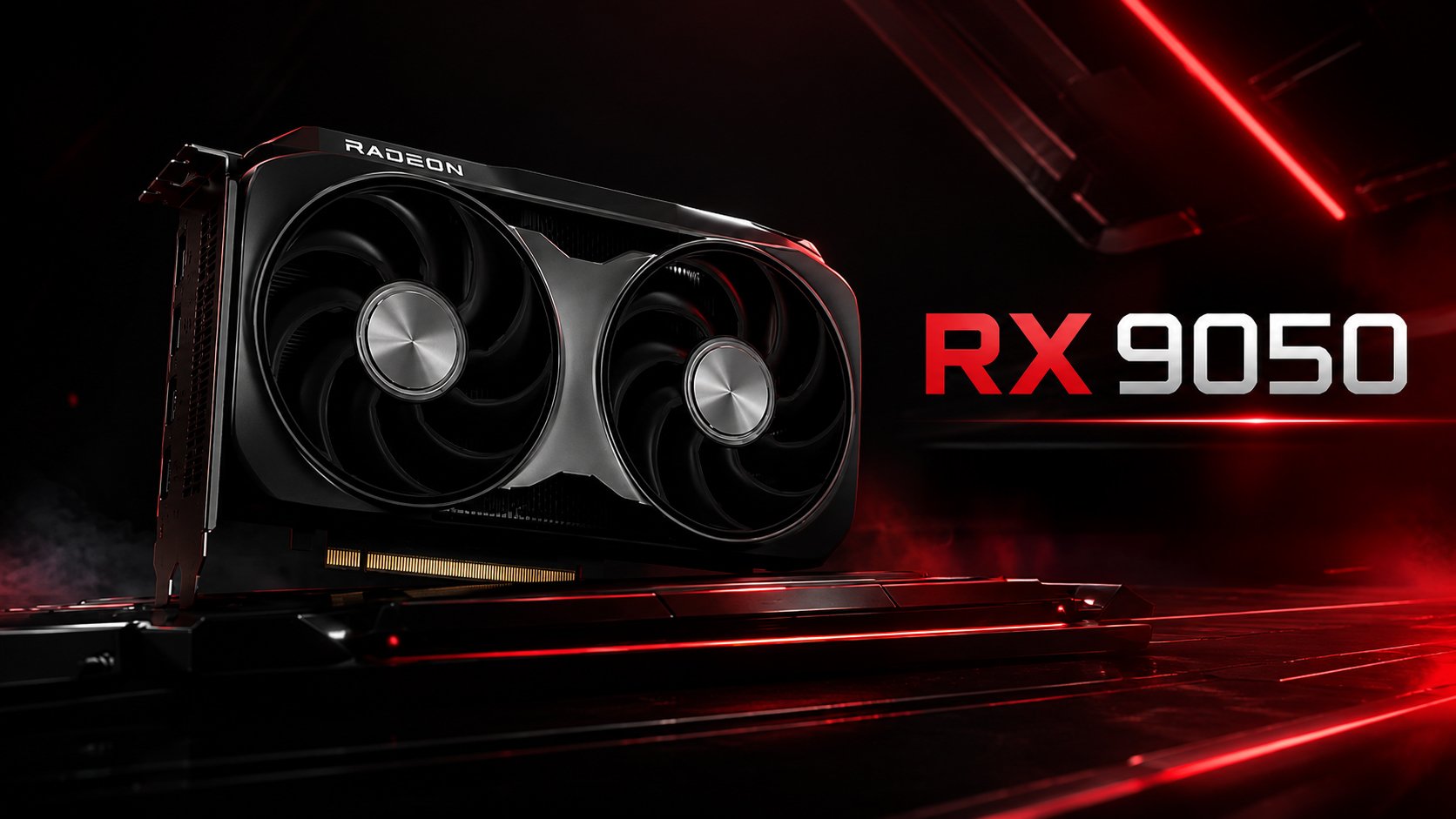
AMD may be preparing to expand its RDNA 4 desktop graphics lineup once again, this time with a more aggressively trimmed entry that reportedly carries the Radeon RX 9050 name. According to a new leak from VideoCardz, the card is expected to ship with 2048 stream processors, 8 GB of GDDR6 memory, and boost clocks up to 2600 MHz, making it an unusual product on paper because it appears to retain the full shader configuration associated with the Radeon RX 9060 XT while dialing back memory speed and clock behavior to create more separation in the stack.
If the leak is accurate, the Radeon RX 9050 would use a full Navi 44 class configuration with 2048 stream processors, the same shader count found on current Radeon RX 9060 XT partner cards and AMD’s official RX 9060 XT product page. That immediately makes the rumored positioning more interesting, because the official Radeon RX 9060 uses 1792 stream processors instead, which means the RX 9050 would not be a simple cut below the RX 9060 in raw shader count.
The catch is that AMD appears to be reducing the rest of the configuration enough to keep the product lower in the hierarchy. The leak points to 8 GB of GDDR6 on a 128 bit bus running at 18 Gbps, which works out to 288 GB/s of bandwidth. That matches the official memory setup of the Radeon RX 9060, while the RX 9060 XT runs faster 20 Gbps memory for up to 320 GB/s of bandwidth. In practical terms, that means the rumored RX 9050 may carry stronger core resources than some buyers would expect from its model name, but still face a real bandwidth handicap compared with the XT tier.
Clock speed is where the rumored Radeon RX 9050 appears to give up the most ground. VideoCardz says the card is expected to operate at a 1920 MHz base clock and up to 2600 MHz boost, which is noticeably lower than existing RX 9060 XT board specs from major add in board vendors, many of which list boost clocks well above 3000 MHz. Even the non XT RX 9060 has been listed by partners at higher boost frequencies than what is being rumored here for the RX 9050, which strongly suggests AMD is shaping this card for a lower power, lower cost segment rather than letting the full shader count translate directly into higher real world performance.
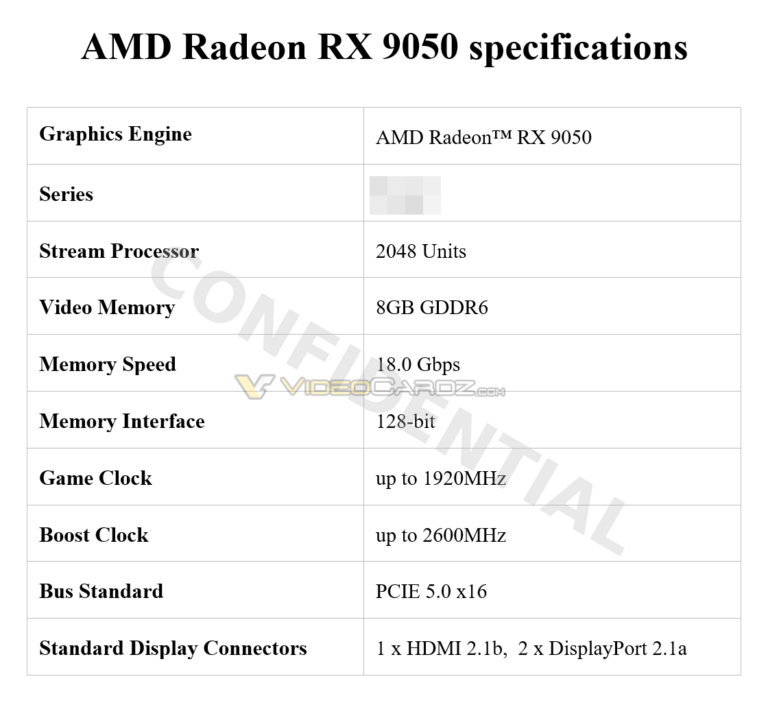
Power also appears to stay in modest territory. While the leak does not include a finalized board power figure, the reported recommended 450 W power supply aligns with AMD’s official RX 9060 guidance, where the company lists a 450 W minimum PSU recommendation and 132 W typical board power. That does not confirm the RX 9050 will land at exactly the same wattage, but it does suggest AMD is keeping this rumored card in the lower power part of the stack.
From a market strategy perspective, the rumored RX 9050 looks like a product designed to widen AMD’s price ladder without spending a new die on the effort. By combining a full 2048 shader configuration with slower clocks and narrower effective memory performance, AMD could create a card that still sounds technically competitive on a spec sheet while fitting below the RX 9060 XT and likely targeting a more budget focused segment. The bigger concern, however, is the continued use of 8 GB VRAM in 2026. That may still be workable for many esports and mainstream 1080p workloads, but it is becoming an increasingly tighter fit for newer AAA releases, especially for players expecting higher texture settings and longer product longevity. That final judgment, of course, depends on AMD’s pricing, which has not been reported in any official form.
As of now, AMD has not officially announced the Radeon RX 9050 on its product pages, so this remains a leak rather than a confirmed product reveal. Still, if this report proves accurate, the RX 9050 could become one of the more unusual RDNA 4 entries so far: a card with RX 9060 XT class shader count, RX 9060 class memory bandwidth, and even lower clocks designed to carve out a new budget tier in the Radeon 9000 family.
Would you consider an RX 9050 with 8 GB VRAM in 2026, or do you think AMD needs to move past 8 GB entirely for modern desktop gaming?
