
Bolt Graphics Tapes Out Zeus GPU and Claims Up to 5x Faster Path Tracing Than RTX 5090 at Roughly Half the Power
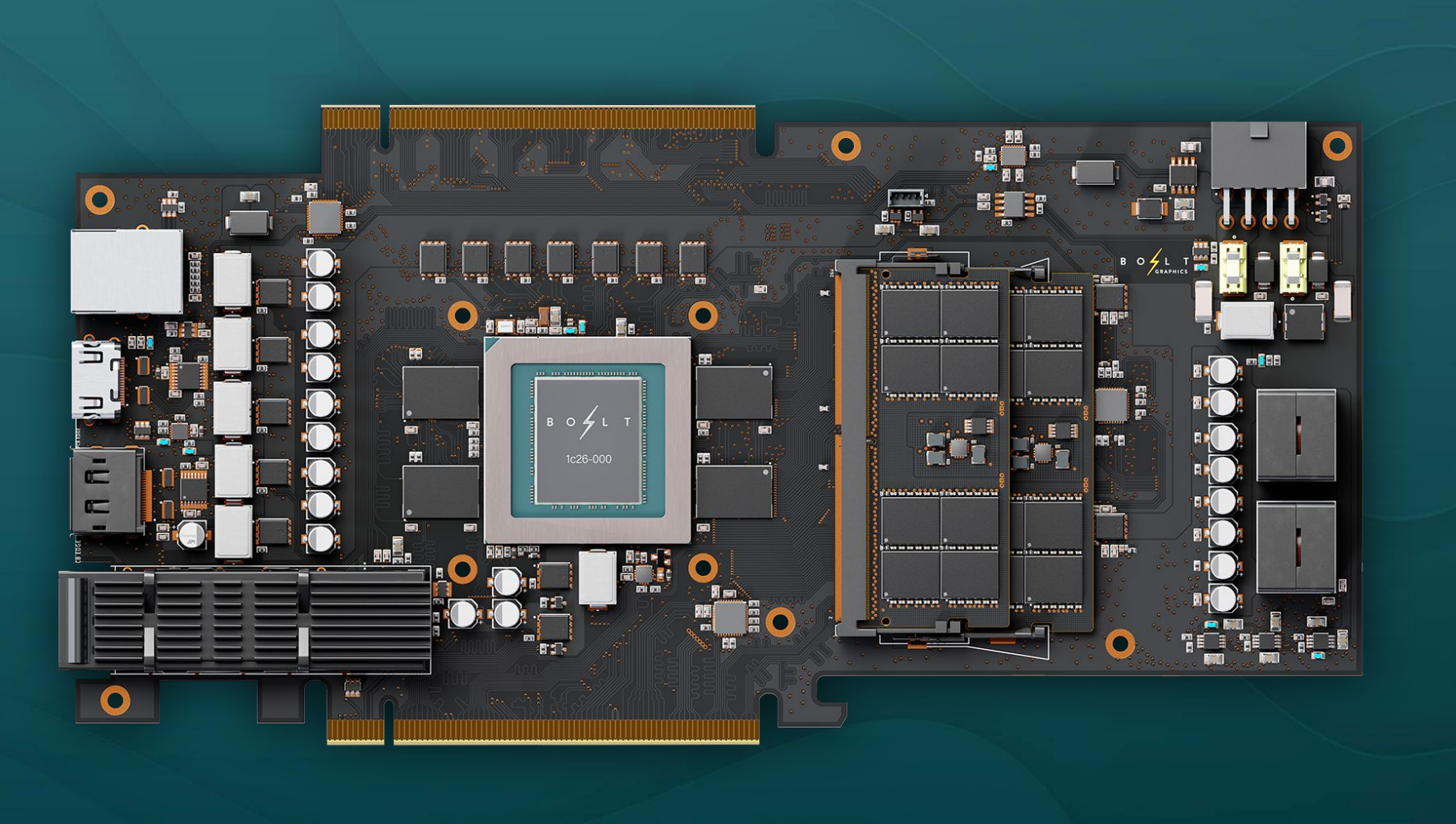
Bolt Graphics says it has successfully taped out its first Zeus GPU test chip at TSMC on the 12FFC process, marking the transition from architecture and FPGA validation into physical silicon. The company describes Zeus as a scalable GPU platform designed for rendering, HPC, simulation, and AI adjacent workloads, with PCIe card and 2U server deployments planned. Coverage from Tom’s Hardware also confirms that the tape out milestone has now been reached, which gives Bolt’s long running Zeus project a more concrete foundation than before.
The biggest headline, however, is Bolt’s performance claim. According to materials cited in recent coverage, Bolt is now saying a 250 W dual chip Zeus configuration can deliver up to 5x the path tracing performance of NVIDIA’s GeForce RTX 5090, while also offering up to 6x better HPC performance in selected workloads. That is an eye catching claim, especially because the comparison pits a 250 W Zeus card against a 575 W RTX 5090, meaning Bolt is framing the product not just as faster in path tracing, but dramatically more power efficient as well. At this stage, though, these are still vendor claims rather than third party benchmark results from shipping hardware.
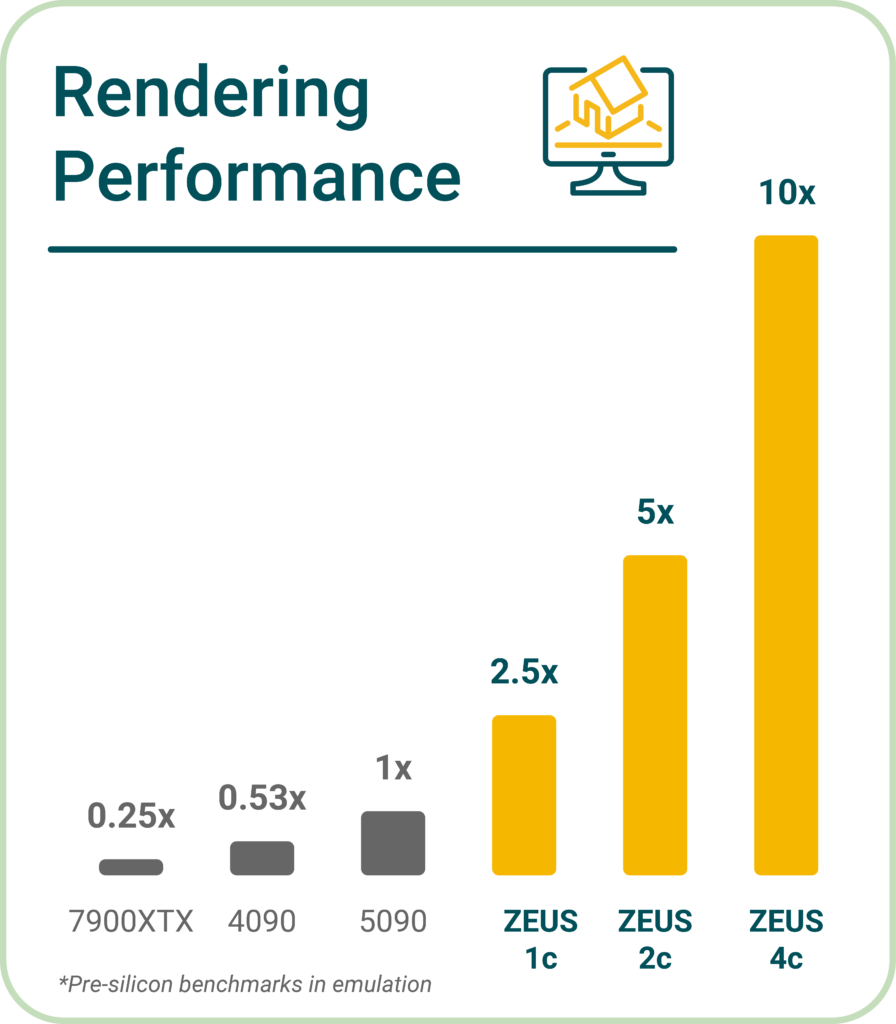
That distinction matters a lot. Zeus has now taped out, but mass production and product availability are still being targeted for the end of 2027 according to the recent reporting. So while the chip is no longer just a concept, the performance story is still based on Bolt’s own numbers and positioning rather than broad independent testing in real world retail conditions. That makes Zeus an intriguing hardware story, but still one that needs a healthy level of caution.
Bolt is also approaching the GPU problem from a very different angle than NVIDIA, AMD, or Intel. The Zeus platform uses LPDDR5X and DDR5 instead of the GDDR memory typically seen in gaming GPUs, and Bolt argues that this opens the door to far larger memory capacities at lower total system cost for professional workloads. The company’s own HPC messaging says Zeus is designed for precision heavy simulation, modeling, and analysis, while recent reporting notes that the architecture is especially focused on path tracing and FP64 capable workloads rather than traditional raster first gaming.
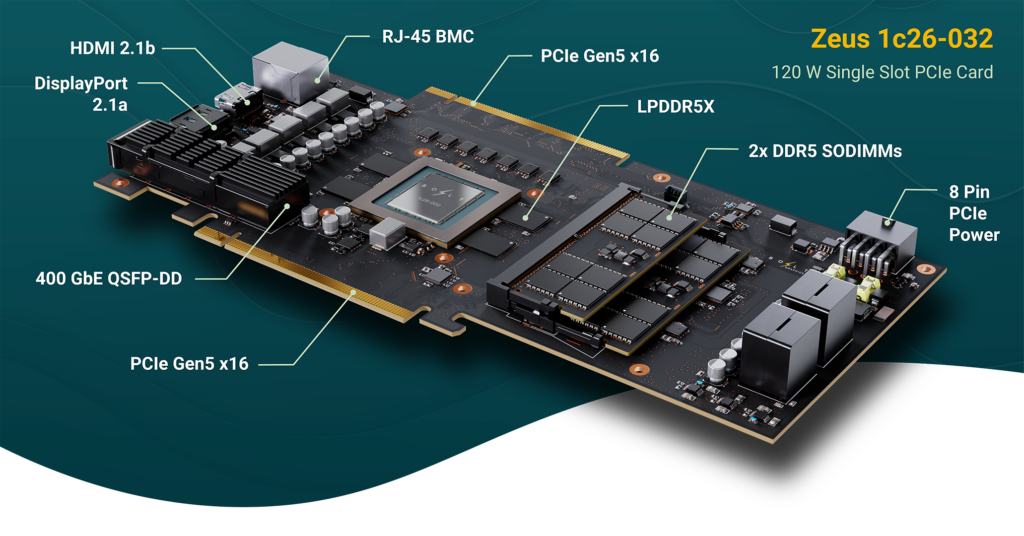
The product stack Bolt is discussing is also unusually broad for a startup GPU company. Recent coverage outlines single chip and dual chip card designs, plus a larger 2U server variant that scales memory and cache far beyond normal consumer graphics card territory. That suggests Bolt is not trying to attack the market as a standard gaming GPU vendor. Instead, it is building a platform story around rendering, path tracing, HPC, and memory dense compute systems where capacity and specialized performance can matter more than raw gaming frame rates.
| Feature | Bolt Zeus 1c26-032 | Bolt Zeus 2c26-064 | Bolt Zeus 2c26-128 |
|---|---|---|---|
| Form Factor | Single-Slot PCIe, Full Length | Dual-Slot PCIe, Full Length | Dual-Slot PCIe, Full Length |
| Board Power | 120 W | 250 W | 250 W |
| FP64 / FP32 / FP16 vector tflops | 5 / 10 / 20 | 10 / 20 / 40 | — |
| INT16 / INT8 matrix tflops | 307.2 / 614.4 | 614.4 / 1,228.8 | — |
| On-chip cache | 128 MB | 256 MB | 256 MB |
| Memory | Up to 160 GB @ 363 GB/s 32 GB LPDDR5X 2x DDR5 SO-DIMMs | Up to 320 GB @ 725 GB/s 64 GB LPDDR5X 4x DDR5 SO-DIMMs | Up to 384 GB @ 725 GB/s 128 GB LPDDR5X 4x DDR5 SO-DIMMs |
| Path Tracing | 77 gigarays | 154 gigarays | — |
| Video Encoding & Decoding (AV1, H.264/265) | 2x 8K60 streams | 4x 8K60 streams | 4x 8K60 streams |
| I/O | 400 GbE (QSFP-DD) & GbE (RJ-45 BMC) 2x PCIe 5.0 x16 DisplayPort 2.1a & HDMI 2.1b | 400 GbE (QSFP-DD) & GbE (RJ-45 BMC) 2x PCIe 5.0 x16 DisplayPort 2.1a & HDMI 2.1b | 400 GbE (QSFP-DD) & GbE (RJ-45 BMC) 2x PCIe 5.0 x16 |
The appeal of Zeus, at least on paper, is easy to understand. If Bolt can actually deliver path tracing performance anywhere close to its claims, while keeping power and TCO below incumbent solutions, the company could become a serious niche challenger in rendering farms, simulation clusters, and specialized workstation deployments. That said, the road from tape out to production hardware is long, and the GPU market is brutally difficult even for well funded incumbents. Software support, driver maturity, ecosystem compatibility, and sustained manufacturing execution will likely matter just as much as the raw silicon.
For now, the most important takeaway is not that Bolt has already beaten NVIDIA. It has not proven that yet in independently verified shipping products. The real milestone is that Zeus is now a taped out chip at TSMC, and that alone moves Bolt Graphics into a much more serious phase of its roadmap. If the company can follow that with working silicon, stable software, and credible third party benchmarking, Zeus could become one of the most interesting alternative GPU stories in the market over the next 18 months.
Do you think a startup like Bolt Graphics can realistically break into the GPU market through path tracing and HPC first, or is the software and ecosystem barrier still too high?
