
Former AMD FSR Lead Claims Team Departures May Explain FSR 4 Frustrations
AMD’s FidelityFX Super Resolution technology has remained one of the most important topics in the PC gaming space, especially as the company continues to push FSR forward against NVIDIA DLSS and Intel XeSS. However, recent discussion around FSR 4, FSR Redstone, and the limited availability of newer AMD upscaling features has created a much larger debate about support, communication, and the internal direction of AMD’s graphics software teams.
The latest discussion started after renewed community attention around FSR support on older Radeon GPUs. While the newest FSR Redstone update and the updated FSR 4.1 release have been viewed as positive steps for AMD’s AI assisted rendering roadmap, many Radeon users were disappointed that FSR 4 support remains limited to newer RDNA 4 based GPUs, including Radeon RX 9000 series graphics cards. AMD’s official FSR pages describe its current ML powered upscaler as a major image quality improvement over previous FSR generations, using neural networks to reconstruct visuals from lower resolution frames.
The controversy grew after an FSR 4.1 leak reportedly included specific DLL files that allowed FSR 4 support on older GPUs with INT8 support. AMD quickly removed the leaked files, and many users believed the situation could push the company to release proper FSR 4 support for older hardware. Instead, AMD has continued to keep official FSR 4.1 support focused on RDNA 4 hardware, which has left many Radeon users frustrated and looking for answers. Reports around the leak also noted that the unofficial INT8 version appeared to work on older architectures through community solutions, but it remains unsupported by AMD.
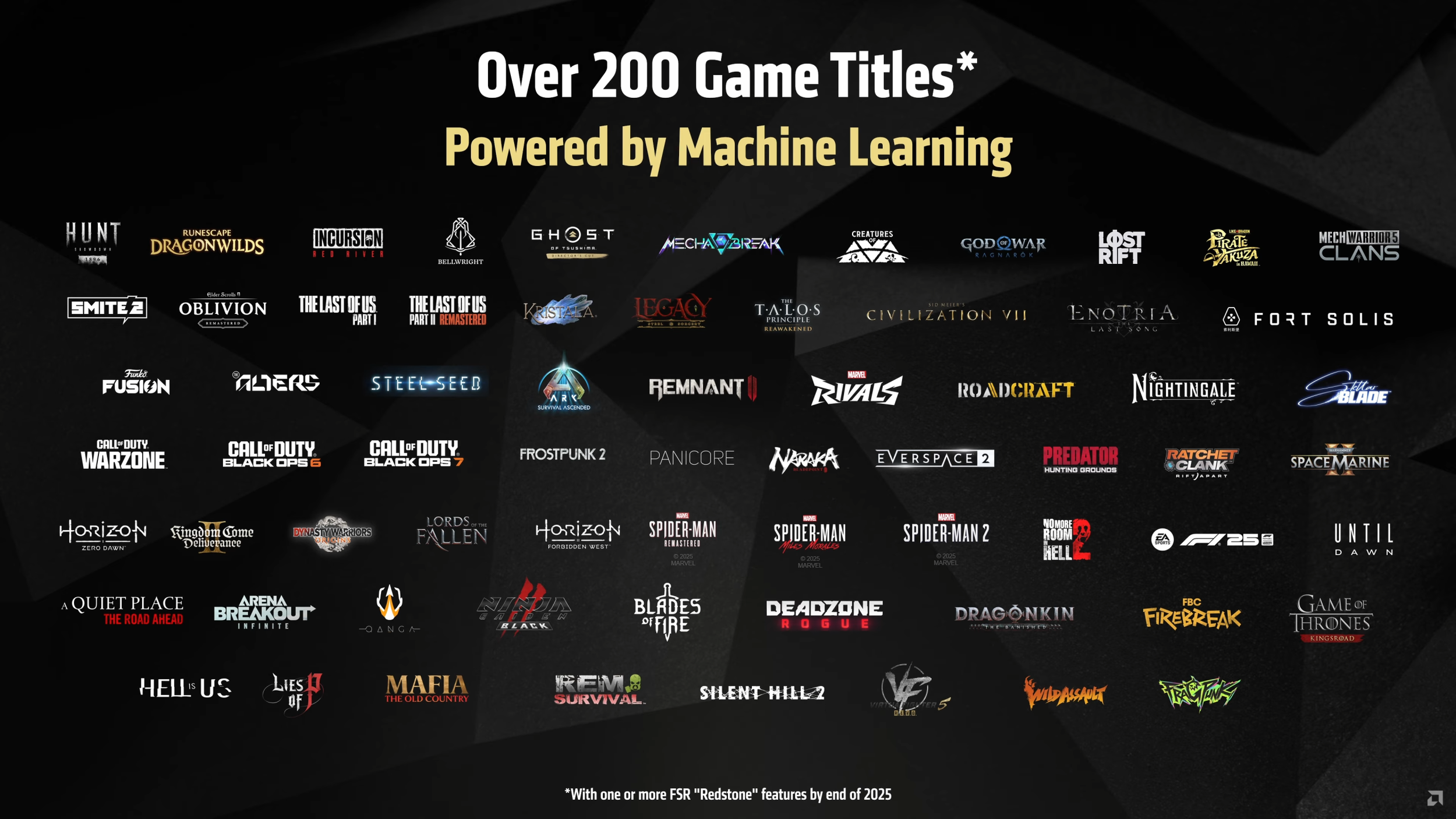
At the same time, FSR 4 adoption has been gradual. More than 100 games may support FSR 4 in some form, but not every title has full native integration. In several cases, users must rely on AMD Adrenalin Software overrides to access enhancements, and those enhancements are still tied to RDNA 4 hardware. Features such as FSR Ray Regeneration are also appearing in select titles rather than across the full supported library, with games such as Call of Duty: Black Ops 7 and Crimson Desert being used as major examples in the current discussion. AMD officially describes FSR Ray Regeneration as a neural network based feature that restores full quality ray traced detail from sparse samples, aiming to produce cleaner ray traced lighting, shadows, and reflections.
Now, according to former AMD FSR lead Colin Riley, also known online as Domipheus, the state of AMD’s FSR rollout may be connected to key personnel leaving AMD for NVIDIA and Intel. In a community discussion shared on Reddit, Riley reportedly said that several prominent members of AMD’s GPUOpen and FidelityFX teams have moved to competing companies. Riley previously worked on FSR 2, FSR 3, and FSR 4 during his time at AMD before later joining JECO, a software company.
Riley stated that although he did not specifically work on FSR Ray Regeneration, he knows the person who did, and that individual reportedly left AMD to join NVIDIA. He also claimed that the director who originally started GPUOpen later left AMD for Intel, while another director who managed Riley around the FSR 4 release also left AMD to join NVIDIA.
"Great Engineers""Until it didn't"
Quote by: Colin Riley”
Those short statements have resonated strongly with Radeon users because they suggest a shift in morale and retention inside AMD’s graphics software teams. Riley’s comments do not prove that FSR 4’s limitations are directly caused by employee departures, but they do add weight to the concern that AMD may need stronger internal support, clearer leadership, and better long term investment in its developer facing graphics technologies.
This is an important distinction. It is common for engineers, managers, and directors to move between major technology companies, especially in graphics, AI, rendering, and game development. NVIDIA, AMD, and Intel all compete for the same highly specialized engineering talent. However, when several known figures connected to GPUOpen, FidelityFX, and FSR move to direct competitors, it naturally raises questions about continuity, roadmaps, and how much momentum AMD can maintain in software innovation.
The timing also makes the discussion more sensitive. AMD has produced several valuable technologies under the FidelityFX and GPUOpen banners. FSR helped bring open upscaling options to a wider range of GPUs, including hardware outside AMD’s own ecosystem. FSR 2 improved image reconstruction, FSR 3 introduced frame generation, and FSR 4 brought AMD further into machine learning based upscaling. These are meaningful achievements, especially considering AMD is competing against NVIDIA’s mature DLSS ecosystem and Intel’s rapidly improving XeSS and driver stack.
However, the community frustration around FSR 4 is not only about image quality. It is also about communication. Radeon users want to know why older RDNA 2 and RDNA 3 cards cannot officially access FSR 4, especially after leaked files suggested that some form of INT8 based support may be technically possible. If there are performance, quality, compatibility, licensing, validation, or support reasons behind the decision, AMD would benefit from explaining them more clearly.
Silence can sometimes protect a company from overcommitting, but in this case, silence has created speculation. Some users now believe AMD is holding back older GPU support to push newer Radeon RX 9000 cards. Others believe the limitation may be tied to quality control, console development, internal resource constraints, or third party agreements. Without a clear answer, the conversation keeps moving away from technical facts and toward frustration.
NVIDIA has also faced criticism for locking certain features behind newer hardware, especially Multi Frame Generation, which remains limited to newer GeForce RTX GPUs. However, NVIDIA has kept core DLSS upscaling available across older RTX generations, including RTX 20 series graphics cards. Intel has also had a difficult road with Arc, including driver maturity and game optimization problems, but the company has steadily improved its software reputation since the Alchemist generation, with many developers now acknowledging the progress of Intel’s graphics team.
This is why AMD’s situation feels more complicated. Radeon has millions of users across multiple GPU generations, and FSR has historically been positioned as the more open, more flexible alternative in the upscaling market. If FSR 4 represents a major quality leap but remains locked to RDNA 4, AMD risks disappointing the same user base that helped build goodwill around earlier FSR versions.
Looking forward, AMD is already preparing the next chapter of its graphics technology roadmap with FSR Diamond, while also doubling down on its console strategy and future GPU architectures. That could be a strong position if AMD can align its hardware, software, developer relations, and player communication more effectively. The company has the technology foundation, the console partnerships, and the Radeon user base to remain highly competitive, but FSR’s future will depend on more than just new features.
AMD does not need to promise everything to every GPU generation. What it does need is clarity. If older GPUs cannot support FSR 4 properly, the company should explain why. If the limitation is temporary, AMD should say so. If FSR 4 requires RDNA 4 specific hardware acceleration to meet quality or performance targets, that should be clearly communicated. If the team needs more time, that message would likely be better received than continued silence.
For Radeon users, the concern is not only whether FSR 4 runs on older GPUs. The concern is whether AMD is still fully committed to supporting its existing graphics community with the same openness that made GPUOpen and FidelityFX important in the first place.
What do you think? Should AMD officially explain why FSR 4 remains limited to RDNA 4, or is the company right to keep its focus on newer Radeon hardware?
